
Nobody Ransomware Decryptor
After extensive threat research, our cybersecurity division has engineered a specialized decryption solution for Nobody ransomware, a Chaos-based variant known for attaching random four-character suffixes (like .ckoz, .jylq, .l3ii) to encrypted files. This decryptor is compatible across all modern Windows builds and can be deployed in enterprise server environments. It performs variant fingerprinting, pattern correlation with known Chaos behaviors, and complete integrity verification prior to data restoration.
How It Works
Once an encrypted sample is received, it’s processed in a secured analytical sandbox where the system determines the encryption pattern and variant details.
The decryptor identifies the victim’s unique identifier (usually found inside the ransom note README-NOBODY.txt) and correlates it with the specific encryption batch for key retrieval or reconstruction.
Following confirmation, the decryption module runs a read-only verification, ensuring your data remains untouched until full integrity checks pass. The restored files are then logged with timestamped audit trails for validation and compliance.
Requirements for Use:
To execute the recovery properly, you’ll need:
- The original ransom note file (README-NOBODY.txt)
- Several encrypted samples (files with 4-character random extensions)
- An active internet connection (if using cloud validation)
- Local administrative rights on the infected device or system
Essential Steps Immediately After a Nobody Ransomware Attack
When Nobody ransomware strikes, time and control are critical.
Immediately disconnect compromised endpoints from the network, shared drives, and external storage to prevent further spread.
Preserve all encrypted files and ransom notes in their original form — avoid renaming, modifying, or deleting any files, as this could interfere with decryption analysis.
If the infection reaches VMware or virtual hosts, perform a controlled shutdown to stop ongoing encryption.
Finally, reach out to cyber incident response experts and collect forensic data including logs, system memory, and network traffic for investigation.
Recovering Files Encrypted by Nobody Ransomware
Free Recovery Solutions
Backup Restoration:
If your organization maintains clean offline or immutable backups, they remain your best route to recovery. Always verify snapshot integrity and ensure that ransomware didn’t propagate into the backup system. Run checksum tests or mount the backups in isolated environments before restoring.
VM Snapshot Reversion:
If hypervisors such as VMware ESXi or Hyper-V retain snapshots from before the attack, you can roll back affected systems. However, verify logs first to ensure the attacker didn’t tamper with or delete them during the intrusion.
Paid and Specialized Recovery Routes
Paying cybercriminals should always be a last resort. Even when ransom payments are made, there’s no certainty of receiving a functional decryptor. Moreover, payment directly funds illicit operations and may expose your organization to regulatory issues.
If every recovery avenue fails, structured negotiation through approved cybersecurity intermediaries is an option—but only under strict legal supervision and insurance authorization.
Our research team has developed a secure, AI-enhanced decryptor purpose-built for Nobody ransomware (Chaos-based). The tool employs victim-specific login IDs and blockchain-verified recovery logging to restore encrypted data safely, without resorting to attacker contact.
How the Decryptor Operates
Reverse Engineering & Analysis
Our specialists thoroughly reverse-engineered the Chaos encryption algorithm, isolating key patterns, seed generation flaws, and build-specific inconsistencies. This allows the decryptor to align recovery attempts with known encryption batches while preventing any risk of file corruption.
Secure Cloud Execution
Encrypted files can be uploaded to an isolated, cloud-sandboxed environment where controlled decryption is conducted. Each session is logged, ensuring end-to-end data traceability. Once files are restored, we deliver a digital verification report confirming authenticity.
Fraud Prevention and Verification
Because fake decryptors and ransomware scams are widespread, we enforce multi-layer verification. Clients receive a small proof-of-concept decryption before committing to full-scale recovery. No payments are requested upfront — every session includes cryptographic integrity checks and validated case references.
Step-by-Step Nobody Recovery Using the Decryptor
1. Assess the Infection
Identify the characteristic .ckoz, .jylq, or .l3ii extensions and confirm the ransom note file (README-NOBODY.txt) exists in encrypted folders.
2. Isolate Affected Devices
Disconnect infected systems from your corporate network to stop ongoing encryption or lateral propagation.
3. Submit Files for Variant Analysis
Send a few encrypted samples along with your ransom note to our experts. The files are analyzed to verify the variant and estimate recovery feasibility.
4. Launch the Nobody Decryptor
Run the decryptor as an administrator on a clean or restored environment. The software connects to our secure backend for decryption key validation and variant matching.
5. Enter the Victim Identification Code
Find the victim ID provided within the ransom note and input it in the decryptor to ensure accurate mapping to your unique encryption instance.
6. Begin the Recovery Process
Initiate decryption and allow the tool to methodically recover files. Progress logs, integrity validation, and sample verification are automatically generated during execution.
Understanding Nobody Ransomware
Nobody ransomware belongs to the Chaos malware family, a rapidly evolving framework used by cybercriminals to build custom ransomware strains. It encrypts personal and corporate files, renames them with randomly generated 4-character suffixes (such as 1.jpg.ckoz, 2.png.jylq, 3.exe.l3ii), and leaves a ransom note called README-NOBODY.txt.
The note usually claims that three files can be decrypted for free as proof and instructs the victim to contact the attackers through Telegram and pay a ransom in Bitcoin.
Identification Details: Name, Extensions & Ransom Note Content
Name: Nobody (Chaos-based family)
File Extensions: Random 4-character additions appended to all encrypted files (examples: .ckoz, .jylq, .l3ii)
Ransom Note: Typically titled README-NOBODY.txt; alternate builds may use README.txt with more aggressive or fear-inducing language.
Extract from a ransom note (recorded variant):
!!! ULTIMATE WARNING: NOBODY RANSOMWARE DOMINATES YOUR SYSTEM !!!
ALL YOUR FILES, DOCUMENTS, PHOTOS, AND PERSONAL DATA HAVE BEEN ENCRYPTED WITH MILITARY-GRADE ALGORITHMS. IT IS IMPOSSIBLE TO RECOVER THEM WITHOUT OUR UNIQUE DECRYPTION KEY.
ANY ATTEMPT TO RECOVER, MODIFY, OR EVEN TOUCH A SINGLE FILE WITHOUT OUR CONSENT WILL RESULT IN INSTANT AND COMPLETE DESTRUCTION OF YOUR DATA. YOUR LIFE’S WORK, YOUR SECRETS, EVERYTHING WILL BE GONE FOREVER.
WE CONTROL YOUR SYSTEM. WE WATCH EVERY STEP YOU TAKE.
YOU HAVE 72 HOURS TO OBEY OUR INSTRUCTIONS. AFTER THIS PERIOD:
– EVERY FILE ON YOUR COMPUTER AND NETWORK WILL BE DESTROYED.
– CONFIDENTIAL AND PRIVATE DATA WILL BE PUBLISHED ONLINE FOR THE WORLD TO SEE.
– YOUR IDENTITY AND CREDENTIALS MAY BE SOLD TO CRIMINAL MARKETS.
THERE IS NO ‘ESCAPE’, NO ‘RECOVERY SOFTWARE’, NO ‘HELPFUL EXPERTS’. YOUR SYSTEM WILL SELF-DESTRUCT IF TAMPERED WITH.
INSTRUCTIONS TO OBEY AND RECOVER:
1. INSTALL TELEGRAM IMMEDIATELY.
2. CONTACT US: hxxps://t.me/stfuhq
3. SEND YOUR PERSONAL ID FROM THE ENCRYPTED FILES.
4. PAY THE RANSOM IN BITCOIN: 1Co3gSbyxoktTqMt85y4V4KPT7nsUNiY19
ONCE PAYMENT IS CONFIRMED, YOU WILL RECEIVE THE DECRYPTION TOOL. FAIL, AND YOU LOSE EVERYTHING.
FINAL WARNINGS:
– RENAME OR MOVE FILES = INSTANT DATA WIPE
– USE RECOVERY TOOLS = FATAL ERROR, EVERYTHING DELETED
– TALK TO “SECURITY EXPERTS” = IRREVERSIBLE PUBLIC LEAK
FOLLOW OUR COMMANDS OR FACE COMPLETE RUIN. THIS IS YOUR ONLY CHANCE.
— NOBODY RANSOMWARE: WE OWN YOUR DATA —
Technical Overview: IOCs, TTPs & Tools Employed
Indicators of Compromise (IOCs)
- Ransom Note: README-NOBODY.txt (or README.txt in later samples)
- Bitcoin Wallet: 19DpJAWr6NCVT2oAnWieozQPsRK7Bj83r4
- Telegram Handle: https://t.me/stfuhq
- File Pattern: filename.extension.[random4chars] (e.g., report.docx.l3ii)
- AV Detections:
- Avast: Win32:MalwareX-gen [Ransom]
- ESET: MSIL/Filecoder.Chaos.C
- Kaspersky: HEUR:Trojan-Ransom.Win32.Generic
- Microsoft: Ransom:MSIL/FileCoder.YG!MTB
- Avast: Win32:MalwareX-gen [Ransom]
Tactics, Techniques, and Procedures (TTPs)
Initial Access:
Attackers often spread Nobody ransomware through malicious email attachments, cracked or pirated software, malvertising, torrent downloads, or compromised websites.
Execution:
Upon activation, the ransomware encrypts all reachable directories, both local and network-mapped. It appends random four-character extensions to each filename and then creates ransom notes across affected folders.
Persistence and Impact:
The malware ensures victims see its note prominently on desktops and directories. Some builds may also deploy password stealers or remote access components alongside encryption.
Tools Observed in Attacks
- Malicious executables and compressed archives (ZIP/RAR) as payloads
- Telegram used for attacker communication
- Bitcoin wallets for ransom collection
- Optional add-ons such as credential dumpers or RATs for data theft before encryption
Victim Landscape: Countries, Sectors & Timeline
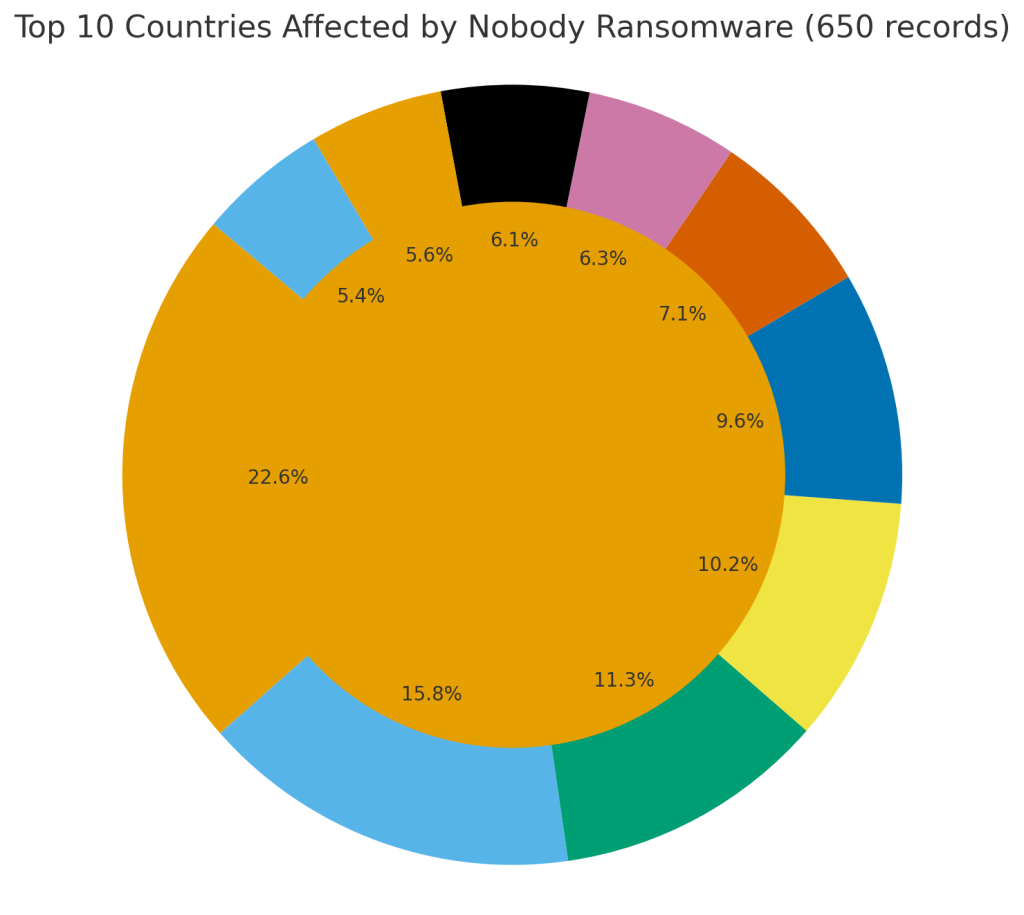
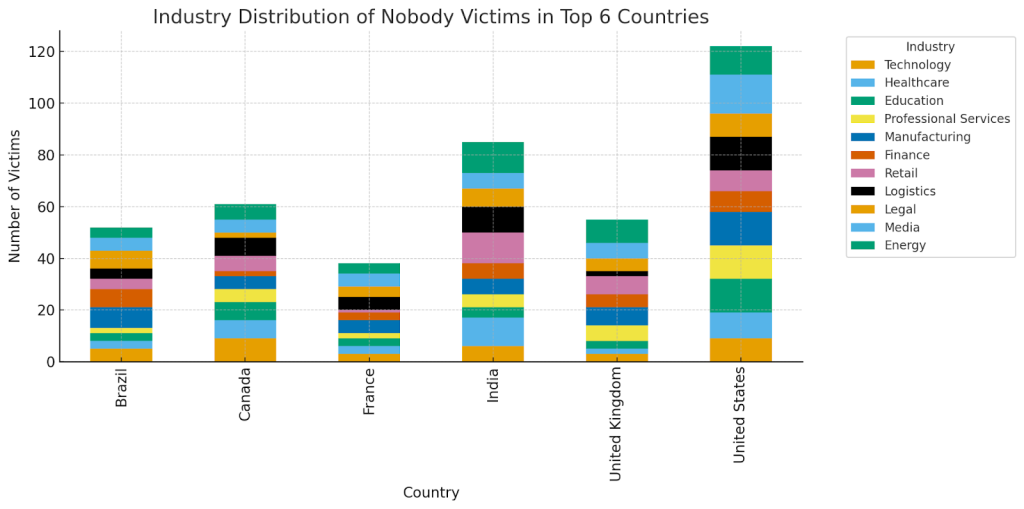
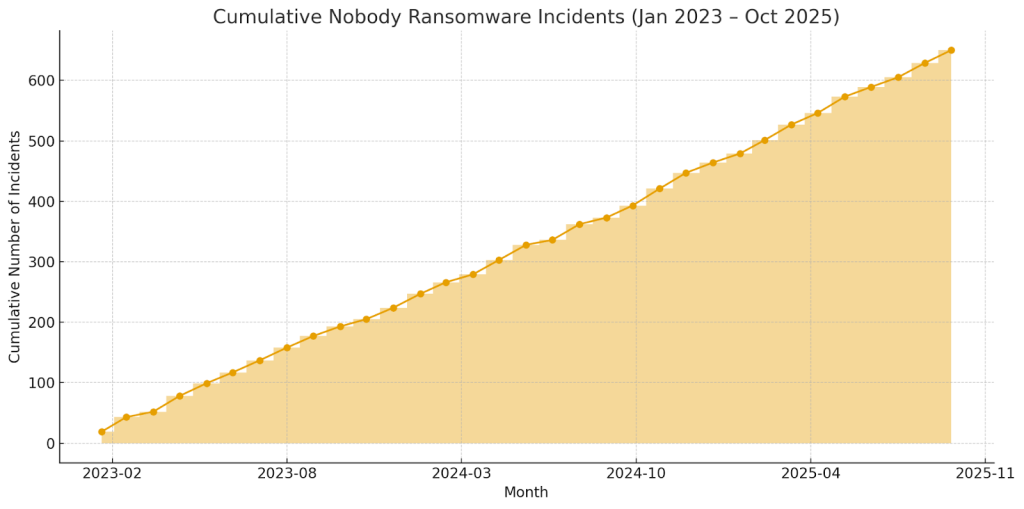
Nobody ransomware incidents have been reported globally.
Top affected countries
Top affected sectors
Timeline
Conclusion
Nobody ransomware, while derived from Chaos, continues to evolve and remains a major threat to both organizations and individuals. Paying the ransom does not ensure data restoration and may result in further targeting. Focus on containment, verified recovery, and expert decryption services.
With robust backups, verified decryptors, and forensic support, data can often be restored safely without empowering threat actors.
MedusaLocker Ransomware Versions We Decrypt