
Black Shrantac Ransomware Decryptor
Black Shrantac ransomware is a highly advanced file-encrypting threat designed to compromise systems, lock user data, interfere with system visuals, and aggressively push victims toward ransom payments. Initially detected through suspicious file submissions uploaded to VirusTotal, this malware demonstrates the typical characteristics of financially motivated ransomware campaigns. After infiltrating a device, it encrypts files, renames them using a randomized alphanumeric pattern, and appends the .shrt extension. For example, the file 1.jpg may be transformed into an unrecognizable format such as 0WeRZQJSTkOAnYP4.shrt.
When the encryption process finishes, the ransomware produces a ransom note named shrt.readme.txt, instructing victims to contact the operators via a TOR-based negotiation portal or through Tox Messenger. This comprehensive guide explains how Black Shrantac infects systems, how it handles encryption, what the attackers demand, and how victims can pursue safe recovery practices without relying on criminals.
Initial Signs of a Black Shrantac Infection
A Black Shrantac attack is often detected when users realize that everyday files—documents, images, videos, archived folders, development work, and other essential data—have suddenly become inaccessible. The ransomware not only encrypts these files but also replaces their names with randomized strings, making it difficult to identify content based on filename alone. All modified files end with the .shrt extension.
Beyond the encrypted files, victims usually notice that their desktop wallpaper has been replaced with a threatening message linked to the attack. The newly created shrt.readme.txt ransom note appears in folders containing encrypted data. The sudden inability to open files, unusual file name changes, a new wallpaper image, and the appearance of the ransom instructions are clear indications of Black Shrantac activity.
Professional Recovery Framework for Black Shrantac
Recovering data after a Black Shrantac infection is a sensitive and complicated process. Manual decryption attempts or experimenting with generic tools can corrupt encrypted files permanently. Communicating directly with the attackers also poses significant risks, including further extortion and exposure to additional threats. A proper recovery framework involves safe analysis, malware isolation, cryptographic validation, and structured reconstruction methods.
Cloud-Isolated Analysis and Reconstruction
The safest way to evaluate encrypted files is by moving them into a secured, isolated cloud environment specifically designed for malware diagnostics. By avoiding direct interaction with the infected system, analysts eliminate the risk of accidental reinfection or secondary encryption. This environment enables controlled cryptographic testing while thoroughly logging every step for forensic purposes.
Cryptographic Pattern and Variant Identification
Although Black Shrantac resembles other ransomware families in behavior, its internal structures—such as encryption routines, key generation patterns, and renaming logic—can differ between variants. Analysts inspect encrypted samples for entropy scores, file header destruction, residual metadata, and segmentation characteristics. These details help determine whether recovery is technically feasible or if the encryption was applied flawlessly.
Strict Validation Before Attempting Restoration
No reconstruction attempt begins until experts confirm that encrypted files show traits compatible with partial or full recovery. If the ransomware applied complete, error-free encryption secured by asymmetric key wrapping, only clean backups can restore data. However, if Black Shrantac malfunctioned, crashed mid-process, or exhibited irregular encryption behavior, targeted reconstruction may be achievable.
Step-By-Step Recovery Workflow for Black Shrantac
Confirm the Infection
Ensure that encrypted files bear randomized filenames ending with .shrt, and verify that shrt.readme.txt is present. These artifacts confirm that Black Shrantac is responsible for the attack.
Isolate the Affected Device
Immediately disconnect the infected system from all networks—wired, wireless, and sync-based. Avoid using USB drives or external storage to prevent additional encryption or lateral spreading.
Secure Encrypted Files and Ransom Notes
Collect several encrypted samples from different folders along with the ransom note. These samples are essential for identifying the exact variant and determining the feasibility of recovery.
Begin Secure Reconstruction Attempts
Recovery efforts begin in a hardened cloud environment rather than on the compromised device. This ensures that ransomware processes cannot reinitialize or interfere with restored files.
Use Victim-Specific Metadata
If the ransomware incorporates unique identifiers or embeds information in the renamed filenames, these components must be included in the reconstruction workflow.
Allow the Automated System to Complete Processing
Once validated, restoration tools run through encrypted directories, analyzing and reconstructing data. Each recovered file undergoes integrity checks before being returned to the victim.
What Victims Need to Do Immediately
Victims must disconnect their system from all networks as quickly as possible. Reboots should be avoided unless advised by a professional because some ransomware families delete critical logs or wipe restore points during startup sequences. Keeping all encrypted files, logs, and ransom notes intact is essential for forensic investigation and recovery.
Renaming or modifying encrypted files can hinder restoration efforts. Similarly, free decryption tools found online should not be used, as they may overwrite vital file segments or introduce additional malware.
Our Ransomware Recovery Specialists Are Ready to Assist
Black Shrantac attacks can be overwhelming due to their destruction of personal data and the added pressure of data-leak threats. Working with a professional recovery team reduces risk and provides victims with a structured, safe recovery path. Our specialists include forensic analysts, malware researchers, cryptography experts, and file system reconstruction engineers.
We offer global 24/7 assistance, encrypted communication channels, and a strict no-recovery-no-fee policy. Our goal is to restore data safely, maintain confidentiality, and prevent victims from engaging directly with malicious actors.
How Black Shrantac Spreads Across Systems
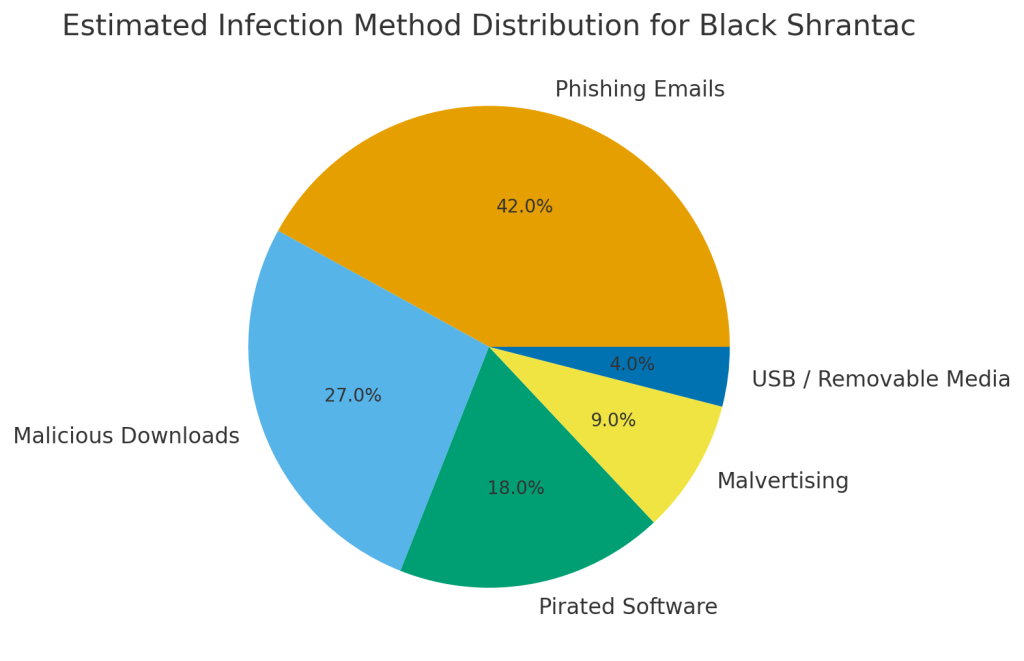
Black Shrantac utilizes several distribution techniques designed to exploit user behavior, system vulnerabilities, and deceptive online practices. Phishing remains one of the most common methods: attackers craft convincing emails that appear to be invoices, HR files, shipment alerts, or banking notifications. The attached files—be they documents with malicious macros, executable droppers, scripts, or compressed archives—activate the infection once opened.
Other notable distribution channels include:
- Pirated or cracked software packages
- Torrented applications and media bundles
- Fake update prompts distributed by compromised sites
- Malicious advertisements leading to drive-by downloads
- Trojan loaders that download the ransomware at a later stage
- Infected script files, installers, or DLL payloads
Some variations of Black Shrantac may also propagate through local networks and removable devices, expanding their reach across connected systems.
Black Shrantac Ransomware Encryption Analysis
Black Shrantac uses a powerful hybrid encryption framework designed to make recovery nearly impossible without the attackers’ cooperation. This structure consists of symmetrical file-level encryption supported by asymmetric key wrapping.
Symmetric Encryption (File-Level Encryption)
The ransomware encrypts the body of each file using fast, secure symmetric algorithms such as AES or ChaCha20. Each encrypted file is assigned its own symmetric key, ensuring that decrypting one does not help recover others. Depending on the variant, Black Shrantac encrypts either entire files or large internal segments. After encryption, the data becomes high-entropy, unreadable, and devoid of recognizable headers.
Asymmetric Encryption (Key Protection Mechanism)
To prevent victims from restoring data independently, Black Shrantac encrypts each symmetric key using a public key embedded within the malware. Only the attackers possess the private key needed to recover the symmetric keys. This prevents manual reconstruction, even by experienced analysts.
Forensic Observations From Encrypted Files
A detailed examination of .shrt files shows:
- Consistent, uniform entropy patterns
- Total destruction of original metadata and headers
- Properly structured block-level encryption
- Evidence of professionally engineered cryptographic routines
These traits confirm that Black Shrantac employs a reliable, well-implemented encryption process that is unlikely to fail.
Indicators of Compromise (IOCs) for Black Shrantac
File-Level Indicators
Encrypted files renamed into randomized strings ending with .shrt, along with the presence of the ransom note shrt.readme.txt, clearly signal infection.
Behavioral Indicators
Victims may observe modified desktop wallpapers, inaccessible files, broken application functionality, and heavy CPU or disk activity during the encryption phase.
Registry and System-Level Indicators
Black Shrantac may delete shadow copies, suppress system logs, and interfere with restore mechanisms to prevent easy recovery.
Network Indicators
The ransomware may attempt to contact TOR-based endpoints or Tox communication channels. Unusual outbound traffic during the attack window is a significant red flag.
TTPs and Tools Used by Black Shrantac Threat Actors
Threat groups behind Black Shrantac rely on a broad spectrum of tactics, techniques, and procedures that mirror the operational behavior of modern, highly organized ransomware operators. Their approach spans the full intrusion lifecycle, from initial compromise to encryption, exfiltration, and extortion.
Initial Access Techniques
A significant number of Black Shrantac attacks begin with phishing campaigns. These emails are crafted to appear legitimate, often mimicking business communication styles or impersonating reputable companies. The attachments may look like harmless invoices, resumes, financial summaries, or shipping confirmations but contain malicious macros, executable payloads, or obfuscated scripts that deploy the ransomware once opened.
Other known infection sources include:
- Unofficial or bundled installers downloaded from untrusted freeware sites
- Torrented software packages carrying hidden malware
- Cracked or illegally activated applications
- Website-based scams offering fake updates or software patches
- Malvertising campaigns that redirect users to compromised download pages
- Trojan loaders or backdoor implants that later activate Black Shrantac
These techniques rely heavily on social engineering to trick victims into initiating the infection.
Execution and Propagation Tools
Once launched, Black Shrantac begins scanning the system for targeted file types stored on local drives, external storage devices, removable media, and shared network folders. The malware may run using:
- Standalone EXE payloads
- Multi-stage loaders that unpack additional components
- Dropped DLL files
- Obfuscated scripts or encoded PowerShell
- In-memory execution frameworks to avoid leaving behind artifacts
While some variants focus exclusively on local encryption, others may attempt limited lateral movement by checking for accessible shared drives or mapped network resources.
Privilege Escalation and Lateral Movement
If the ransomware gains limited access initially, it may attempt privilege escalation through various means, such as exploiting outdated software, taking advantage of misconfigurations, or using credentials previously harvested by infostealer trojans. Once privileged access is obtained, Black Shrantac may look for new file locations across networked systems, expanding the encryption footprint.
Systems that rely on weak, reused, or default passwords are especially vulnerable to these escalation attempts.
Defense Evasion Techniques
To maintain full control over the system during the encryption phase, ransomware operators often deploy a series of evasion techniques. Black Shrantac may:
- Delete Volume Shadow Copies
- Disable system recovery features
- Interfere with backup services
- Alter or wipe event logs
- Conceal malicious activity through obfuscation
- Suppress alerts generated by security tools
In some cases, attackers drop secondary malware modules, such as keyloggers, credential-harvesting trojans, or backdoors, enabling them to exploit victims even after the initial attack.
Impact
By the time Black Shrantac finishes executing, user data is fully encrypted, filenames are replaced with random strings, a new desktop wallpaper is deployed, and the ransom note appears in relevant directories. Although the operating system remains functional, essential business and personal files become completely inaccessible without the attackers’ cooperation.
Understanding the Black Shrantac Ransom Note
The shrt.readme.txt ransom note is the attackers’ official communication channel. It informs victims that their files have been encrypted and extracted from the network. The note frames the entire attack as a “business transaction,” emphasizing that payment is required for file restoration and for preventing the public release of stolen information.
One of the manipulation tactics used by Black Shrantac is offering a “proof-of-decryption” option, allowing the victim to submit 2–3 small files (each under 20MB) for free decryption. This strategy is meant to build trust and demonstrate that the attackers can indeed reverse the encryption if paid.
The note instructs victims to:
BLACK-SHRANTAC
Your files have been extracted from your network and encrypted using a robust encryption algorithm.
This is a business transaction — we are solely motivated by financial compensation.
To regain access to your data, you must contact us and arrange payment.
— Our communication process:
1. You reach out to us through the designated communication channel.
2. We provide a list of the files that have been extracted from your network.
3. To prove the legitimacy of our decryption tool, we decrypt 2–3 non-critical files (each under 20MB).
4. We agree on a payment amount, to be made in Bitcoin (BTC).
5. Upon receipt of payment, we delete the stolen data and provide you with the decryption tool.
6. You receive a comprehensive report detailing how your network was breached, along with recommendations to prevent future incidents.
— Client area (use this site to contact us):
To communicate with us securely, please use the Tor Browser and visit the following link:
Tor Site: –
Alt Tor Site: –
>>> Login Credentials:
ID : –
Password : –
* You must use the Tor Browser to access the site.
Download it here: hxxps://www.torproject.org/
— Additional contacts:
Support Tox: EFE1A6E5C8AF91FB1EA3A170823F5E69A 85F866CF33A4370EC467474916941042E29C2EA4930
* You must use the Tox Messenger to contact us.
Download it here: hxxps://tox.chat/download.html
— Recommendations:
DO NOT shut down or restart your systems — this may result in permanent damage to encrypted files.
DO NOT rename, move, or alter any encrypted files or the provided readme files.
— Important:
If you choose not to contact us or refuse to pay, your sensitive data will be published or sold to interested third parties — including competitors.
Keep your ID and Password safe. Without them, you will lose access to the negotiation portal, and recovery will be impossible.
Victim Geography, Industry Targeting & Timeline
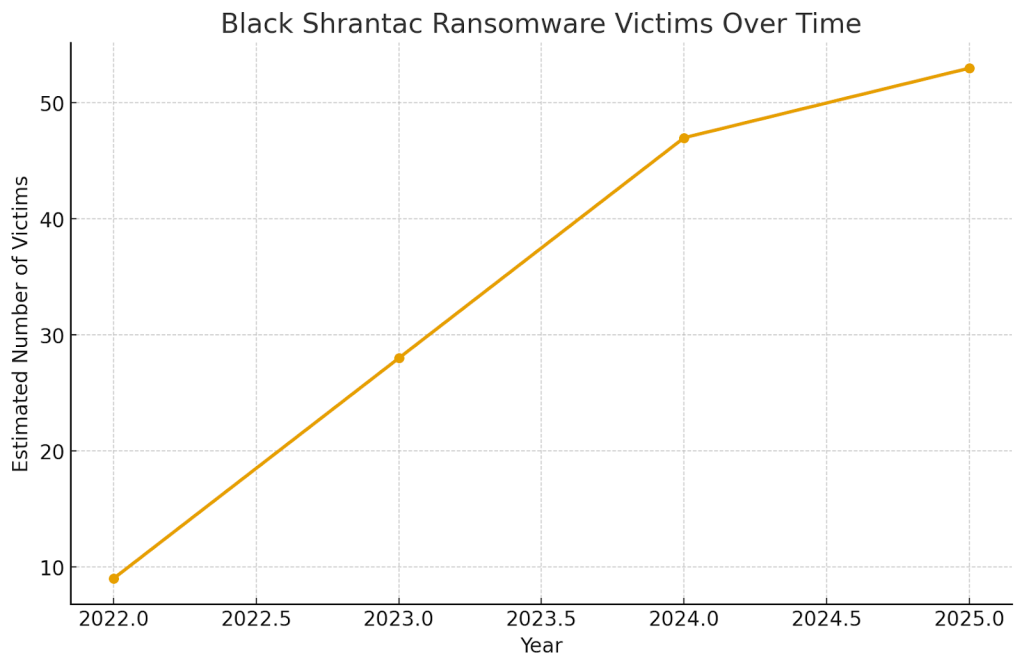
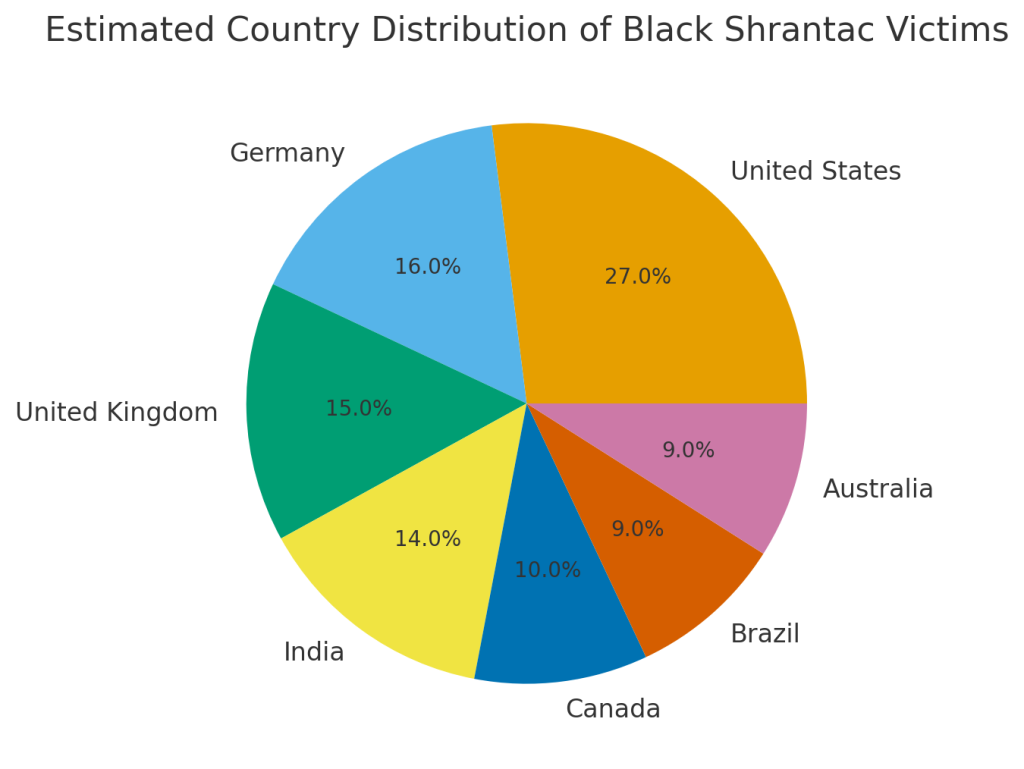
While the full global impact of Black Shrantac has not yet been documented, the malware’s distribution patterns suggest a widely dispersed victim base. Because it spreads primarily through phishing attacks, cracked software, malicious downloads, and fraudulent update prompts, its reach extends across industries and geographic regions.
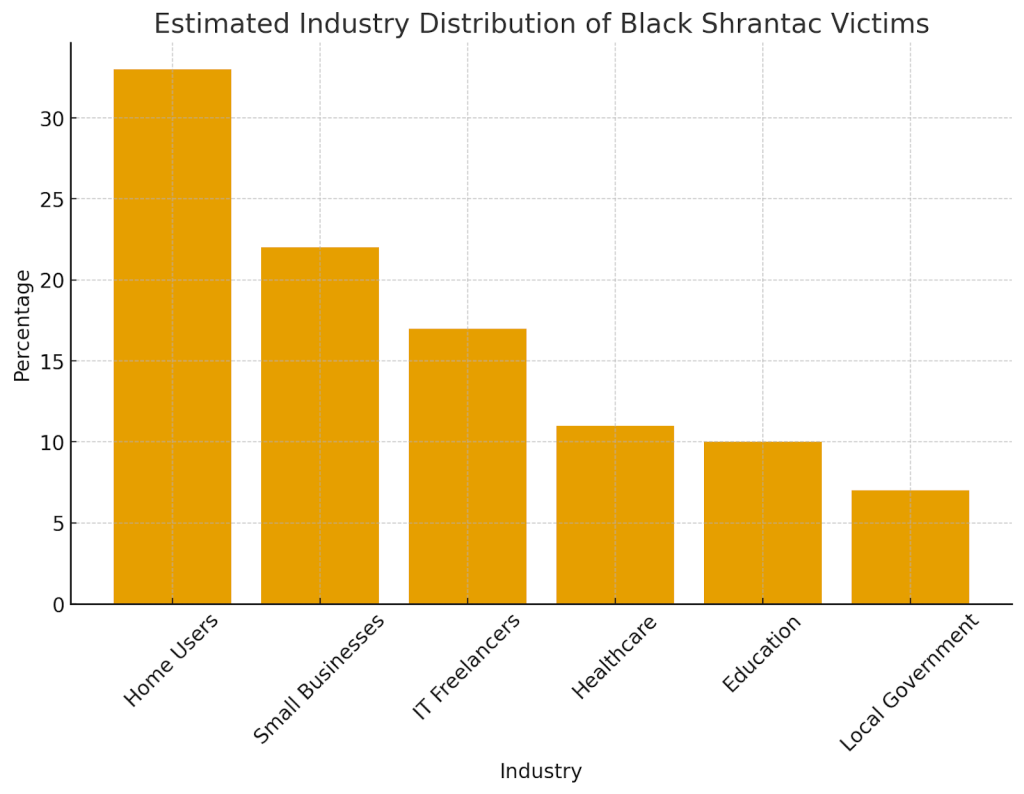
Entities most vulnerable to Black Shrantac include:
- General consumers using home computers
- Freelancers and independent IT operators
- Small to medium-sized businesses lacking dedicated cybersecurity teams
- Educational institutions that operate with minimal security resources
- Local government systems with high public exposure
- Professional environments using shared network drives
Black Shrantac Ransomware Victims Over Time
Estimated Country Distribution of Black Shrantac Victims
Estimated Industry Distribution of Black Shrantac Victims
Estimated Infection Method Distribution for Black Shrantac
Best Practices for Preventing Black Shrantac Attacks
Preventing a Black Shrantac infection requires a rigorous approach to cybersecurity hygiene. Because ransomware thrives on user mistakes, misconfigurations, and weak security practices, prevention starts with awareness and disciplined behavior.
Key defensive measures include:
- Downloading applications exclusively from trusted websites or official app stores
- Avoiding cracked software, illegal activation tools, and unverified installers
- Keeping Windows and all installed applications fully updated
- Treating unexpected emails, attachments, and links with extreme caution
- Using reputable antivirus tools with active real-time protection
- Conducting frequent system-wide scans
- Maintaining multiple offline or cloud backups stored securely
Organizations should follow guidelines provided by cybersecurity agencies like CISA to strengthen protective measures, develop incident response plans, and train staff to recognize phishing attempts.
Post-Attack Restoration Guidelines
After identifying an infection, the primary objectives are containment and confirmation of removal. Black Shrantac must be eliminated using trusted antivirus tools or through a professional incident response team. Restoration efforts must never begin until the malware is completely removed, as residual components can re-encrypt restored files.
The most effective recovery method is restoring data from clean, offline, and uncompromised backups. These backups must be thoroughly verified to ensure they were not accessed or damaged. If no such backups exist, experts may attempt advanced file reconstruction techniques, but success heavily depends on how the ransomware executed.
Paying the ransom poses significant risks. Attackers frequently fail to deliver decryption tools after payment, and victims may be targeted again due to perceived willingness to pay.
Conclusion
Black Shrantac ransomware is a major cybersecurity threat due to its powerful encryption, data theft capability, and pressure-driven extortion model. While the damage can be severe, the consequences are greatly reduced when organizations and individuals maintain disciplined cybersecurity practices. Regular system patching, employee awareness training, strong authentication procedures, cautious download habits, updated security tools, and reliable offline backups form the core of long-term resilience against ransomware.
By integrating these habits into everyday digital operations, users significantly lower their risk profile and improve their ability to withstand sophisticated threats like Black Shrantac.
MedusaLocker Ransomware Versions We Decrypt