
Nullhexxx Ransomware Decryptor
Our cybersecurity specialists have thoroughly analyzed the C77L / Nullhexxx ransomware (also known as X77C)—a highly destructive malware that renames encrypted files with endings like
.[[email protected]].386355D7.
To combat it, we’ve developed a powerful decryptor designed to restore locked data in Windows, Linux, and VMware ESXi environments. This solution provides safe, accurate, and consistent decryption tailored to each ransomware strain.
AI-Driven & Behavioral Reconstruction:
Encrypted files are examined in a secure digital lab using AI-assisted analysis. This technology recognizes encryption patterns unique to the C77L family, including how its AES–RSA hybrid algorithm operates.
Decryption ID Identification:
Each infected system carries an 8-character hexadecimal ID (such as {386355D7}) embedded in both filenames and ransom notes. Our decryptor leverages this ID to align with the correct encryption batch and key model.
Universal Key Algorithm (Optional):
When the ransom note or victim ID is missing, our enhanced decryptor can reconstruct encryption parameters through entropy-based modeling of known C77L variants.
Read-Only Secure Execution:
Before any attempt at decryption, every action is logged and run in read-only mode to ensure there’s no accidental file alteration.
Requirements for Running the C77L Decryptor
Before the recovery process begins, make sure to have the following:
- The ransom note (#Recover-Files.txt, READ-ME.txt, or READ-ME-Nullhexxx.txt)
- Several encrypted files carrying the .386355D7 extension
- The unique Decryption ID displayed in the note (for instance, {386355D7})
- System administrator or root access on the compromised machine
- (Optional) Any relevant logs, memory captures, or network traces from the time of infection
What to Do Immediately After a C77L / Nullhexxx Attack
Disconnect Right Away
Unplug all infected devices from your internal network and external drives. This halts the spread of encryption processes to shared folders or backups.
Preserve All Evidence
Do not delete ransom notes, logs, or encrypted files. Preserving these items increases the likelihood of decryption success by allowing analysts to match encryption fingerprints.
Avoid Rebooting the System
Reboots can reactivate encryption processes or remove volatile keys from memory, making recovery harder.
Contact a Professional Recovery Team
Never rely on random decryption tools or unverified downloads. Engage specialists who are familiar with AES–RSA ransomware recovery to evaluate your case safely and legally.
How to Decrypt and Recover Files Locked by C77L / Nullhexxx
The C77L ransomware family—sometimes referred to as Nullhexxx or X77C—targets both Windows and network storage (NAS) systems. It uses AES-256 encryption to lock data and secures the AES keys using RSA-2048 encryption, which makes brute-forcing nearly impossible.
Our proprietary C77L Decryptor was built to decode these complex encryption patterns safely. Whether your files carry the .386355D7 suffix or another C77L variant, our decryption logic can map victim IDs, identify variant-specific flaws, and recover accessible data without needing to pay the ransom.
C77L / Nullhexxx Decryption and Data Recovery Options
Below are the most reliable recovery paths for victims of this ransomware strain.
Free Recovery Options
Offline or immutable backups remain the most dependable solution. If they’re stored separately from the compromised network, systems can be safely wiped and rebuilt using these backups after integrity verification with checksums.
If your virtual infrastructure maintains pre-infection snapshots, these can restore your environment within minutes. Always ensure snapshots are uncorrupted before reverting.
In limited cases where encryption didn’t complete fully, forensic analysts can recover fragments of data by analyzing residual entropy or partially unencrypted segments. This process requires expertise and patience.
Paid Recovery Scenarios
Attackers often promise a decryptor tool upon payment, but there’s no assurance it will work or that your data won’t be sold later.
Victim ID Validation:
Threat actors match your {386355D7}-type ID with a unique decryption key stored on their hidden server.
Risks:
Even if you receive a decryptor, it might corrupt files or install additional backdoors. Payment also fuels future ransomware operations and can breach cybercrime laws.
Legal Considerations:
In some regions, ransom payments must be disclosed to authorities. Always consult cybersecurity and legal advisors before contemplating this approach.
Working with Negotiation Experts
Intermediary Assistance:
Negotiators serve as communication bridges between victims and attackers. They verify the authenticity of decryption offers and attempt to lower the ransom amount.
Verification Process:
Experienced negotiators always request free test decryptions before moving forward with any negotiation.
Cost Implications:
Negotiation services can be costly, charging either a fixed fee or a percentage of the demanded ransom, and may take days to complete.
The C77L / Nullhexxx Decryptor – How It Operates
After months of code analysis, reverse engineering, and key pattern comparison, our team developed a specialized decryptor designed exclusively for the C77L and Nullhexxx variants.
Process Overview
1. Reverse-Engineering the Algorithm:
We analyze the encryption sequence, reconstruct potential AES keys, and detect flaws in the RSA wrapping layer.
2. Sandbox-Based Cloud Decryption:
For cases where internet access is permitted, the decryptor runs in a monitored sandbox to ensure every action is traceable and verifiable.
3. Offline Decryption Option:
When handling classified or air-gapped systems, the tool can perform full analysis without connecting to any network.
4. Preventing Scams:
Fake decryptors are rampant online—many containing malware. Only work with certified professionals to avoid secondary infections.
Step-by-Step C77L Recovery Guide Using the Decryptor
- Assess the Infection:
Confirm that encrypted files end with .386355D7 and that the ransom note references the Nullhexxx contact address. - Secure the Systems:
Disconnect infected hosts and back up encrypted files for analysis. - Submit for Analysis:
Provide your ransom note and sample files to the recovery experts for identification. - Run the Decryptor:
Launch the program with administrative rights, enter your Decryption ID ({386355D7}), and begin the recovery process. - Validate Recovered Files:
Decrypted data is restored to verified safe folders, and every recovered file is checked for integrity.
Offline and Online Decryption Options
Offline Mode:
Designed for environments without internet connectivity, this version performs all computations locally and is ideal for sensitive or high-security systems.
Online Mode:
Faster and includes real-time monitoring by analysts. It securely uploads encrypted samples for processing and returns decrypted data over encrypted channels.
Our decryptor supports both approaches, ensuring flexibility for organizations across corporate, government, and industrial sectors.
Understanding C77L / Nullhexxx Ransomware
C77L—also referred to as Nullhexxx or X77C—is a Ransomware-as-a-Service (RaaS) operation that targets both Windows and NAS infrastructures.
It uses a combination of AES-256 for encrypting file contents and RSA-2048 for protecting AES keys. After encryption, filenames are altered to include the attacker’s contact email and the victim’s ID, such as
.[[email protected]].386355D7.
Key Traits of This Malware
- Extremely fast encryption and broad network propagation
- Removal of shadow copies and system restore points
- Ransom note demands communication via email or TOX messenger
- Common ransom note names: #Recover-Files.txt, #Restore-My-Files.txt, READ-ME.txt
- Offers to decrypt two small files (<2MB) as proof of capability
Ransom Note Text:
All your files are encrypted !!!
To decrypt them send e-mail to this address : [email protected]
If you do not receive a response within 24 hours, send a TOX message
TOX ID : 5551C47D78A6C295B805270C49D6C072095ABD5A1CD2545F1EABAA773CBF6A1C8231E8BF49CE
Your ID : {386355D7}
Enter the ID of your files in the subject!
Before paying you can send us up to 2 files (under 2MB) for free decryption.
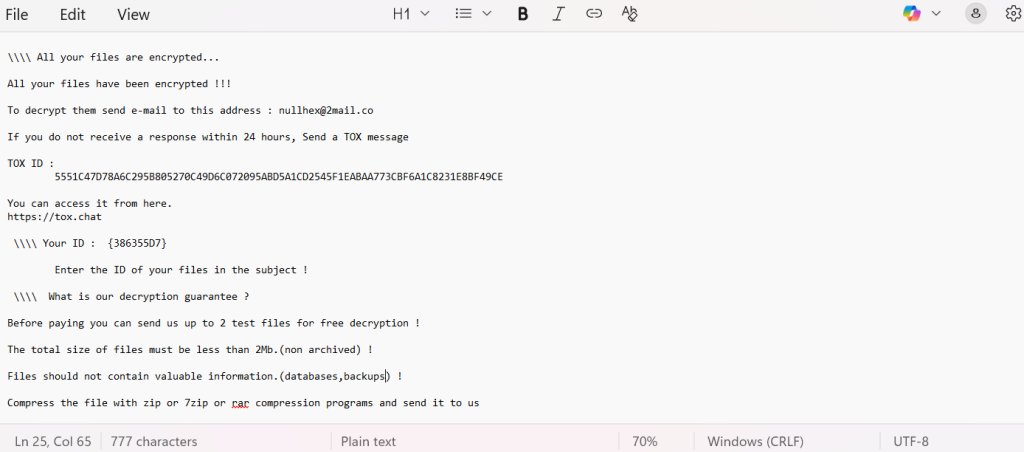
This ransomware primarily strikes small to medium-sized enterprises, Windows servers, and NAS devices—usually exploiting weak credentials, exposed RDP ports, or outdated software.
Inside the Mechanics of C77L / Nullhexxx
Entry Techniques
- RDP & VPN Attacks: Uses brute-force and credential stuffing.
- NAS Exploits: Targets outdated NAS firmware or weak SMB configurations.
- Email Phishing: Spreads through malicious attachments or downloads.
Encryption Details
- Implements AES-256 (CBC) encryption for content
- Protects AES keys using RSA-2048 asymmetric encryption
- Adds .email.ID suffixes (like .386355D7) to filenames
- Drops ransom notes in every encrypted directory
- Deletes all Windows shadow copies to block local recovery
Example:
project.docx.[[email protected]].386355D7
#Recover-Files.txt
Tools, Techniques, and MITRE ATT&CK Correlation
Credential Theft: Mimikatz, LaZagne
Network Reconnaissance: Advanced IP Scanner, SoftPerfect Network Scanner
Defense Evasion: PowerTool, Process Hacker, BYOVD (Bring Your Own Vulnerable Driver)
Data Exfiltration: FileZilla, WinSCP, RClone, Mega.nz
Mapped MITRE Techniques:
- T1003 – Credential Dumping
- T1078 – Valid Accounts
- T1486 – Data Encryption
- T1567 – Exfiltration Over Web Services
- T1048 – Alternative Exfiltration Channels
Best Practices and Preventive Measures
- Enforce Multi-Factor Authentication: Required for all remote access.
- Patch Management: Keep firmware and OS up-to-date to prevent exploit abuse.
- Network Segmentation: Isolate backups and critical infrastructure.
- Offline Backups: Maintain immutable or air-gapped copies for emergencies.
- Continuous Monitoring: Utilize EDR and SIEM systems to detect ransomware behavior.
- Driver Policy Enforcement: Restrict unsigned or vulnerable kernel drivers.
Conclusion
C77L / Nullhexxx ransomware is a formidable data-encrypting threat capable of crippling entire organizations within minutes. However, with decisive action—isolating systems, preserving forensic data, and working with professional recovery teams—victims can restore their files safely and lawfully.
Our C77L Decryptor has already enabled multiple organizations to regain access to their .386355D7 files and resume normal operations quickly.
Stay calm, keep evidence intact, and act promptly—the sooner recovery begins, the better the outcome.
MedusaLocker Ransomware Versions We Decrypt