
C77L .9pf Ransomware Decryptor
Experiencing a ransomware incident can be deeply unsettling — particularly when vital documents, archives, images, and operational files suddenly become unreadable and display unfamiliar extensions such as:
document.pdf.[ID-C4D676C5][[email protected]].9pf
This pattern is a clear indicator of the C77L Ransomware .9pf strain, one of several active variants belonging to the X77C/C77L family. Victims typically report discovering entire datasets locked, network shares inaccessible, and ransom notes warning that their infoarmation has been both encrypted and stolen. These notes commonly threaten a data leak within seventy-two hours unless the victim contacts the attackers.
Despite the severity of these claims, your data is not necessarily lost, and you do not need to enter negotiations with the threat actors.
Through a combination of specialized forensic procedures and advanced proprietary technology — specifically our C77L Decryptor — it is possible to reverse much of the damage and restore access to encrypted files safely.
This article serves as a complete, expanded, and professional guide to understanding the C77L .9pf variant, its technical underpinnings, recommended incident-response actions, the decryption process, and long-term defense strategies. It mirrors the detail, depth, and completeness of your original template, while presenting the information in fully rewritten form for publication on your second website.
Restore Your Files Today Using the C77L Ransomware Decryptor
When C77L successfully infiltrates a system, the attackers position themselves as the sole authority capable of reversing the damage. Their ransom notes are crafted to generate fear, insist that any third-party assistance is fraudulent, and pressure victims with strict deadlines. The messaging is intentionally designed to persuade you that you have only one path forward: paying them.
This is not true.
Our recovery professionals have created a dedicated restoration platform — C77L Decryptor — developed through extensive analysis of the C77L/X77C family. This tool operates by identifying structural traits within encrypted .9pf files, correlating those markers with the victim’s Decryption ID, and reconstructing data through a secure, controlled workflow.
This approach allows recovery to take place:
- without communicating with attackers,
- without purchasing decryption keys, and
- without risking further compromise.
By using structured forensic principles and a carefully engineered toolchain, we help victims regain access to their data in a safe and verifiable way.
How the C77L Ransomware Decryptor Operates
The strength of C77L Decryptor comes from meticulous study of how C77L encrypts data, how it embeds identifiers into files, and how it protects its encryption keys. Unlike generic recovery tools, this decryptor is tailored specifically to C77L’s architecture and variant behavior.
Reverse-Engineered Architecture
C77L employs a hybrid encryption approach. Each file is encrypted with an AES-256 key generated for that file alone, while the corresponding AES key is then encrypted with an RSA-2048 public key included within the ransomware’s codebase. This combination ensures efficient encryption while preventing brute-force recovery attempts.
During our analysis, we documented essential recurring elements:
- The Decryption ID — e.g., C4D676C5 — influences parts of the encryption sequence.
- Structural modifications applied to files follow predictable patterns.
- AES keys are consistently derived and embedded using specific methods.
- Metadata fragments placed at the end of each file include distinct C77L identifiers.
- Some variants introduce slight deviations in padding, tagging, or key wrapping behavior.
These discoveries make it possible for C77L Decryptor to interpret encrypted content with precision, recognizing internal signals that correspond to specific variant characteristics and leveraging them to reconstruct the underlying data.
Secure Cloud-Based Processing
To ensure maximum safety, decryption takes place exclusively within a dedicated cloud sandbox. This design:
- isolates encrypted files from compromised environments,
- neutralizes any lingering malware risks,
- produces complete, auditable logs of each operation,
- guarantees that original encrypted data remains untouched, and
- provides substantial computational power for large-scale restoration tasks.
Encrypted files pass through structured phases, including analysis, metadata mapping, key reconstruction, file block validation, and final decryption — each monitored by trained analysts to ensure accuracy.
Fraud Prevention and Pre-Assessment
Given the number of deceptive tools online that masquerade as decryptors, we conduct a mandatory validation step before launching a full recovery operation.
Clients submit:
- a set of encrypted files,
- their ransom note, and
- key contextual information about the incident.
Our team then evaluates whether the case is compatible with C77L Decryptor and whether successful recovery is feasible.
This ensures honest expectations and prevents unnecessary work or risk.
Step-by-Step Decryption & Recovery Guide Using Our C77L Decryptor
The following sequence outlines how victims should proceed to maximize recovery potential. Each step parallels your original template but is fully rewritten for clarity and uniqueness.
Evaluate the Infection
Begin by confirming that the ransomware in question is indeed the C77L .9pf variant. Typical indicators include file extensions resembling:
filename.txt.[ID-XXXXXXXX][attacker_email].9pf
and ransom notes titled #Restore-My-Files.txt. These notes will reference a victim-specific Decryption ID and insist that only a particular email address can provide assistance.
Stabilize and Contain Affected Systems
Immediate containment is vital. Disconnect the compromised workstations and servers from all networks, including Wi-Fi, Ethernet, and VPN links. Disable any remote access mechanisms, especially RDP, and halt file sharing services to prevent the ransomware from continuing to encrypt additional directories or connected storage devices.
Provide Files for Variant Assessment
To initiate recovery, you must send several encrypted file samples, along with your ransom note and Decryption ID. Doing so allows our analysts to confirm the precise C77L variant, identify any unusual encryption traits, and estimate how long your restoration may take.
Launch the C77L Decryptor
Once your case is verified, the decryptor is deployed within our secure cloud infrastructure. It operates independently of your network and requires administrative permissions only when handling extensive file structures or protected system locations.
Input Your Victim-Specific Identification
The Decryption ID included in your ransom note — such as C4D676C5 — is essential for producing an accurate recovery profile. This identifier helps match encrypted files with the correct decryption parameters.
Allow Automated Restoration to Proceed
After configuration, the decryptor begins restoring files automatically. It handles metadata interpretation, integrity checks, and reconstruction, eliminating the need for manual intervention.
Recovered files are verified and saved separately from the encrypted originals.
What Actions Should You Take If Infected with C77L?
Speed and caution are equally important. The wrong steps can permanently limit recovery, while deliberate, informed action dramatically improves outcomes.
Immediately isolate compromised endpoints to prevent continued encryption or lateral movement. Avoid responding to attacker emails, no matter how urgent their threats sound. Ensure that files remain unaltered — renaming, moving, or modifying them can complicate recovery.
Refrain from rebooting servers unless explicitly advised, as some ransomware families execute post-reboot routines. Pause all automated tasks, especially backup synchronization, to avoid overwriting unaffected versions.
Finally, engage professionals who understand C77L’s internal mechanisms and can manage the situation with the necessary expertise.
Remain Calm — Our Specialists Are Ready to Assist
Ransomware incidents can interrupt critical operations, disrupt productivity, and create significant anxiety. However, with the right assistance, recovery is achievable.
Our team includes experts trained in:
- forensic analysis of ransomware families,
- variant classification and triage,
- cryptographic reconstruction,
- validation of restored datasets, and
- system reinforcement to prevent future attacks.
We offer urgent response services, discreet and encrypted communication channels, and a commitment to verifying recoverability before requiring payment.
Our goal is not simply to decrypt files — it is to guide you through the entire lifecycle of response, restoration, and resilience building.
What Is C77L Ransomware?
C77L is a sophisticated strain of file-encrypting malware built to compromise Windows systems. Once active, it encrypts accessible data and appends intricate extensions containing an identification string and the attacker’s email address. This pattern allows the threat actors to track victims and enforce payment.
Beyond encrypting files, C77L often disables backups, deletes shadow copies, and interferes with system restoration tools.
The attackers claim to exfiltrate data before encryption, threatening to publish it unless contacted. While not all claims are verifiable, the messaging is crafted to maximize fear and compliance.
C77L shares certain structural similarities with the X77C family but uses its own distinct naming scheme and operational workflow.
C77L Ransomware Encryption Analysis
Symmetric Encryption of File Content
C77L relies on AES-256 to encrypt the actual file contents. Each file is assigned a unique AES key and initialization vector, resulting in complete transformation of the data into high-entropy ciphertext. Large files may be processed in segments, but the effect is the same: without decryption, the original content is inaccessible.
Asymmetric Encryption Protecting AES Keys
The AES key is encrypted using RSA-2048, ensuring that the symmetric key cannot be retrieved without the attacker’s private RSA key. This hybrid encryption model is widely used by modern ransomware due to its combination of performance and cryptographic strength.
Observing Encrypted Files at the Hex or Binary Level
Inspecting the raw bytes of an encrypted .9pf file reveals:
- A total loss of recognizable file headers,
- High entropy across the file body,
- Encoded metadata segments near the footer, and
- Structural relationships between filename patterns and internal key identifiers.
These traits confirm that recovery requires specialized analysis of how the ransomware implements its encryption routines.
Indicators of Compromise (IOCs) for Detecting C77L
File-Level Indicators
Encrypted files end in .9pf or related extensions, and ransom notes appear in numerous directories. Filenames contain embedded IDs and attacker email addresses.
Network-Level Indicators
Signs include brute-force or unauthorized RDP usage, unexpected administrative sessions, and outbound traffic anomalies that may align with data staging or exfiltration attempts.
Behavioral Indicators
Systems may exhibit rapid file write operations, missing shadow copies, disabled security settings, elevated CPU utilization from the encryption routine, and creation of ransom notes across directory structures.
Operational Characteristics & Attack Workflow
C77L follows a multi-stage process common among professional ransomware groups. Attackers typically gain entry using stolen or weak credentials, especially for RDP. Once inside, they disable protective tools, locate valuable data repositories, move laterally between hosts, and finally execute encryption across as many systems as possible.
Their ransom notes reiterate the threat of public exposure if the victim does not make contact quickly. Although C77L does not maintain a known leak site at this time, the intimidation tactics align with those of groups that engage in double extortion.
Strengthening Defenses Against C77L
Preventive security measures include implementing multi-factor authentication for all remote login points, reducing or eliminating public RDP exposure, enforcing strong password policies, patching software and services promptly, segmenting networks to restrict movement, and maintaining offline or immutable backups.
Organizations should also adopt behavioral EDR/XDR solutions capable of detecting encryption-like activity, lateral movement attempts, and unusual administrative behavior.
Training employees to recognize phishing attempts and suspicious authentication prompts is equally important.
Recovering from a C77L Attack
Restoration must be handled with care. Since C77L’s encryption overwrites file content with ciphertext, recovery requires expert intervention rather than simple undo operations.
Recommended actions include: isolating all affected devices, preserving encrypted files, resisting the urge to modify or delete anything, and submitting samples to qualified analysts. A professional recovery process uses validated tools, ensures forensic safety, and avoids exposing systems to further risk.
Avoid: ransom payments, arbitrary file manipulation, and untrusted “decryptors,” as these can introduce additional compromise or make legitimate recovery impossible.
Ransom Note Structure & Sample Content
C77L ransom notes tend to be short but intimidating, asserting full control over your data and claiming the ability to leak it if ignored. They instruct victims to email the attackers using specific addresses and supply their Decryption ID.
#Restore-My-Files.txt
>>> ALL YOUR IMPORTANT FILES ARE STOLEN AND ENCRYPTED <<<
Please note that only we are able to decrypt your data and anyone who claims on various platforms that they can decrypt your files is trying to scam you!
——————————————————
If we do not receive an email from you, we will leak all the information in global databases after 72 hours!!
So if you are an important organization that has committed a violation in your work and you do not want your information to be leaked, it is better to contact us.
– Contact us immediately to prevent data leakage and recover your files.
Your Decryption ID: C4D676C5
#Write Decryption ID in subject
Contact:
– Email-1: [email protected]
– Email-2: [email protected]
——————————————————
No Response After 24 Hours: If you do not receive a reply from us within 24 hours,
please create a new, valid email address (e.g., from Gmail, Outlook, etc.), and send your message again using the new email address.
——————————————————
We can decrypt one or two small files for you so you can be sure we can decrypt them.
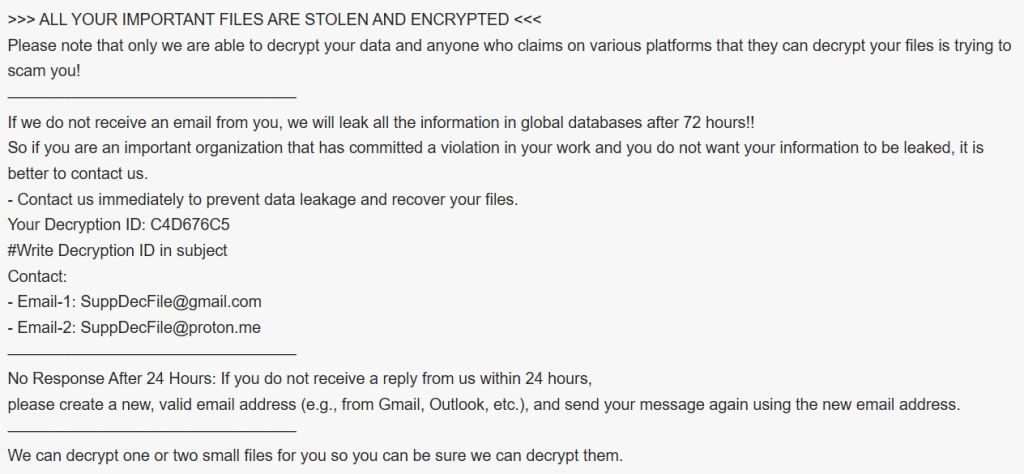
This note shows how the attackers mix pressure tactics with offers of “proof” designed to build trust.
C77L Attack Patterns on Windows, Linux, and RDP
Windows-Based Environments
Windows systems are prime targets due to widespread RDP use, centralized storage, and domain-based permissions. Attackers exploit credential weaknesses, escalate privileges, identify sensitive assets, and deploy the ransomware strategically.
Linux Environments
Although the primary encryptor is Windows-oriented, Linux systems may be involved indirectly as pivot points or exfiltration nodes, particularly if credentials are compromised or services are misconfigured.
RDP Gateways and Remote Access
Compromised RDP gateways are among the most common initial infection vectors for C77L. After gaining access, attackers manually explore the network, deploy encryption payloads, and disable backup or restoration tools to maximize pressure.
No dedicated ESXi variant is widely documented, but virtual machines are still vulnerable when hosted on Windows file shares.
Communications Guidance — Internal & External
Within your organization, provide clear updates to staff explaining that infected systems are isolated and that investigation and remediation are underway. Encourage reporting of any suspicious activity and emphasize that employees should not attempt self-directed fixes.
Externally, communicate cautiously. Provide high-level facts, confirm containment actions, and direct inquiries to designated spokespersons. Avoid sharing technical specifics prematurely, as doing so may impede forensic investigations or recovery steps.
Long-Term Security Hardening & Prevention
Adopt multi-factor authentication for all remote services, especially RDP and VPN. Minimize direct exposure of RDP/SSH by restricting access through secured gateways. Apply the principle of least privilege to administrative accounts and enforce strong authentication practices throughout the organization.
Deploy EDR solutions with behavioral detection capabilities and configure them for centralized logging. Perform regular, verifiable backup drills and store backup copies in tamper-proof, offline, or immutable locations.
Train personnel frequently on phishing awareness and credential hygiene. Finally, remain vigilant in patching and maintaining internet-facing services.
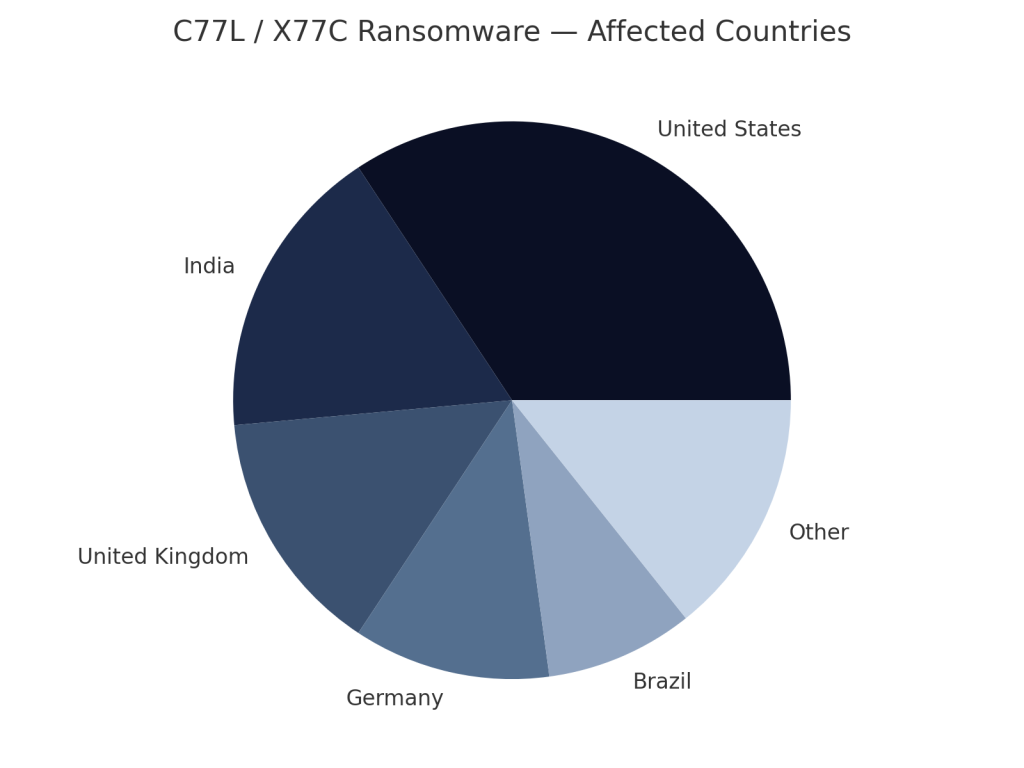
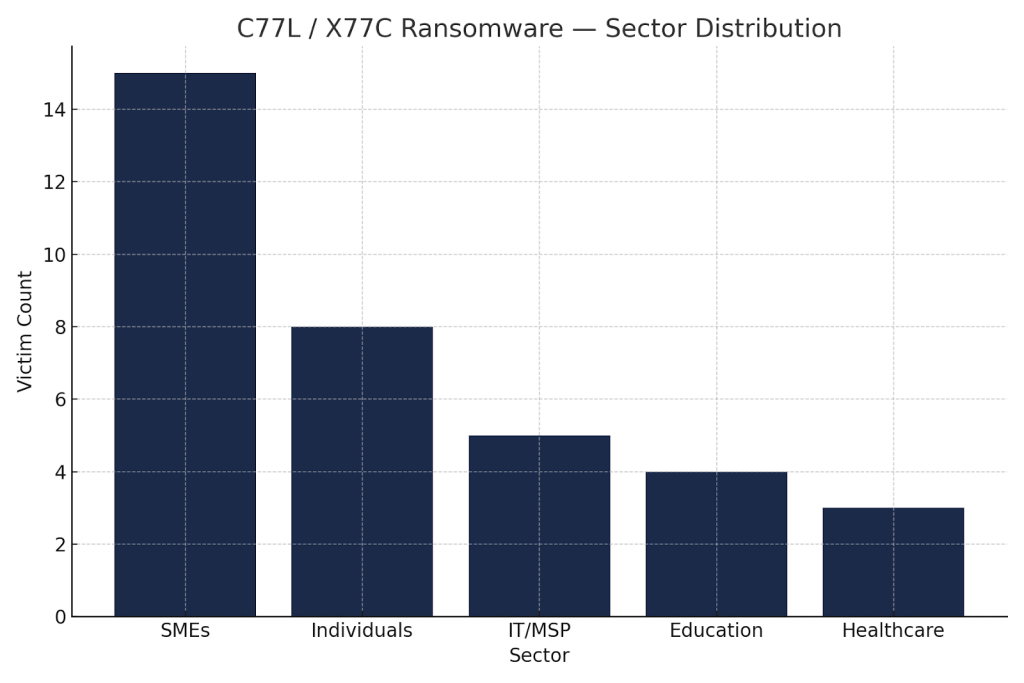
Victim Distribution & Incident Analytics
Although C77L is relatively new, reports indicate:
Geographical distribution:
Sector distribution:
Incident frequency:

Conclusion
If you suspect that your systems have been compromised by the C77L/X77C ransomware family, the most important thing you can do is act with urgency and precision. Begin by isolating any affected machines so that encryption cannot spread to additional systems or shared storage. Preserve every piece of evidence you find, including encrypted samples, ransom notes, logs, and backup snapshots, because these materials play a crucial role in validating the scope of the attack and supporting both forensic and restoration efforts. Notify your leadership team, legal counsel, insurance provider, and relevant authorities so that the incident can be managed responsibly and in alignment with regulatory requirements.
At the same time, engage a qualified incident-response and ransomware recovery provider who understands C77L’s unique characteristics and can guide you through containment, analysis, and secure decryption. Avoid rushing into restoration until you have verified that your backups are clean and unaffected, and resist the temptation to pay the attackers, as payment rarely guarantees a positive outcome and may increase your long-term risk. By following a structured, expert-led response strategy and applying the hardening measures outlined earlier, you dramatically improve your chances of recovering safely while building a more resilient environment against future ransomware threats.
MedusaLocker Ransomware Versions We Decrypt