Ransomware

  • LURK Ransomware Decryptor

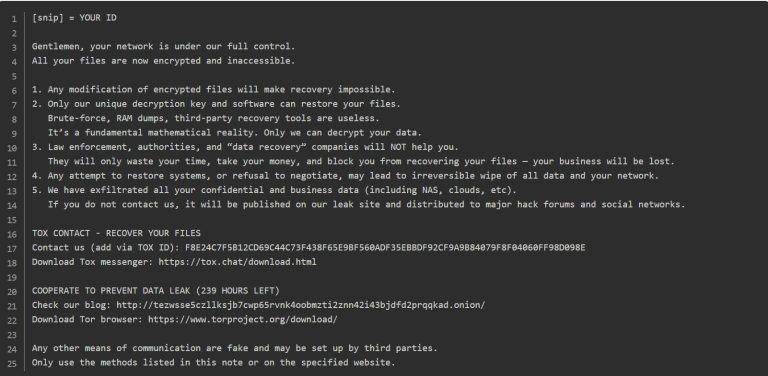
    A new and aggressive ransomware variant, identified as LURK, has been discovered targeting individuals and businesses. Security analysis confirms that LURK is a direct variant of the notorious Sojusz ransomware family, inheriting its cross-platform capabilities and its dangerous ability to target a wide range of storage architectures, including NAS, SAN, and DAS. This malware encrypts…

  • Sojusz Ransomware Decryptor

    A sophisticated and highly adaptable ransomware variant, identified as Sojusz, has been discovered by security researchers. This malware is particularly dangerous due to its cross-platform capabilities, targeting both Windows and Linux environments, and its ability to encrypt data across a wide range of storage architectures, including NAS, SAN, and DAS. The attack is accompanied by…

  • NOCT Ransomware Decryptor

    A NOCT ransomware intrusion often unfolds abruptly. Files that functioned normally moments earlier suddenly fail to open, their icons shift, and their filenames expand to include the unmistakable .NOCT extension. A harmless photo such as 1.jpg becomes 1.jpg.NOCT, confirming that the malware has already encrypted the system’s data. Alongside these file changes, the ransomware typically…

  • Kazu Ransomware Decryptor

    A Kazu attack doesn’t always introduce itself with locked files or malfunctioning systems. In many cases, organizations learn of an intrusion indirectly: a quiet mention on a dark-web leak forum, a sudden appearance on a Kazu-branded Telegram channel, or unexpected alerts that confidential data has begun circulating outside the organization. Sometimes the warning signs surface…

  • Cod Ransomware Decryptor

    A Cod ransomware attack can unfold within moments, disrupting routine operations and leaving users staring at files that no longer open. Documents, spreadsheets, photos, and archives suddenly display unfamiliar naming patterns such as: 1.jpg.[2AF20FA3].[[email protected]].cod This transformation is a hallmark of Cod ransomware, a variant built on the broader Makop family. The altered filename reflects three…

  • Cracker Ransomware Decryptor

    The Cracker (Beast) ransomware family represents a deeply disruptive form of malware designed to destroy workflows, undermine business continuity, and coerce victims into rapid payment. What begins as an ordinary moment on a workstation—a user opening a daily report, synchronizing files, or interacting with a seemingly harmless attachment—can escalate instantly into chaos as familiar documents,…

  • Ripper Ransomware Decryptor

    The Ripper variant, a member of the MedusaLocker family, executes a devastating attack by encrypting files and appending the .ripper12 extension, effectively holding your data hostage. A file like my_contract.pdf become client_contract.pdf.ripper12, and a critical database myimportant.sql is rendered useless as myimportant.sql.ripper12. Beyond encryption, Ripper deploys a READ_NOTE.html ransom note, alters the desktop wallpaper, and…

  • Coinbase Cartel Ransomware Decryptor

    Discovering that your organization has been targeted by a ransomware-style extortion group is a moment that freezes the entire business. Everything feels like it changes at once — your inbox fills with alerts, unexplained activity appears in logs, and suddenly you learn that your company’s name, website, revenue, and internal data have been posted on…

  • C77L .9pf Ransomware Decryptor

    Experiencing a ransomware incident can be deeply unsettling — particularly when vital documents, archives, images, and operational files suddenly become unreadable and display unfamiliar extensions such as: document.pdf.[ID-C4D676C5][[email protected]].9pf This pattern is a clear indicator of the C77L Ransomware .9pf strain, one of several active variants belonging to the X77C/C77L family. Victims typically report discovering entire…

  • LockBit 5.0 .Qw85NsD1yLf27KgM Ransomware Decryptor

    A LockBit 5.0 ransomware attack can instantly paralyze an organization, leaving essential files encrypted with a long, unfamiliar extension such as .Qw85NsD1yLf27KgM. This strain is one of the most technically advanced versions of LockBit ever observed, built to infiltrate networks quietly, bypass authentication controls, extract sensitive information, and encrypt critical systems in a highly coordinated…

End of content

End of content