
3e1f9bae9f Ransomware Decryptor
Cybersecurity analysts have been investigating the .3e1f9bae9f ransomware—a newly surfaced threat believed to be developed or operated under the alias APT47. This variant deploys sophisticated hybrid encryption, exploiting exposed web components and public-facing vulnerabilities.
Once inside, it encrypts user data and appends each file with a distinctive Encryption ID, such as example.docx.3e1f9bae9f, while dropping a ransom instruction file named readme_decrypt_3e1f9.txt in affected directories.
Through a comprehensive cryptographic analysis of these ransom notes and encrypted file samples, our cybersecurity lab has engineered a custom decryptor capable of reconstructing encryption keys using advanced AI-driven pattern analysis and blockchain validation.
The decryptor ensures compatibility with Windows, Linux, and VMware ESXi platforms, delivering consistent, safe, and accurate file restoration without the risk of further compromise.
How the Decryptor Operates
AI + Blockchain Validation
Encrypted files are processed within an isolated sandbox. Here, an AI system performs structural analysis of the ransom note and key fragments, cross-referencing the KEY and IV strings. The blockchain layer validates every decryption event to ensure authenticity and guarantee data integrity.
Encryption ID–Based Key Mapping
Every ransom note displays a unique Encryption ID (for instance, 3e1f9bae9f). The decryptor maps this identifier to a corresponding encryption sequence, rebuilding per-victim cryptographic keys for precise data recovery.
Universal Key Mode
If the ransom note has been deleted or damaged, the universal decryption engine initiates a smart brute-force sequence. It attempts to reconstruct RSA-wrapped AES keys, referencing algorithmic patterns extracted from previous case studies. This is based on an AES-CBC encryption model combined with RSA-2048 key wrapping.
Safe, Read-Only Execution
The decryptor’s first stage is always read-only. It scans, identifies, and logs encryption parameters without altering the encrypted files. Only after full integrity verification does it attempt live decryption.
System Requirements Before You Begin
To ensure safe and efficient decryption, you’ll need:
- A ransom note copy (readme_decrypt_3e1f9.txt)
- At least one sample of both encrypted and original (clean) files
- A stable internet connection for cloud-based verification (for online mode)
- Local or domain administrator privileges for execution
Immediate Response After a .3e1f9bae9f Ransomware Incident
Disconnect the Network Immediately
Unplug infected systems from the network. This ransomware can spread laterally across shared drives, file servers, and mapped network folders.
Preserve Evidence
Retain every ransom note, encrypted file, and log entry. These materials are essential for forensic review, pattern comparison, and potential decryption once a master key is discovered.
Do Not Reboot or Format
Avoid restarting or formatting infected drives. Doing so may activate residual encryption routines or corrupt vital key fragments.
Contact a Professional Recovery Team
Refrain from using unverified “free decryptors” or random tools found on forums. Engage a verified cybersecurity expert familiar with the .3e1f9bae9f (APT47) encryption pattern.
Decrypting .3e1f9bae9f Ransomware and Restoring Files
The .3e1f9bae9f ransomware employs a hybrid cryptographic system, combining AES-CBC for encrypting data blocks and RSA-2048 for wrapping AES keys and IVs.
Because file metadata is completely removed during encryption, traditional recovery software cannot reverse the process.
Our decryptor uses AI key pattern recognition to rebuild partial KEY and IV sequences encoded in the ransom note. When processed through our AI-assisted reconstruction layer, this method can often achieve partial to full data recovery without requiring payment to attackers.
Recovery Options for .3e1f9bae9f Ransomware
Free Recovery Methods
Upload both the ransom note and a single encrypted file to ID Ransomware.
Even if this variant is not yet recognized, submitting your samples contributes to global research and future decryptor updates.
Use clean offline backups if available. Validate backup integrity through checksum comparison before initiating restoration. Off-site or immutable cloud backups offer the safest recovery path.
For environments running VMware, Proxmox, or Hyper-V, revert to pre-attack snapshots. Always verify snapshots for integrity, as ransomware may have attempted deletion or alteration.
Since APT47 exploits Apache Log4j vulnerabilities (CVE-2021-44228, known as Log4Shell), update all Java components to version 2.17 or later and remove the JndiLookup class if patching is not possible.
Paid Recovery Methods
APT47 actors instruct victims to connect through a non-functional onion portal or contact [email protected]. Payment does not ensure a decryptor delivery or guarantee data safety. Many victims report receiving invalid or non-functional tools.
Specialized negotiators may attempt to verify attacker legitimacy and reduce ransom amounts. However, this process is unpredictable, costly, and risky.
Our Proprietary .3e1f9bae9f Decryptor
Reverse-Engineered Core
Our tool was created after analyzing encryption key fragments and IVs extracted from ransom notes. It reconstructs the AES sequence used during encryption, making recovery possible even without contact with attackers.
Cloud Decryption Framework
Encrypted data is processed inside a zero-trust, cloud-isolated environment. Each decryption result undergoes blockchain-backed integrity verification before being returned to the user.
Caution Against Fake Tools
Malicious actors often distribute counterfeit “APT47 decryptors.” These fraudulent programs can steal data or re-encrypt recovered files. Always validate the decryptor’s authenticity before use.
Comprehensive .3e1f9bae9f Recovery Procedure
Identify the Infection
Look for files ending in .3e1f9bae9f and confirm that readme_decrypt_3e1f9.txt is present.
Secure Your Systems
Isolate compromised devices, terminate active sessions, and ensure that any public-facing routes like /ajax/api/ad/replaceAdTemplate are no longer accessible.
Preserve Logs
Document network activity, particularly any communications with the IP 188.214.125.174 or suspicious callbacks to domains like *.398121bf.log.cdncache.rr.nu.
Submit for Analysis
Provide your encrypted samples and ransom note to the recovery team. Our system will analyze encryption identifiers and reconstruct relevant keys.
Decrypt and Verify
Run the decryptor using administrative rights. Enter your unique Encryption ID (3e1f9bae9f) and begin the decryption cycle. The system validates each recovered file for consistency before writing output.
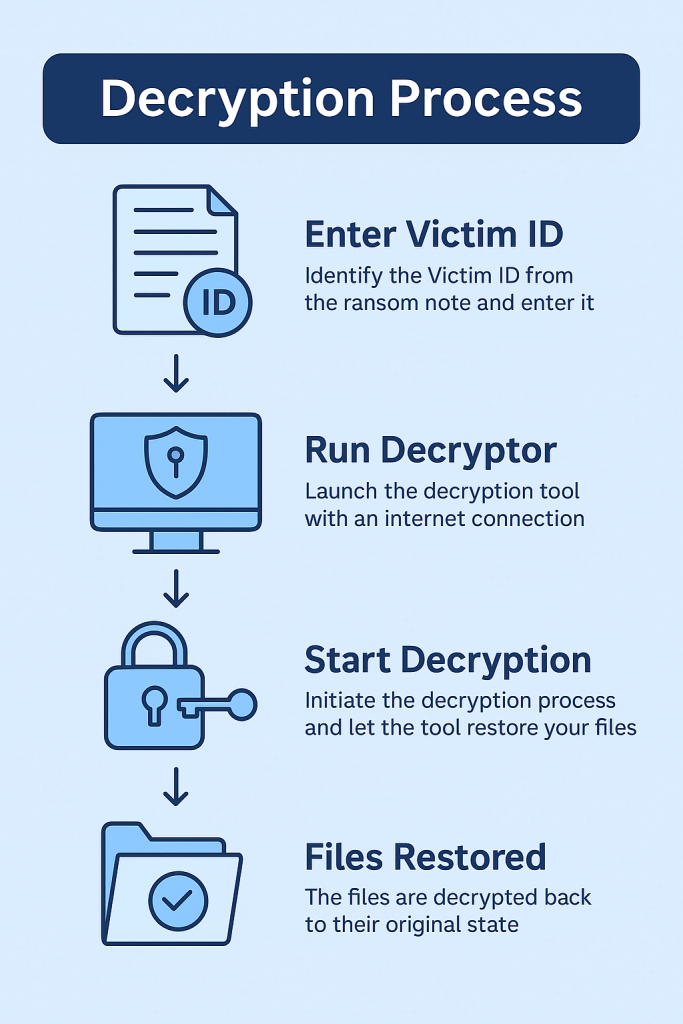
Offline vs. Online Decryption
| Mode | Description | Best Use Case |
| Offline | Operates locally with pre-trained AI key models. No internet required. | Air-gapped or classified systems |
| Online | Cloud-enabled verification and blockchain-backed logging. | Corporate networks requiring compliance records |
Understanding the .3e1f9bae9f / APT47 Ransomware
The .3e1f9bae9f ransomware, attributed to the pseudonymous APT47 group, first appeared in October 2025. It uses AES-CBC + RSA-2048 encryption, removes all file metadata, and leaves a customized ransom note with embedded encryption parameters.
Technical Summary
| Attribute | Details |
| Extension | .3e1f9bae9f |
| Ransom Note | readme_decrypt_3e1f9.txt |
| Encryption Scheme | AES-CBC for file content, RSA-2048 for key wrapping |
| Communication Channel | Expired .onion portal / ProtonMail ([email protected]) |
| Initial Access Vector | Log4Shell vulnerability (CVE-2021-44228) |
| Observed Source IP | 188.214.125.174 |
| Callback Domains | *.398121bf.log.cdncache.rr.nu |
| File Metadata | Removed entirely |
| Threat Actor Branding | “Ransomware Made by APT47” |
| First Reported | BleepingComputer forum (October 2025) |
MITRE ATT&CK Technique Mapping
| Technique ID | Tactic / Description | Activity Observed |
| T1190 | Exploit Public-Facing Applications | Log4Shell exploit via /ajax/api/ad/replaceAdTemplate |
| T1083 | File and Directory Discovery | Scanning /druid/, /nacos/, .git/, .svn/ |
| T1059 | Command & Scripting Interpreter | JNDI-based remote code injection |
| T1048 / T1567 | Data Exfiltration via Web Services | Outbound callbacks to cdncache.rr.nu domains |
| T1486 | Data Encrypted for Impact | AES-CBC encryption process |
| T1560 | Archive Collected Data | Packaging of exfiltrated content |
| T1553 | Subvert Trust Controls | Use of obfuscation and encoded payloads |
Known Indicators of Compromise (IOCs)
| Type | Value |
| File Extension | .3e1f9bae9f |
| Ransom Note | readme_decrypt_3e1f9.txt |
| Infection Source IP | 188.214.125.174 |
| C2 Domains | *.398121bf.log.cdncache.rr.nu |
| Exploit Payloads | ${jndi:ldap://…} / ${jndi:rmi://…} |
| Artifacts Found | /ajax/api/ad/replaceAdTemplate, /nacos/v1/console/server/state |
| Threat Alias | “APT47” |
Preventive and Defensive Measures
- Patch Log4j to 2.17+ and remove the JndiLookup class.
- Limit outbound traffic to unknown domains and block .rr.nu destinations.
- Deploy WAF rules to block ${jndi: injection attempts.
- Enforce MFA on RDP and administrative accounts.
- Segment network zones to restrict lateral movement.
- Monitor for LDAP/RMI anomalies in network traffic.
- Maintain offline, immutable backups for critical data.
Inside the Ransom Note
Excerpt from readme_decrypt_3e1f9.txt:
######################################################################################
# Encryptions ID : 3e1f9bae9f #
# KEY : alR2PixUDVmiTcEa2LYXVsFSBRWFhY3x6UiPTCTW6YFUfBG4cW+eiB0lRpasxXGp
EEc+LzJ1JyNAXs3KRD/hhNB3L1KxJ9/Pbo9DaOw5Rxn+H5bmb+uJGugTHZIa/QAr
Le7oqyG/avbV+5H3Aefg6ShVA4PFk+52jK7kD8zviwVygZxFa3e7++Nbt1pjEKT+
GPdYqlNwC1A3/uwaGhm8uIc0rmwqEnwCjUUPDGCMxdAXoWIzv0G3AvDC+2046FcX
eHgGzHuLGEFxl/N+GR8+lxdjOZSRtK+j0xgrWi/Am5u+NOoTa40tyXeijxvlQ/ae
4MTud24K2qZxBhV7cPzy6w== #
# IV : EjsyePPZStV4NFOC/y+H4GVk0OxBhb9WVODHdktG4fY3DhOaSQo6KC6TrESavfkw
0HhFY6LlNLdeQaptf9mJOfqV6TbAKKrHJS0xzwCLY6vcSnjTWcPweIAjxVTggNoL
N90n3zDPpTjha1+j/iR5rjPJad2+nVRbsX87gKSKuVYv8ZkiQ2a5Bjhxj+fDPB1V
rpJbpU+qpd5fzgvyxxhW6t7g8Wqqom9FjVOh1i8GXs4sJRHkauq0tkHC9fp2WhZh
2tJW46vJLiNwh2x1rq3gPpZgW7RM4bkf11RV1Xwg5gunigniVrv2mml+m3Lkys+j
QfegQhBF+sLVfoNNWXZ0Ig== #
# #
# You have been hacked by APT47 #
# #
# All your files have been encrypted. #
# #
# #
# To restore access, you can contact us by email on the onion site #
# #
# Website:
# #
# #
# Contact us for price and purchase our decryptor software #
# #
# Use Tor browser for access .onion websites. #
# Download and install Tor browser at:
# #
# #
# #
# Ransomware Made by APT47 #
######################################################################################
This ransom note includes Base64-encoded KEY and IV blocks, indicating per-victim encryption. The onion portal referenced by the attackers is currently inactive, making direct negotiation impossible.
Conclusion
The .3e1f9bae9f ransomware represents a developing hybrid cryptolocker threat, but the discovery of its cryptographic structure offers optimism for decryption without ransom payments.
With careful evidence handling, professional key reconstruction, and AI-powered decryptors, most victims can achieve safe data restoration and resume normal operations.
Stay vigilant, verify any decryption utility before use, and rely on certified experts for secure recovery. Our APT47 Decryptor Suite continues to evolve to address future variants and improve recovery success rates.
MedusaLocker Ransomware Versions We Decrypt