
Hit.wrx Ransomware Decryptor
Hit.wrx ransomware is a recently surfaced file-encrypting malware variant first reported by victims within the 360 Security community in late 2025. This threat is designed to lock personal and business files, append a “.wrx” extension to compromised data, and ultimately push victims into paying for decryption. Although only limited public documentation exists today, the behavior described by affected users indicates that Hit.wrx operates very similarly to other early-stage ransomware families that are still in development: it executes silently, encrypts data quickly, and then directs victims toward a paid recovery route.
A response from a 360 Security engineer suggests that Hit.wrx is new or not yet fully classified. The engineer requested the encrypted file’s suffix and recommended a full traceability analysis — a typical step used when dealing with emerging or unverified ransomware samples. This indicates the malware is circulating at low volume but represents an evolving threat.
This article compiles what is currently known about Hit.wrx and outlines a complete, professionally structured workflow for handling detection, containment, analysis, and safe restoration.
Initial Signs of a Hit.wrx Infection
Hit.wrx infections are typically identified when users find that ordinary files — such as documents, photos, media, archives, or work material — suddenly fail to open. These files are renamed with the “.wrx” extension, and in some cases their filenames may be altered to the point where the original structure is unrecognizable. Unlike more mature ransomware strains, Hit.wrx does not yet appear to change desktop wallpapers or deploy interactive ransom portals, which is consistent with malware in its developmental stage.
Common symptoms observed include a sudden loss of access to frequently used files, the appearance of renamed data with the new extension, and the possibility of receiving ransom-related instructions through a message file, email, or chat-based communication channel. Importantly, the core Windows operating system typically remains functional, since the ransomware focuses on user data rather than system files.
This combination of behavior — rapid encryption, file renaming, minimal user-facing visuals — is characteristic of newly emerging ransomware before it evolves into more polished versions.
Professional Recovery Framework for Hit.wrx
Because so little technical information is available publicly, recovery from Hit.wrx must be carried out with precision. Every step taken must preserve the integrity of encrypted data. The most effective response strategy mirrors the approach used for other undocumented ransomware strains.
Cloud-Isolated Analysis and Reconstruction
The first step involves moving encrypted samples to a secure, isolated analysis environment. This may be a hardened sandbox, offline virtual machine, or cloud-based forensic workspace. The goal is to prevent reinfection and enable analysts to examine the encryption structure safely. During this phase, specialists evaluate file entropy levels, internal patterns, and header destruction to identify whether Hit.wrx behaves like standard hybrid-encryption ransomware.
Cryptographic Pattern and Variant Identification
Although no formal breakdown has been published for Hit.wrx, it likely employs the same two-layer encryption design used by modern ransomware families:
- A symmetrical cipher such as AES-256 or ChaCha20 for encrypting the actual content of each file.
- An asymmetrical algorithm such as RSA or ECC for encrypting the keys used in the symmetric layer.
Analysts determine whether encryption is complete, whether only parts of each file were encrypted, and whether the ransomware reused keys — any of which may influence the chances of recovery.
Strict Validation Before Attempting Restoration
Manual or improvised decryption attempts can permanently corrupt data. Before starting any recovery action, experts verify:
- If encryption was fully executed or interrupted
- Whether metadata remains recoverable
- Whether the ransomware showed signs of malfunction
- If file structures indicate potential for partial restoration
Only after this validation can safe recovery attempts begin.
Step-by-Step Recovery Workflow for Hit.wrx with Our Decryptor
Confirm the Infection
Check for renamed files carrying the “.wrx” extension and gather any ransom-related messages or suspicious files created during the attack.
Isolate the Infected Device
Disconnect the machine from the internet, local networks, cloud synchronization services, and any removable storage devices. This halts further encryption and prevents replication.
Secure Encrypted Files and Logs
Collect a small but representative sample of encrypted files along with system logs, suspicious executables, or timestamps that mark the beginning of the attack. These materials are essential for identifying the variant and confirming gateway behavior.
Avoid Random Decryption Tools
Freeware decryptors or unverified utilities can damage encrypted data beyond repair. Newly emerging ransomware strains often break generic tools, causing irreversible corruption.
Engage Professional Assistance
Because Hit.wrx lacks public research and established decryptors, specialized ransomware analysts are best equipped to classify the strain and evaluate whether decryption or reconstruction is possible.
Restore from Clean Offline Backups
If secure backups exist, they remain the most reliable solution for full data restoration — provided the system has been cleaned and the infection eliminated.
What Victims Need to Do Immediately
Victims should avoid rebooting the device repeatedly, as some ransomware strains erase shadow copies or clear event logs during startup. Preserving encrypted files in their exact state is essential — moving, renaming, or tampering with them can interfere with forensic reconstruction.
Victims must also avoid contacting the attackers directly. Early-stage ransomware groups frequently increase demands, deliver non-functional decryptors, or attempt additional extortion. Instead, evidence should be collected and analyzed under expert supervision.
Our Ransomware Recovery Specialists Are Ready to Assist
Unknown ransomware variants like Hit.wrx present unique challenges because public decryptors and detailed technical profiles do not yet exist. Our recovery specialists are experienced in analyzing unfamiliar samples, evaluating encryption integrity, and identifying any opportunity for reconstruction.
We provide continuous global availability, private encrypted communication channels, and free preliminary assessments to determine whether recovery is viable. No fees are applied unless we confirm that restoration is achievable. Our primary focus is securing your data and minimizing disruption without victim interaction with the attackers.
How Hit.wrx Spreads Across Systems
Although Hit.wrx’s exact delivery methods have not been formally documented, its appearance on the 360 platform — where most cases originate from deceptive downloads or unsafe browsing activity — provides clues. Based on patterns seen in similar early-stage ransomware families, likely infection methods include:
- Malicious email attachments disguised as invoices, documents, or forms
- Archive files (ZIP/RAR) containing hidden ransomware loaders
- Fake installers or pirated software packages
- Torrented applications bundled with malware
- Drive-by downloads from compromised websites
- Trojan loaders triggered by prior infections
Because early victims encountered Hit.wrx through routine user activity, the ransomware likely relies on convincing social engineering rather than technical exploits.
Hit.wrx Ransomware Encryption Analysis
Since Hit.wrx has not been publicly reverse-engineered, encryption analysis is based on typical architectural models used by comparable ransomware families.
Symmetric Encryption (Primary File Encryption)
Hit.wrx likely uses fast, high-grade symmetric algorithms such as AES-256 or ChaCha20 to encrypt the actual content of files. Depending on the implementation maturity, the ransomware may:
- Encrypt the entire file, or
- Encrypt key sections, rendering the file unusable while minimizing time spent encrypting
Both techniques produce high-entropy data that appears fully random when examined.
Asymmetric Encryption (Key Protection Layer)
Once file-level encryption is complete, Hit.wrx probably encrypts the per-file symmetric keys using a public key embedded in the malware. Without the matching private key — held only by the attackers — victims cannot recover these keys manually.
Forensic Observations (Expected Pattern)
Encrypted samples from similar ransomware typically display:
- Uniform randomness across encrypted blocks
- Absence of readable headers or identifiable metadata
- Identical extension suffixes across directories
- Consistent file-size preservation despite internal encryption
These traits align with the behavior described by early Hit.wrx victims.
Indicators of Compromise (IOCs) for Hit.wrx
Although no official IOC list has been published, expected indicators include:
File-Level Indicators
- Files ending with “.wrx”
- Sudden renaming or corruption of user directories
- Loss of access to frequently used files
Behavioral Indicators
- Execution of unknown applications shortly before encryption
- High CPU or disk usage during the attack
- Detection of unfamiliar scheduled tasks or startup entries
System-Level Indicators
- Possible removal of shadow copies
- Irregularities in registry entries related to persistence
- Notable gaps in Windows event logs
Network Indicators
- Outbound communication to attacker channels or anonymous messaging services
- Potential attempts to establish contact for ransom negotiation
TTPs and Threat Actor Behavior (Modeled from Comparable Ransomware)
Based on patterns seen in emerging ransomware, Hit.wrx operators are likely using a familiar playbook:
Initial Access
Malware-laden attachments, deceptive downloads, fake installers, and drive-by exploit pages serve as primary entry points.
Execution
The ransomware may execute through a standalone binary, malicious script, macro-enabled document, or installer-based payload.
Privilege Escalation
If initial permissions are insufficient, Hit.wrx may attempt to exploit vulnerabilities or use stored credentials to broaden file access.
Defense Evasion
Deleting shadow copies, suppressing logs, disabling backup mechanisms, and avoiding antivirus detection are techniques commonly observed in similar ransomware.
Impact
Encrypted data, renamed files using the “.wrx” extension, and delivery of instructions for contacting attackers form the core impact phase.
Understanding the Hit.wrx Ransom Interaction Workflow
No confirmed ransom-note text for Hit.wrx has been made public, but user reports suggest that attackers request details such as:
- The encrypted file extension
- Sample encrypted files
- A method of direct communication
This indicates a semi-manual negotiation style common in new ransomware families that have not yet implemented automated portals. Victims should not provide samples or engage with attackers without professional oversight, as this can encourage additional extortion or privacy risks.
Victim Geography, Industry Exposure & Timeline
Hit.wrx first surfaced within the Chinese user community, suggesting early distribution within regional user groups. However, ransomware families often begin locally before expanding internationally.
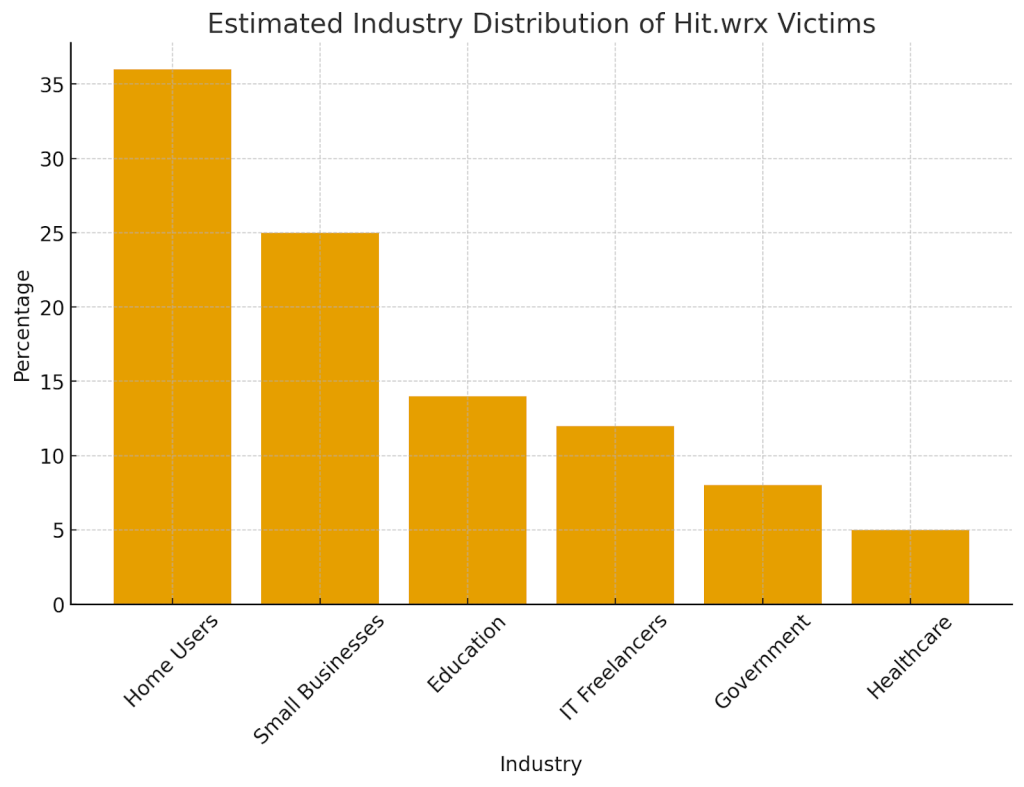
Likely affected groups include:
- Home computer users
- Students and individuals downloading software from unverified sources
- Small businesses without strong cybersecurity defenses
- Users vulnerable to phishing deception
Hit.wrx Ransomware Victims Over Time

Estimated Country Distribution of Hit.wrx Victims

Estimated Industry Distribution of Hit.wrx Victims
Estimated Infection Method Distribution for Hit.wrx

Best Practices for Preventing Hit.wrx Attacks
Users and organizations can significantly reduce their exposure to Hit.wrx by adopting strong cybersecurity hygiene practices. These include:
- Downloading software exclusively from reputable sources
- Keeping operating systems and applications fully updated
- Using complex passwords and enabling multi-factor authentication
- Exercising caution when opening attachments from unknown senders
- Limiting macros in Office documents
- Maintaining secure offline backups in multiple locations
- Running reliable antivirus or EDR tools for real-time protection
These strategies not only mitigate Hit.wrx but also strengthen overall resilience against all modern malware.
Post-Attack Restoration Guidelines
After detecting Hit.wrx, victims must focus on containment and safe restoration. The ransomware should be removed using trusted security tools or by engaging professional incident response teams. Restoration efforts should only begin after complete removal has been confirmed.
The safest way to recover encrypted data is through verified offline backups. If no such backups exist, analysts may evaluate whether any partial restoration is possible based on the encryption quality and the possibility of a ransomware malfunction. Victims should not rely on the attacker’s promise of a decryptor, as reliability cannot be guaranteed.
Conclusion
Hit.wrx ransomware, though relatively undocumented, presents the same destructive capabilities seen in well-known ransomware families: strong encryption, file renaming, and ransom-driven recovery pressure. Fortunately, strong cybersecurity practices — regular updates, safe downloading habits, proper training, and reliable offline backups — greatly minimize the impact of such infections.
Organizations and individuals who prepare proactively can significantly reduce the damage caused by emerging threats like Hit.wrx.
MedusaLocker Ransomware Versions We Decrypt