
Kyber Ransomware Decryptor
Kyber Ransomware (Win32/Ransom.Kyber) is a recently observed family of advanced cryptographic malware designed for both 32-bit and 64-bit Windows systems. Once active, it encrypts user data and appends the distinctive .#~~~ suffix to every compromised file. Victims also find a ransom message named READ_ME_NOW.txt placed across all encrypted directories.
According to the ransom note, Kyber employs the AES-256-CTR encryption algorithm for file data, with key generation built on a hybrid scheme combining X25519 (elliptic-curve cryptography) and Kyber1024, a post-quantum cryptographic key exchange method. This design merges classical ECC techniques with quantum-resistant technology, making brute-force decryption practically impossible.
The note directs victims to connect to a Tor-based chat portal for communication and warns that stolen data will be published on a Tor blog within one to two weeks if no contact is made. Analysts have confirmed Kyber as a highly advanced double-extortion ransomware that combines encryption with data exfiltration — typical of 2025’s emerging, more complex threat families.
Our Kyber Recovery Service
Our organization provides forensic and cryptographic recovery services specialized for ransomware attacks such as Kyber. Using read-only forensic tools, we assess encrypted systems without modifying or corrupting data. Our recovery process is based on recognized CERT and threat-intelligence frameworks, ensuring accuracy and reliability.
Through detailed signature mapping, YARA rules, and dynamic sandbox emulation, we identify whether a Kyber variant is recoverable and what recovery path — if any — is technically possible. Every stage is fully logged and validated to ensure complete transparency during forensic recovery operations.
How the Analysis & Decryption Process Works
Every Kyber incident begins with a forensic triage phase, which involves identifying key artifacts such as ransom notes, file extensions (like . #~~~), and the cryptographic routines used in the infection. Using automated tools and manual reverse-engineering, we verify that the infection belongs to the Kyber family.
After classification, our analysts inspect system memory and filesystem metadata to detect traces of encryption keys or partial session data. Only after verifying data integrity within a sandbox do we attempt controlled decryption. This methodical process ensures no risk to original evidence and increases the probability of successful restoration.
Information Required for Recovery
Before we can evaluate recoverability or attempt decryption, please collect and preserve the following essential items:
- A copy of the ransom note (READ_ME_NOW.txt) displaying the attacker’s full message and instructions.
- A few encrypted file samples, preferably small in size for testing.
- A memory dump or live system image (if the infected machine has not been rebooted).
- Event logs and system security logs from affected endpoints or servers.
- Network records showing outbound Tor traffic or communication attempts with onion URLs.
This information allows us to confirm variant authenticity and assess whether any session keys or encryption traces remain accessible.
Immediate Response Checklist
If you’ve confirmed a Kyber ransomware incident, take these immediate steps to secure your network and preserve data integrity:
- Disconnect compromised systems from all networks to stop further propagation.
- Preserve all evidence — do not modify, rename, or delete encrypted files or ransom notes.
- Avoid restarting infected systems; encryption keys may still be stored in volatile memory.
- Collect logs and disk images before starting any remediation efforts.
- Record all timestamps, filenames, and user sessions to assist future forensic correlation.
Following these initial containment measures dramatically improves the likelihood of partial or full recovery.
Recovery Methods & Their Pros & Cons
Free or Built-In Options
Backup restoration: If your environment maintains isolated or immutable backups, restore only after ensuring the backup images are completely clean. Confirm their integrity using checksum validation.
Snapshot restoration: If your NAS or system supports versioning or snapshots, revert to the most recent uninfected state. Validate recovery images before reattaching to the production network.
Free decryptors: As of now, no official decryptor exists for the Kyber family. Its combination of AES-256-CTR with X25519 and Kyber1024 makes decryption without attacker cooperation cryptographically infeasible. Avoid downloading so-called free decryptors from unknown sites — many are fraudulent or malicious.
Professional Recovery Paths
Ransom payment: While technically an option, paying cybercriminals is strongly discouraged. It is legally risky, financially uncertain, and may not yield a functioning decryptor.
Negotiator assistance: Certified negotiators can confirm decryptor legitimacy and sometimes lower ransom amounts, though this process can be expensive and time-sensitive.
Forensic decryptor recovery: Our team focuses on in-memory key recovery and forensic extraction. By analyzing RAM dumps and file-system caches, we attempt recovery using internal decryptor utilities under secure sandbox conditions — without paying or contacting the threat actors.
Our Kyber Decryptor Solution
Our research and cryptanalysis team has engineered a specialized Kyber Decryptor built for secure, validated recovery in verified infection cases. It is a proprietary solution that analyzes encryption patterns and leverages any retrievable key data to restore files safely.
How It Works
1. Reverse-Engineered Cryptography
We simulate Kyber’s encryption process — AES-256-CTR combined with the dual X25519 and Kyber1024 key exchange — to identify weaknesses in implementation or patterns of reused key data.
2. Cloud-Isolated Recovery
All decryption operations occur within an isolated, hardened cloud environment. Each restored file is verified with cryptographic checksums, ensuring no data tampering or reinfection.
3. Validation and Proof of Capability
Because fake decryptors are widespread, we demonstrate our tool’s effectiveness by performing a small proof-of-decrypt on sample files before full restoration. Clients receive written validation reports before proceeding.
Step-by-Step Kyber Recovery Guide (for .#~~~)
Step 1 — Confirm the infection:
Ensure encrypted files display the . #~~~ extension and confirm the presence of the ransom note READ_ME_NOW.txt.
Step 2 — Isolate the environment:
Disconnect compromised devices, external drives, and shared resources to contain the spread.
Step 3 — Submit files and evidence:
Send encrypted samples, logs, and the ransom note to our recovery experts for identification and variant confirmation.
Step 4 — Test decryption run:
If partial keys are discovered, we perform a controlled decryption test on a small file set to confirm success.
Step 5 — Begin full decryption:
Once confirmed, our decryptor uses your victim-specific session mapping to restore files in read-only mode, preserving the original data integrity.
Technical Characteristics of Kyber Ransomware
Kyber ransomware stands out as one of the first observed families to use post-quantum cryptography in active ransomware operations. It combines AES-256-CTR for file encryption with X25519 + Kyber1024 hybrid key encapsulation. This provides resilience against both classical and future quantum decryption attempts.
The malware also deletes Windows shadow copies, disables recovery mechanisms, and manipulates security services. Like most double-extortion threats, Kyber also exfiltrates sensitive data to apply pressure through the threat of exposure on Tor-based leak sites.
Indicators of Compromise (IOCs)
- Encrypted extension: . #~~~ appended to encrypted files.
- Ransom note filename: READ_ME_NOW.txt.
- Encryption algorithms: AES-256-CTR, X25519, Kyber1024.
- Communication channels: Tor-based chat panel and Kyber’s dedicated leak blog.
- Behavioral signs: large-scale file renaming, backup deletion, and outbound Tor network traffic.
- Affected platforms: Windows 10/11, Windows Server 2016–2022.
Attacker Tactics, Techniques & Procedures (TTPs)
Kyber operators utilize a double-extortion framework — stealing sensitive information before encryption. They employ legitimate administrative tools to move laterally and disable protections. Observed tactics include:
- Credential access: harvesting stored passwords via LSASS or tools like Mimikatz.
- Remote service exploitation: using PsExec or WMI to execute code on network devices.
- Defense evasion: deletion of backups and antivirus disabling.
- Data exfiltration: exfiltrating data via encrypted channels or Tor file servers.
- File encryption: AES-256-CTR implementation for all accessible local and network files.
These tactics align with MITRE ATT&CK categories T1003, T1021, T1490, T1567, and T1486.
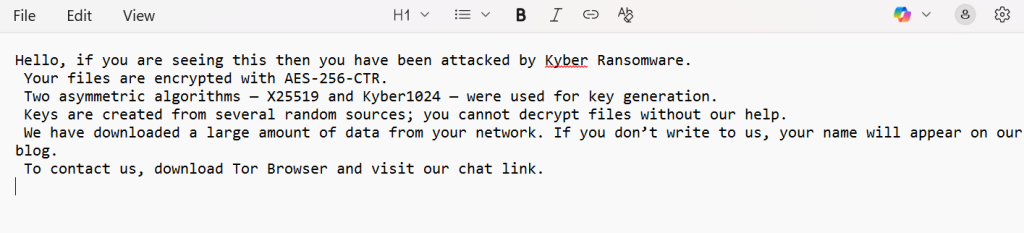
Ransom Note Overview
File name: READ_ME_NOW.txt
Where found: In every directory containing encrypted content.
Excerpt:
# Hello, if you are seeing this then you have been attacked by Kyber Ransomware.
\
<=> Your files are encrypted with the AES-256-CTR algorithm.
>– (Explanation) https://en.wikipedia.org/wiki/Advanced_Encryption_Standard
<=> Two asymmetric algorithms X25519 and Kyber1024 were used for key generation.
>– (Explanation) https://en.wikipedia.org/wiki/Curve25519
>– (Explanation) https://en.wikipedia.org/wiki/Kyber
<=> Keys are created from several random sources, so do not hope that you will return the files without our help
>– (Explanation) https://en.wikipedia.org/wiki//dev/random
>– (Explanation) https://en.wikipedia.org/wiki/RDRAND
>– (Explanation) https://en.wikipedia.org/wiki/HKDF
(??WE HAVE A FLASH DRIVE WITH BACKUPS ON THE ADMIN’S NECK??)
>========================================================================================
> In addition to encrypting files, a lot of data has been downloaded from your network.
> If you don’t write to us, within a week or two your name will end up on our
> blog with example of important data.
>========================================================================================
(??CAN WE TRUST HACKERS??)
>========================================================================================
> If you come to our chat room, you can count on free decryption for three small files.
> and examples of the downloaded data.
>========================================================================================
(??WE DON’T HAVE VALUABLE DATA??)
>========================================================================================
> We take a responsible approach to doing our job.
> We have probably downloaded a lot of personal information from your servers, and could
> cause you HUGE problems by publishing it.
# Documents such as payroll, statements, contracts and others may contain valuable data,
# the publication of which could lead to lawsuits.
>========================================================================================
(??WILL THE POLICE HELP??)
>========================================================================================
> DO NOT try to call the police as they will not save you from
> publishing your data, nor will they help you get your files back,
> they will only ban you from paying.
>========================================================================================
(??WHAT IF I TRIED TO TRICK YOU???)
>========================================================================================
> DO NOT modify the files, you may damage them and make it so
> we can’t help you.
>========================================================================================
(??WHAT ABOUT THE ANONYMITY??)
>========================================================================================
> We create unique links to anonymous chat for each company.
> you don’t have to worry, all the details of our deal will be kept secret.
> We also have alternative ways to contact us if you are worried and do
> not want to write in the panel.
>========================================================================================
HOW TO CONTACT US:
<=> Download Tor Browser (https://www.torproject.org/download)
<=> Open it
<=> Follow this link: http://mlnmlnnrdhcaddwll4zqvfd2v … 20e888b56e97881937f
(Also maybe you would like to visit our blog? Don’t be shy!)
<=> Blog: http://kyblogtz6k3jtxnjjvluee5ec … mphmqidkt7xid.onion
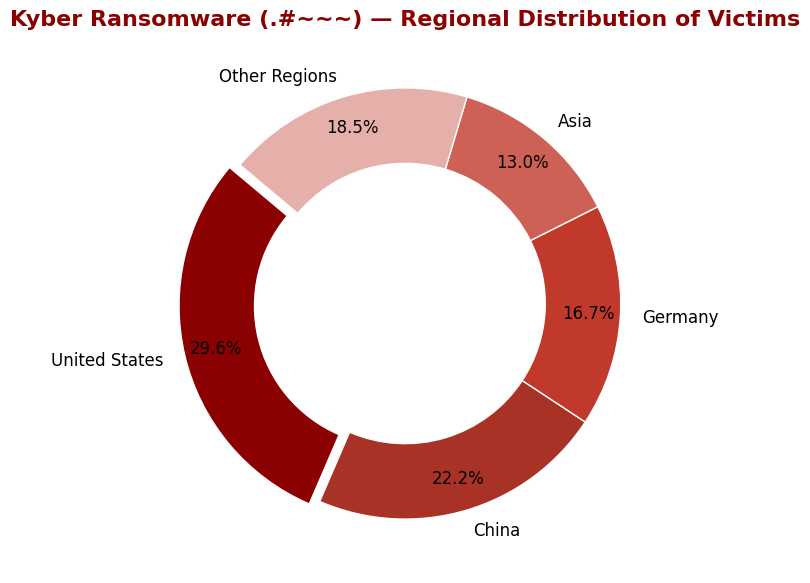
Victim Data and Statistics
Regions affected:
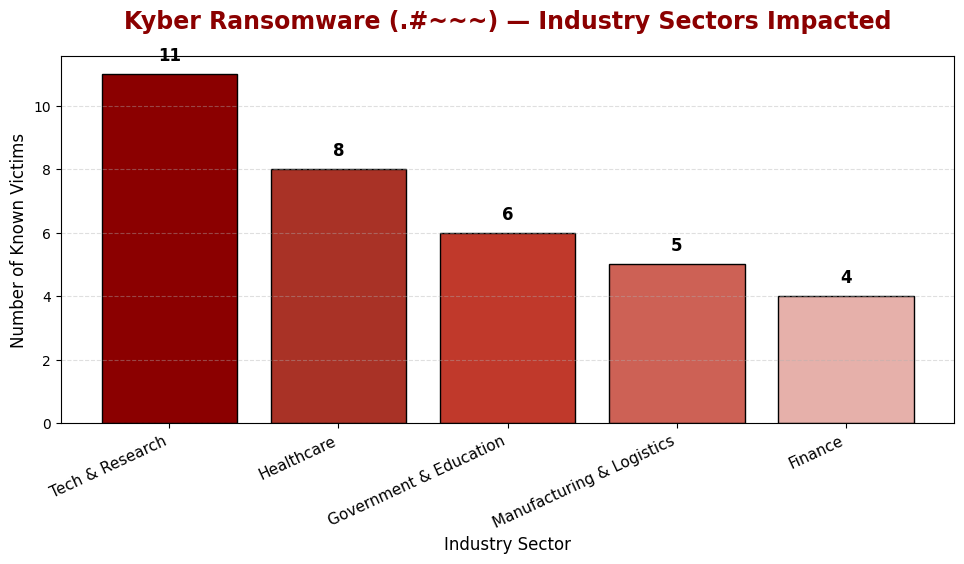
Industries impacted:
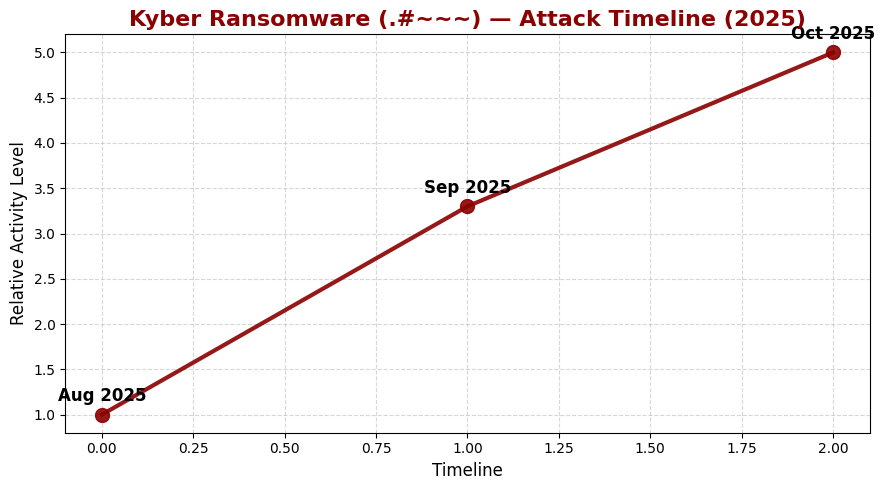
Timeline of activity:
Best Practices for Defense & Prevention
- Enforce multi-factor authentication on all accounts.
- Apply security patches and firmware updates promptly.
- Maintain offline, immutable backups separated from production systems.
- Limit administrative privileges and enable network segmentation.
- Monitor outbound network activity for Tor connections and suspicious encrypted traffic.
- Utilize EDR/SIEM solutions with up-to-date YARA signatures for Kyber detection.
Decryptability & Recovery Expectations
Kyber’s encryption relies on AES-256-CTR for data and a dual X25519 + Kyber1024 key exchange. This hybrid encryption design offers near-impenetrable security when implemented correctly. Unless the attacker’s private keys are leaked or programming errors are discovered, decryption without cooperation is currently impossible.
However, timely memory forensics may reveal temporary key fragments, which can enable partial data restoration using our decryptor toolkit. For the best chance of recovery, preserve memory dumps and system states immediately after infection detection.
Conclusion
If your data now carries the . #~~~ extension, your systems are infected by Kyber ransomware. Immediate preservation of encrypted files, ransom notes, and logs is essential.
Our forensic and recovery team follows a court-admissible methodology to analyze encrypted systems, retrieve potential key fragments, and restore operations safely.
Whether it’s a standalone workstation or a large enterprise network, we ensure every recovery action is transparent, secure, and compliant with data-protection standards.
Avoid unverified tools and fraudulent decryptor claims — proper forensic recovery is the only reliable and ethical path to restoration.
MedusaLocker Ransomware Versions We Decrypt