
PANDA Ransomware Decryptor
PANDA Ransomware Decryptor – Best Recovery Tool & Free Alternatives (2024)
What is PANDA Ransomware?
PANDA ransomware is a type of malicious software that encrypts files on infected systems and demands a ransom in exchange for the decryption key. It typically alters file extensions to .panda and leaves a ransom note containing payment instructions. Its targets include personal users, enterprises, and especially critical infrastructure systems.
Origin and Evolution
Initially emerging as part of a broader ransomware-as-a-service (RaaS) ecosystem, PANDA has evolved to incorporate complex encryption techniques and advanced obfuscation methods. Variants have been known to exploit vulnerabilities in both Windows servers and VMware ESXi environments.
Recent Case Studies
In early 2024, a prominent financial institution in Southeast Asia fell victim to PANDA, leading to several days of operational paralysis. Analysts discovered that the attackers gained entry via an unpatched Remote Desktop Protocol (RDP) port.
PANDA Ransomware Decryptor Tool Overview
What is the PANDA Decryptor Tool?
The PANDA Decryptor Tool is a specialized utility developed to reverse the encryption inflicted by PANDA ransomware. It offers a way to restore access to critical files without making ransom payments.
Compatibility and Supported Systems
This tool works across multiple platforms, including Windows operating systems, QNAP devices, and virtual environments running VMware ESXi. It supports recovery for files with the .panda extension and related variants.
Unique Features
- Connects to secure online servers for decryption
- Does not require ransom payments
- Optimized for speed and data safety
Key Features of the PANDA Decryptor Tool
Targeted File Decryption
The tool is engineered specifically to decrypt files altered by PANDA ransomware, ensuring high accuracy and file integrity.
Secure and Safe Recovery
By leveraging encrypted server communication and read-only operations during decryption, the tool maintains data safety throughout the process.
User-Friendly Design
With an intuitive interface, the tool is usable by both IT professionals and general users. Clear prompts and automated steps reduce the learning curve.
Refund Policy
A money-back guarantee is offered if the tool fails to recover your files, showcasing a strong commitment to customer satisfaction.
How to Use PANDA Ransomware Decryptor
System Requirements
- Windows OS (Administrator Access)
- Stable internet connection
- Ransom note to retrieve Victim ID
Step-by-Step Guide
- Purchase the Tool: Contact the vendor via WhatsApp or email.
- Launch as Administrator: Right-click and run with admin privileges.
- Enter Victim ID: Extract this from the ransom note.
- Start Decryption: Click “Start” and let the tool run until recovery completes.
Common Mistakes to Avoid
- Disconnecting the internet during the process
- Entering incorrect Victim ID
- Running without administrative privileges
PANDA Ransomware vs VMware ESXi
How It Infects Virtual Environments
PANDA ransomware exploits known vulnerabilities in VMware ESXi systems, targeting the virtual machines hosted on them.
Encryption Techniques
It uses RSA (asymmetric) and AES (symmetric) encryption methods to lock files in the ESXi environment.
Real-World Impact
- Total downtime of hosted services
- Loss of customer access portals
- Significant recovery costs and data restoration challenges
PANDA Ransomware vs Windows Servers
Infection Tactics on Windows
The malware often infiltrates systems via phishing, weak credentials, or outdated software. Once inside, it escalates privileges and begins encrypting key directories.
Common Vulnerabilities
- Open RDP ports
- Outdated Windows Server versions
- Weak Active Directory policies
Consequences and Mitigation
- Downtime of CRM and ERP systems
- Delayed communications
- Recommended: Harden RDP access and patch vulnerabilities regularly
Identifying a PANDA Ransomware Infection
Visual and Technical Symptoms
- Files renamed with .panda extension
- Ransom notes such as README.txt appear
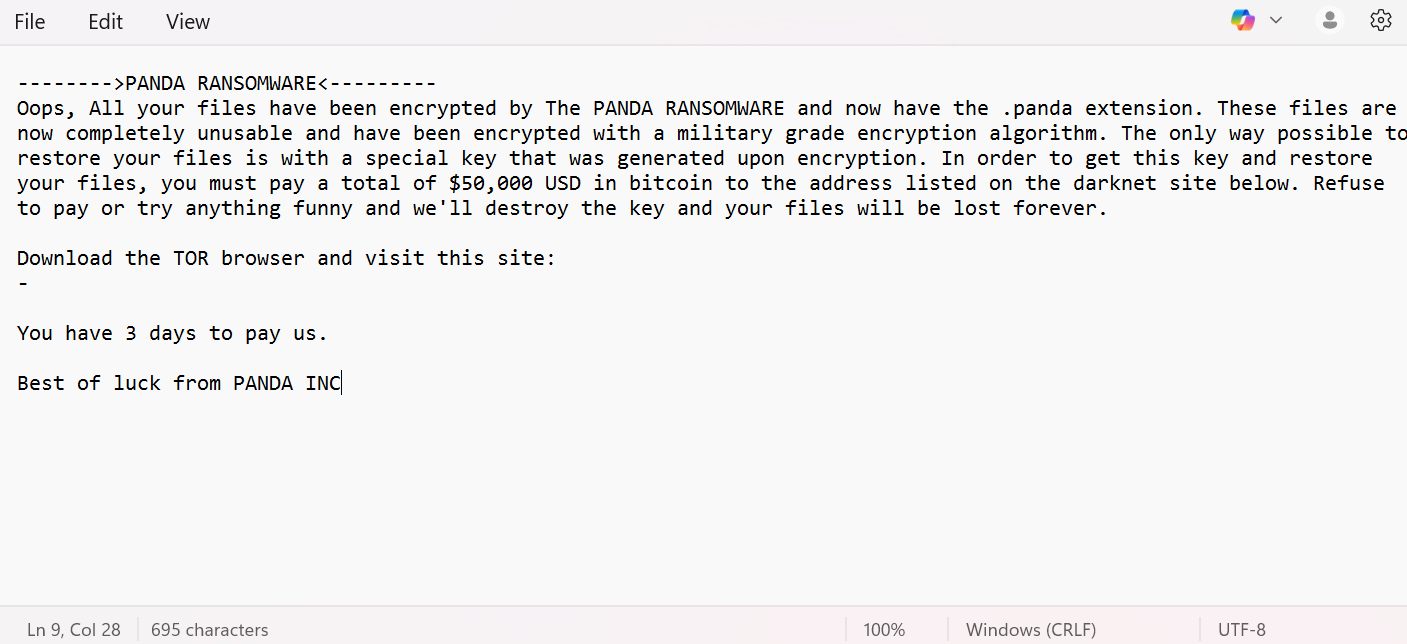
Ransom note detailed analysis:
——–>PANDA RANSOMWARE<———
Oops, All your files have been encrypted by The PANDA RANSOMWARE and now have the .panda extension. These files are now completely unusable and have been encrypted with a military grade encryption algorithm. The only way possible to restore your files is with a special key that was generated upon encryption. In order to get this key and restore your files, you must pay a total of $50,000 USD in bitcoin to the address listed on the darknet site below. Refuse to pay or try anything funny and we’ll destroy the key and your files will be lost forever.
Download the TOR browser and visit this site:
–
You have 3 days to pay us.
Best of luck from PANDA INC
Screenshot of the ransom note:
- Sudden performance lags
Ransom Note Structure
Contains:
- Victim ID
- Payment amount
- Cryptocurrency wallet
- Threat of data leak
Behavioral Indicators
- Spikes in CPU usage
- Suspicious outbound network traffic
- Disabled system restore
Encryption Techniques Used by PANDA Ransomware
RSA Public Key Encryption
This method uses a public key for encryption and a private key for decryption—only the attacker holds the private key.
AES Symmetric Encryption
Files are encrypted quickly and securely, with a unique key for each session.
Why Decryption is Difficult
Without the private RSA key, it’s nearly impossible to decrypt the files manually.
Recovery Options for PANDA Victims
Using PANDA Decryptor Tool
The most reliable method, as it is tailor-made for this ransomware strain.
Manual Recovery Methods
- File backups
- Shadow copy restoration
Third-Party Tools
- Kaspersky’s free decryptors
- Bitdefender’s rescue utilities
Free Recovery Methods and Resources
Platforms Offering Free Decryptors
- NoMoreRansom.org
- Emsisoft Decryptor Library
Using Shadow Copies
If ransomware did not delete shadow copies, previous file versions can be restored.
System Restore Points
Roll back the system to a date before the infection occurred.
Best Practices to Prevent PANDA Ransomware Attacks
Patch and Update Software
Always apply the latest patches to OS, hypervisors, and applications.
Implement Strong Access Controls
Utilize Multi-Factor Authentication (MFA) and limit administrative privileges.
Network Security Enhancements
- Use firewalls and intrusion prevention systems (IPS)
- Segment networks to contain breaches
Backup Strategies for Ransomware Resilience
3-2-1 Backup Rule Explained
- 3 copies of data
- 2 different storage types
- 1 offsite location
Testing and Validating Backups
Conduct regular restore tests to ensure backup reliability.
Cloud vs Local Backups
Use a combination for best protection.
Role of Employee Awareness in Ransomware Prevention
Common Social Engineering Tactics
Phishing emails with malicious links or attachments.
Training Modules
Conduct simulated attacks and refresher courses.
Phishing Simulations
Services like KnowBe4 can help assess staff preparedness.
Understanding the Ransomware Lifecycle
- Infiltration: Through phishing or exploit
- Encryption: Locks data using AES/RSA
- Ransom Demand: Threatens to leak or destroy files
- Data Leak Threats: Pressures victims into paying
Business Impact of a PANDA Ransomware Attack
Downtime and Productivity Loss
Infected systems become unusable, halting operations.
Financial Costs
Beyond ransom, costs include legal fees, system rebuilds, and lost sales.
Legal and Compliance Issues
Data breaches may trigger regulatory scrutiny and fines.
Conclusion
PANDA ransomware poses a serious threat to data integrity and business operations. However, with tools like the PANDA Ransomware Decryptor, robust backup strategies, and proactive cybersecurity measures, its damage can be mitigated. Organizations should adopt a layered defense approach, educate staff, and prepare recovery protocols to face such attacks confidently and effectively.
MedusaLocker Ransomware Versions We Decrypt