
Phenol Ransomware Decryptor
Phenol ransomware is a malicious program that specializes in locking files and extorting its victims. It marks each encrypted file with the .phenol extension and delivers a ransom demand through a note named Encrypt.html. Inside the message, attackers instruct victims to reach out via email for decryption instructions.
This ransomware is especially dangerous because it not only encrypts essential files but also exfiltrates data, creating a double-threat scenario. Victims risk permanent file loss as well as exposure of sensitive data if they refuse to comply.
Mechanism of File Encryption in Phenol
The malware relies on strong cryptographic techniques to lock files so they cannot be opened without a unique decryption key. During testing, for instance, a file titled document.jpg was renamed to document.jpg.[[email protected]].phenol.
The ransom note included with the infection specifically warns against forcefully ending processes or attempting manual repairs, as such actions could result in irreversible damage. Once active, the encryption spreads rapidly through local drives, attached storage devices, and in some cases, networked systems.
Critical First Steps After Infection
The period immediately following a ransomware incident is crucial. Taking the right steps can help reduce further harm and preserve evidence.
Disconnect Impacted Devices
Quickly remove infected machines from the network. This limits the ability of the malware to continue encrypting files on connected systems.
Preserve All Evidence
Do not delete ransom notes or encrypted files. Keep system logs, file hashes, and timestamps intact, as these are valuable for both investigation and recovery.
Avoid Reboots and Formatting
Restarting the compromised device may trigger additional malicious routines. Formatting or wiping affected drives can permanently eliminate recovery possibilities.
Get Professional Help
Instead of depending on unreliable tools or online forum advice, consult cybersecurity specialists. The sooner expert help is engaged, the better the chances for successful decryption.
Approaches to Recovering Phenol-Encrypted Files
Free Solutions
Currently, there is no universally available free decryption tool for Phenol ransomware. Certain security vendors occasionally release tools that work on earlier variants with weak encryption, but these are ineffective against modern builds. Attempting to use them may even damage files further.
If organizations maintain offline or external backups, these offer the safest restoration option. However, all backups should be carefully checked for completeness and possible tampering before restoring.
For companies running virtualized environments, rolling back to pre-infection snapshots can provide a fast recovery route. It is important to confirm that snapshots weren’t deleted or corrupted by the attackers before reverting.
Paid Options
The Phenol operators demand a ransom of $5000 in Tether (USDT) in exchange for a decryptor linked to the victim’s system ID. Paying, however, is extremely risky. Criminals may fail to deliver a tool, send one that only partially works, or even corrupt the data further. Moreover, ransom payment may lead to legal and ethical complications.
Professional negotiators sometimes step in as intermediaries, working with threat actors to reduce ransom amounts and request proof-of-decryption. While this increases the likelihood of receiving a valid decryptor, it is usually costly and results vary from case to case.
Our custom-built Phenol Decryptor is designed specifically for safe recovery from this ransomware.
- In-depth Reverse Engineering – Based on a complete study of Phenol’s cryptographic methods and encryption flaws.
- Cloud Verification Process – Files are analyzed in secure sandbox environments to confirm accuracy before decryption.
- Unique ID Matching – Uses the system’s ransom note ID to ensure precise file decryption.
- Flexible Modes – Operates both online with secure channels and offline in isolated environments.
This decryptor has already helped multiple organizations restore files without the need to fund cybercriminals.
Phenol Infection Pathways and Attack Techniques
Initial Entry Points
Phenol spreads primarily through phishing messages, malicious attachments, downloads from unsafe sources, and software cracks. Other infection routes include drive-by downloads and exploitation of unpatched system vulnerabilities.
Tools and TTPs (Tactics, Techniques, Procedures)
Phenol operators employ methods that align with MITRE ATT&CK categories, such as:
- Credential Access – Using tools like Mimikatz and LaZagne to extract passwords and credentials.
- Network Reconnaissance – Employing scanners like Advanced IP Scanner to map out vulnerable systems.
- Evasion Tactics – Deploying rootkits and obfuscation tools to bypass endpoint protections.
- Data Theft – Exfiltration through RClone, FileZilla, or Mega.nz clients before encryption begins.
- Encryption Strategy – Using asymmetric cryptography and disabling shadow copies with vssadmin delete shadows commands.
Identifying Phenol Infections (IOCs)
Phenol infections can be confirmed through several indicators:
- File Extensions – Locked files carry the .phenol extension along with the attacker’s email.
- Ransom Note – The presence of Encrypt.html across directories.
- Contact Details – Email listed as [email protected].
- Detection Labels – Examples include Ransom.Phenol (Malwarebytes) and Trojan-Ransom.Win32.Crypmodng.btr (Kaspersky).
- Suspicious Utilities – Presence of remote access tools such as AnyDesk, RClone, or Ngrok.
Global and Industry Impact of Phenol
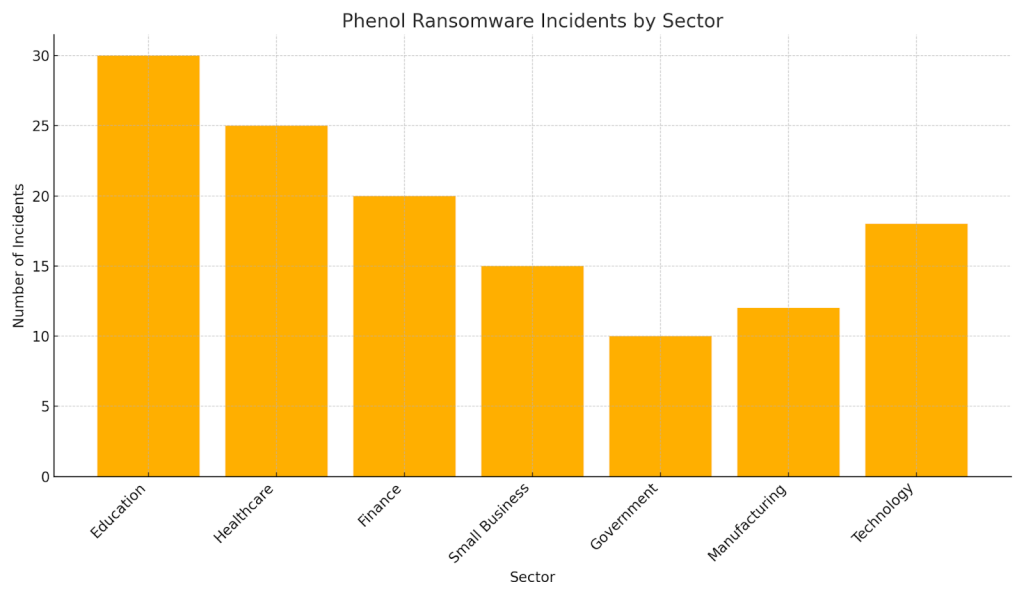
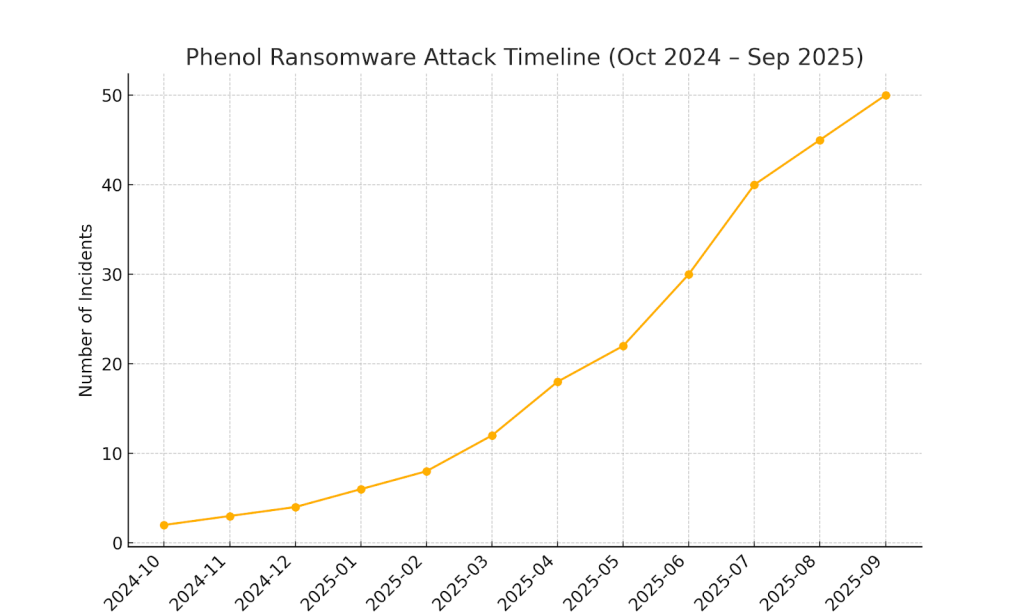
Phenol has affected both personal systems and businesses. Early reports indicate incidents across North America, Europe, and Asia, making it a widespread problem. The ransomware’s extortion model has been particularly harmful to small and medium-sized organizations.
Countries Most Impacted

Industries Targeted
Attack Timeline
Analyzing the Phenol Ransom Note
Phenol ransomware creates a ransom note titled Encrypt.html, which communicates the attackers’ demands. The message stresses urgency, requiring victims to reach out within 24 hours and make payment within three days.
The note outlines that backups and files are fully under the attackers’ control, and that attempts to repair or interfere with processes will prevent recovery. It further threatens that stolen data will be leaked or sold if cooperation does not occur.
Excerpt from Encrypt.html:
You are encrypted!!!
Dear Sir/Madam,We are the PHENOL TeAm
1. All backup data and entire data are under our control.
2. Please contact us within 24 hours.
3. Please do not repair files or terminate related processes, otherwise it may become impossible to recover.
4. If cooperation goes well, we will not destroy, disclose or sell your data.
5. If you violate the above requirements, all data will be published on the Internet or provided to third party organizations and data recovery will not be provided.
Finally, please pay us a ransom of $5000 USDT within three days as requested
Email:[email protected]
© 2025 Ransomware Co.
Preventing Future Phenol Ransomware Infections
- Regularly patch and update firewalls, VPNs, and all software.
- Require multi-factor authentication for remote access services.
- Maintain offline and immutable backups for disaster recovery.
- Track and analyze outbound network traffic for unusual behavior.
- Provide phishing-awareness training to employees.
Conclusion
Phenol ransomware is a severe threat that combines strong encryption with extortion tactics. While free tools are not yet available, professional recovery solutions such as our Phenol Decryptor offer safer alternatives than ransom payment. By following strong cybersecurity practices and responding promptly, organizations can minimize disruption and restore their systems securely.
MedusaLocker Ransomware Versions We Decrypt