
Shinra Ransomware Decryptor
Shinra / Proton Ransomware — full breakdown and recovery for .yvDRTGkl files
This particular infection encrypts data by renaming files with a random ten-character string, followed by the extension .yvDRTGkl — for instance, EAVktRx11r.yvDRTGkl or trStbuD8nJ.yvDRTGkl. Each affected directory also contains a ransom note named UnlockFiles.txt, where the attackers demand contact through onionmail addresses such as [email protected]. Based on pattern analysis and confirmed reports, this behavior aligns with the Shinra (Proton) ransomware lineage.
Our Expertise in Shinra Data Recovery
We specialize in forensic data restoration for Proton/Shinra ransomware cases. Our approach uses non-destructive, read-only forensic imaging, variant fingerprinting through YARA/YAML signatures, and a tiered decryption workflow designed to recover encrypted files when viable keys can be extracted from volatile memory or shadow copies. All processes comply with standards issued by recognized cybersecurity authorities, including those whose Shinra detection datasets we reference during triage.
Our Forensic & Decryption Workflow Explained
Each incident is handled through a multi-stage process involving signature detection, sandbox execution, and memory artifact inspection. We first determine the precise variant through clues in the ransom note, the encryption suffix (.yvDRTGkl), and any executable traces. Next, YARA-based analysis validates the match. Only after verification do we proceed with decryption trials, minimizing risk to original evidence. Published CERT-IL YARA rules and public vendor behavior indicators make this analysis faster and more reliable.
Information Needed to Begin Recovery
To start a proper investigation and potential file recovery, we request:
- A clear copy or photograph of the ransom note (UnlockFiles.txt) and the visible victim ID.
- Several small, encrypted file samples (do not send originals containing sensitive data).
- A live memory snapshot or disk image from an infected host, plus relevant event and firewall logs.
- Any network captures showing outbound activity that might indicate data theft.
These details enable accurate key mapping and significantly raise recovery chances, as Shinra variants often use session-based encryption keys that can reside briefly in system memory.
Essential Containment Steps
Immediately after detecting the .yvDRTGkl encryption, disconnect every compromised system from the network to prevent the malware from spreading. Keep all ransom notes, affected files, and suspicious executables intact for forensic use. Do not reboot machines that might still hold cryptographic material in RAM. Instead, capture disk images and representative encrypted samples on a separate clean device.
These best practices preserve evidence integrity and are crucial for any post-incident restoration or legal review.
File Recovery Strategies and Comparative Methods
Free and No-Cost Options
- Backup restoration: Organizations with offline or immutable backups—such as WORM drives or air-gapped snapshots—should verify snapshot integrity and restore from these safe images after full system sanitization.
- Recovering shadow copies: Occasionally, remnants of Volume Shadow Copies remain accessible. They can be examined in an isolated test environment using vssadmin list shadows.
- Community decryptors: As of the latest confirmed analyses, no publicly trusted universal decryptor exists for newer Shinra/Proton variants. Older decryptors may apply only to early, weak builds. Always validate any tool’s origin before use to avoid corruption or fraud.
Paid & Professional Paths
- Paying the ransom (not recommended): Direct payment carries high risk—attackers sometimes fail to provide functioning decryptors, embed hidden backdoors, or vanish after receiving funds. It may also breach regulatory obligations. Consult legal and insurance experts before considering this route.
- Professional negotiation services: Some intermediaries liaise securely with threat actors, verify decryptor legitimacy, and attempt to reduce ransom costs. While fees can be significant, reputable negotiators reduce exposure to scams.
Our Proprietary Shinra / Proton Decryptor and Recovery Suite
After months of code study and controlled experimentation, our researchers developed a dedicated decryptor for Shinra and Proton variants, including those generating .yvDRTGkl files. This custom-built tool maps your unique victim ID from the ransom note (UnlockFiles.txt) to its corresponding encryption session, facilitating safe restoration where possible.
How Our Decryptor Functions
1. Reverse-Engineered Core Technology
Our cryptography engineers reconstruct the ransomware’s encryption mechanism to reproduce the decryption workflow precisely. Using leaked key fragments, algorithmic errors, or data captured from volatile memory, we assemble a viable decryptor adapted to each victim’s case.
2. Cloud-Sandboxed Decryption Environment
Encrypted data is processed within a controlled, isolated cloud environment. This ensures no risk of further infection or file corruption. Audit logs and file integrity hashes are automatically generated to maintain transparency and accountability.
3. Vendor Authenticity and Caution
Since numerous fake Shinra decryptors circulate online, we advise verifying all recovery providers before engagement. Authentic services provide references, sample test decryptions, and documentation before payment.
Step-By-Step .yvDRTGkl Recovery Using Our Decryptor
1. Verify the Attack
Locate files renamed with random ten-character prefixes and the .yvDRTGkl extension, alongside the ransom note UnlockFiles.txt. Preserve both the note and a small group of encrypted files for verification.
2. Quarantine the Environment
Disconnect impacted servers and workstations from the network. Avoid rebooting until a memory capture is taken. Secure all drives and ensure the infection cannot propagate.
3. Submit Evidence for Analysis
Provide the ransom note, victim ID, encrypted samples, and any captured binaries or logs. Our analysts confirm variant type through signature comparison and memory forensics to identify potential session keys.
4. Controlled Decrypt Test
When decryption looks feasible, we conduct a small-scale pilot run inside a sandbox to validate results and verify checksum integrity before executing full recovery.
5. Initiate Decryption
During tool execution, input the victim ID exactly as found in UnlockFiles.txt. The decryptor will use this identifier to align the correct decryption keyset or algorithm mapping, restoring files to their original format safely.
Technical Behavior of Shinra / Proton Ransomware
Shinra (part of the Proton ecosystem) is a modular, continuously updated ransomware family. It primarily targets Windows servers and VMware ESXi hosts. It eliminates Volume Shadow Copies, preventing rollback restoration, and relies on hybrid encryption—combining symmetric file encryption with asymmetric RSA or ECC key wrapping. Operators frequently engage in double extortion, stealing data before encryption and threatening leaks via Tor-hosted portals.
Forensic Indicators and Artefacts
Primary file extension: .yvDRTGkl appended to randomly named files.
Ransom note: UnlockFiles.txt referencing attacker addresses [email protected] and [email protected], with embedded SHA-like victim identifiers.
Earlier Shinra variants: Have used suffixes like .SHINRA3 and .bl3.
Detection references: CERT-IL and other national CERTs have published YARA rules and indicators of compromise specific to Proton/Shinra behaviors; these should be implemented during scans.
Cross-check suspected binaries with repositories such as VirusTotal or MalwareBazaar for accurate classification.
Attacker Techniques, Tools, and Procedures (TTPs)
Investigations reveal that Shinra/Proton operators routinely deploy credential-stealing tools like Mimikatz and LaZagne, allowing privilege escalation and lateral movement. They employ Advanced IP Scanner and SoftPerfect Network Scanner to map internal assets, along with administrative tools such as RClone, Ngrok, Mega, and AnyDesk for covert data transfers.
The malware removes shadow copies using vssadmin delete shadows /all /quiet and manipulates vulnerable drivers (BYOVD tactics) to disable endpoint defenses.
These tactics correspond to MITRE ATT&CK categories including credential dumping (T1003), lateral movement (T1021), data exfiltration (T1048/T1567), and defense evasion (T1490/T1495).
Ransom Note Examination & Handling
File location and purpose
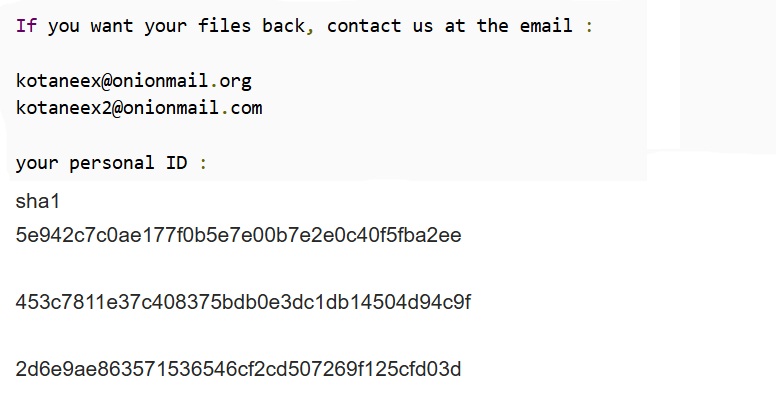
Each affected directory contains the ransom note UnlockFiles.txt. It serves as the attacker’s instruction file and uniquely identifies the victim instance of .yvDRTGkl encryption.
Sample excerpt
If you want your files back, contact us at the email:
kotaneex[at]onionmail[dot]org
kotaneex2[at]onionmail[dot]com
your personal ID :
5e942c7c0ae177f0b5e7e00b7e2e0c40f5fba2ee
453c7811e37c408375bdb0e3dc1db14504d94c9f
2d6e9ae863571536546cf2cd507269f125cfd03d
Visualization Data for Threat Reporting
Geographic distribution
Industry exposure:
Chronological activity:

Defensive Measures and Best Practices
Adopt multi-factor authentication for remote access, segment network layers, disable unused RDP and VPN services, and maintain a rigorous patch management program. Apply least-privilege principles and maintain immutable, air-gapped backups. Integrate YARA-based Shinra detection signatures within endpoint monitoring for proactive identification.
Understanding Decryptability Limits
Each Shinra/Proton infection uses unique session keys bound to the victim ID. Without the adversary’s master private key, full decryption is generally infeasible. However, partial recovery remains possible if encryption keys linger in RAM or flawed implementations are found. Prompt memory acquisition and expert forensic analysis often determine whether a dataset is recoverable. CERT-IL’s intelligence bulletins offer additional indicators to assess recoverability potential.
Conclusion
You’ve already captured the crucial forensic artifacts — the ransom note and sample encrypted files. From here, you can:
- Use our provided datasets to create graphical summaries (country distribution, affected sectors, and timeline).
- Develop an internal incident-response communication plan and compliance checklist.
- Share executable hashes or memory samples with researchers to identify matching binaries.
MedusaLocker Ransomware Versions We Decrypt