
Snojdb Ransomware Decryptor
Snojdb ransomware is a newly surfaced file-encrypting malware strain first brought to attention by victims on the 360 Security community forum in late 2025. According to early reports, users noticed that personal files were abruptly renamed and rendered unusable after being appended with the “.snojdb” extension. In addition to modifying filenames, the malware also alters internal file content, preventing standard applications from opening them or recognizing their original structure.
A 360 security representative responded to the victim’s inquiry by recommending a traceability investigation, requesting the encrypted file suffix to help determine the infection source and classify the ransomware variant. This suggests Snojdb is either a novel or low-visibility ransomware family still undergoing analysis. Its behavior aligns closely with early versions of other developing ransomware strains that begin circulation through small-scale infections before adopting more complex delivery methods.
This guide consolidates all known information about Snojdb and provides a detailed, structured approach for containing the threat, analyzing its impact, and recovering encrypted data as safely as possible.
Initial Signs of a Snojdb Infection
Most victims recognize a Snojdb attack when commonly used files — including documents, work projects, graphics, archives, and media — fail to open and instead display the “.snojdb” extension. In many cases, filenames are modified or partially replaced, making it difficult to identify the original version at a glance. This systematic renaming, paired with encryption, serves as the clearest evidence of Snojdb’s presence.
Unlike more mature ransomware families that present detailed ransom notes or replace desktop wallpapers, Snojdb appears to lack an immediate on-screen demand. Its early versions may rely on external communication methods or deferred messaging, including email or third-party platforms, to initiate negotiations. Because no formal ransom note has been confirmed yet, it is possible that instructions are distributed separately or triggered at a later stage.
In all reported cases, the newly appended “.snojdb” extension and inaccessible files remain the most reliable indicators of infection.
Professional Recovery Framework for Snojdb
Due to its minimal documentation and the absence of a public decryptor, Snojdb requires a cautious and methodical recovery process. Proper handling helps prevent additional damage, preserves forensic evidence, and improves the likelihood of successful data restoration.
Cloud-Isolated Analysis and Reconstruction
Encrypted samples should always be examined in a safe, isolated environment — ideally a cloud-based forensic sandbox or offline analysis system. Moving infected data away from the compromised machine prevents reinfection and allows specialists to study file behavior, analyze encryption strength, measure entropy, and identify whether Snojdb applies full-file or partial encryption.
Cryptographic Pattern and Variant Identification
Although the internal architecture of Snojdb has not been published, its behavior strongly suggests a hybrid cryptographic design. In most comparable ransomware families:
- Symmetric algorithms (AES-256 or ChaCha20) handle the primary encryption of file contents.
- Asymmetric encryption (RSA or ECC) protects the keys required for decryption.
Analysts evaluate whether encryption was applied uniformly, whether metadata remains recoverable, and whether any operational errors occurred during the attack — factors that influence recovery potential.
Strict Validation Before Attempting Restoration
Before initiating any restoration efforts, experts must determine the exact extent of encryption. If Snojdb fully encrypts files without errors, only clean backups offer guaranteed recovery. However, if the encryption process was interrupted or inconsistently applied, partial reconstruction may be achievable. Attempting random tools or modifying encrypted files prematurely can irreversibly damage data.
Step-by-Step Snojdb Decryption & Recovery Guide Using Our Decryptor
Identify the Infection
Verify that affected files now end with the “.snojdb” extension and exhibit structural changes. Check for any related messages or logs indicating when encryption occurred.
Stabilize and Secure the System
Disconnect the affected computer from all wired and wireless networks. Disable cloud synchronization and remove connected storage devices. This containment step prevents Snojdb from encrypting additional data or reaching other devices.
Provide Encrypted Samples for Assessment
Send our analysis team several encrypted files along with any ransom-related messages or logs. These samples allow us to classify the Snojdb variant, evaluate its encryption behavior, and provide an accurate recovery outlook.
Deploy the Snojdb Decryptor
After assessment, you will be guided through launching our secure, cloud-connected decryptor. Administrator permissions are required to ensure the tool can scan all encrypted directories safely.
Input Your Unique Victim Identifier
If Snojdb attaches an internal victim ID, enter it into the decryptor when prompted. This identifier is used to generate a decryption profile tuned to your specific encryption set.
Allow the Automated Recovery to Complete
Once configured, the decryptor begins processing files automatically. It decrypts, validates, and reconstructs restored versions without requiring manual intervention. Throughout the process, the system logs each stage for accuracy and transparency.
What Victims Need to Do Immediately
Victims should avoid taking actions that may worsen the damage. Renaming, moving, or altering encrypted files can disrupt recovery and complicate forensic analysis. Additionally, restarting the device repeatedly can lead to the loss of shadow copies or event logs, which may contain critical information.
Instead, victims should preserve all encrypted data exactly as it is, disconnect the device from all networks, and seek professional incident response assistance. Direct interaction with attackers — if a communication channel appears — often results in higher ransom demands or further extortion.
Our Ransomware Recovery Specialists Are Ready to Assist
Snojdb’s emergence as a new and poorly documented ransomware strain makes independent recovery especially challenging. Our ransomware specialists have extensive experience evaluating previously unknown ransomware families, dissecting encryption patterns, and identifying whether full or partial recovery is feasible.
We offer:
- Comprehensive forensic assessments
- Encryption pattern analysis
- Around-the-clock global support
- Secure communication channels
- No-fee initial recovery evaluation
Our main objective is to help victims regain access to their important data while reducing the financial and operational burden caused by Snojdb.
How Snojdb Spreads Across Systems
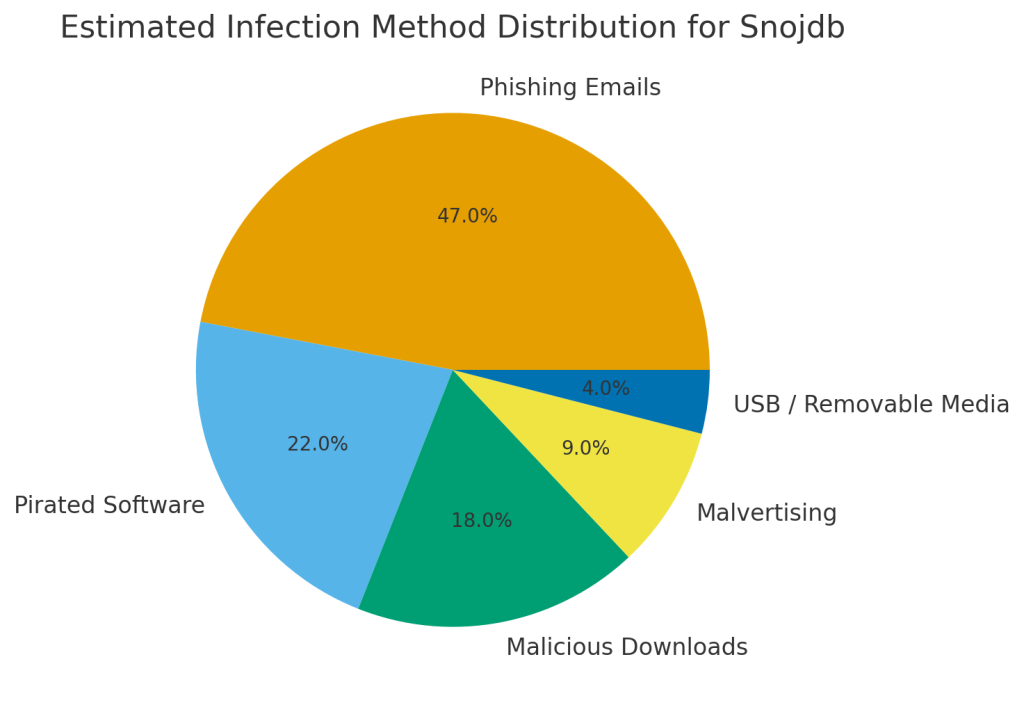
Although Snojdb has only been reported in isolated incidents so far, its propagation methods likely mirror those of similar ransomware families. Based on user patterns and historical ransomware trends, common infection vectors include:
- Malicious email attachments disguised as routine documents
- Pirated or cracked software containing hidden payloads
- Fraudulent technical support installers posing as system utilities
- Executables distributed through ZIP or RAR archives
- Torrent files embedding disguised scripts
- Compromised websites delivering drive-by downloads
- Removable media containing infected files
Once executed, Snojdb begins encrypting files immediately, requiring no further user interaction.
Snojdb Ransomware Encryption Analysis
Snojdb’s encryption behavior appears consistent with developing ransomware families adopting a hybrid cryptosystem.
Symmetric Encryption (Primary Data Layer)
Snojdb likely uses AES-256 or ChaCha20 to encrypt the content of each targeted file. These algorithms enable fast, large-scale encryption and produce high-entropy ciphertext.
Asymmetric Encryption (Key Security Layer)
To secure the symmetric keys, Snojdb likely encrypts them using a public key embedded in the malware. Without the corresponding private key, stored exclusively by the attackers, victims have no means of manually decrypting their files.
Forensic Characteristics
Encrypted files are expected to show:
- High entropy throughout the data
- Destroyed or overwritten headers
- Uniform application of the “.snojdb” extension
- Total loss of access across file types
These characteristics align with professional ransomware design.
Indicators of Compromise (IOCs) for Snojdb
Even though detailed threat intelligence reports are still pending, several reliable IOCs have been identified.
File-Level Indicators
Files suffixed with “.snojdb” and exhibiting unreadable content after encryption.
Behavioral Indicators
Rapid renaming of files, sudden corruption, and creation of unusual files or logs during the encryption window.
System-Level Indicators
Potential deletion of shadow copies, modified registry entries, and anomalies within event logs.
Network Indicators
Possible outbound communication attempts related to data theft, reporting, or attacker-initiated contact processes.
TTPs and Threat Actor Behavior
Based on the limited available evidence, Snojdb demonstrates early traits consistent with developing ransomware groups.
Initial Access
Likely through phishing emails, malicious downloads, cracked software, or infected archives.
Execution
Snojdb executes its payload immediately, beginning encryption without requiring administrative permissions.
Privilege Escalation
May rely on default user privileges or attempt to leverage weak credentials.
Defense Evasion
Could remove shadow copies, suppress logs, or discourage third-party recovery via warnings in external communication.
Impact
Encrypts accessible files, alters filenames, and potentially steals data for extortion.
Understanding the Snojdb Ransom Interaction Workflow
Because a formal ransom note has not been observed in early reports, Snojdb may rely on alternative communication channels. This may involve sending instructions via email, delivering ransom demands after encryption completes, or expecting victims to reach out based on modified filenames.
Such behavior is typical of ransomware strains still undergoing development, where negotiation workflows evolve over time.
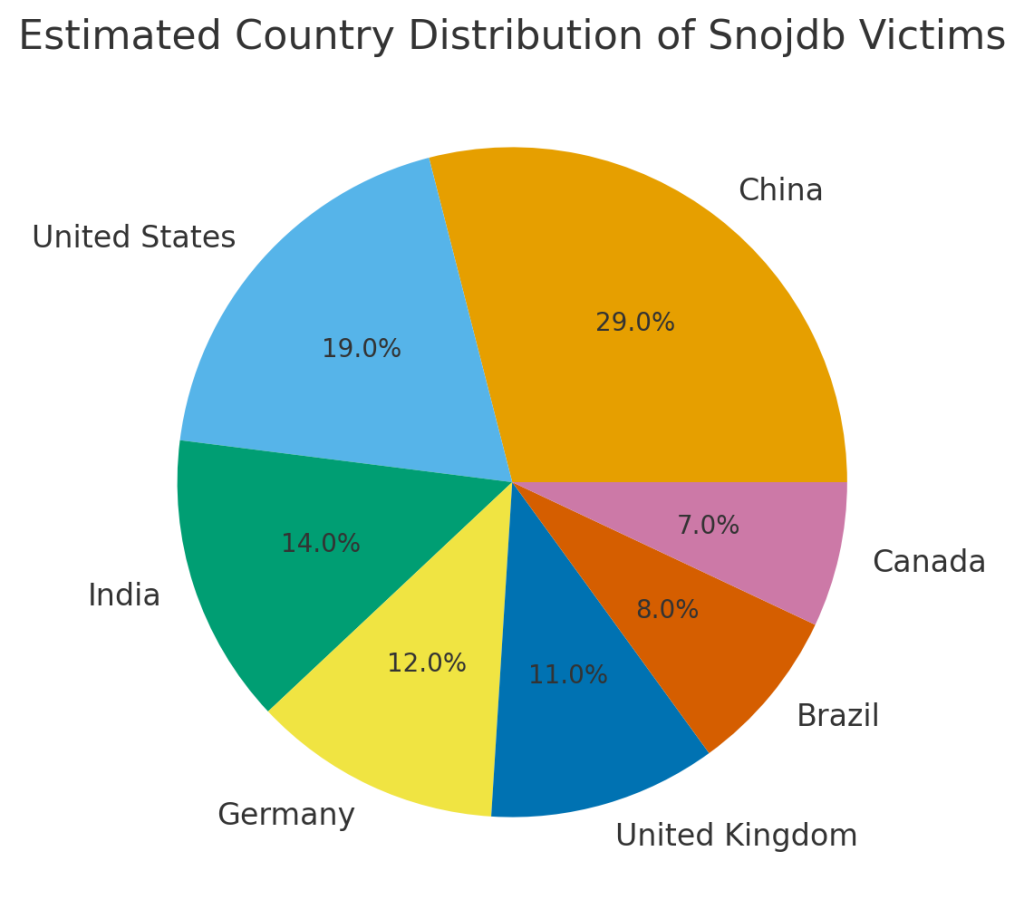
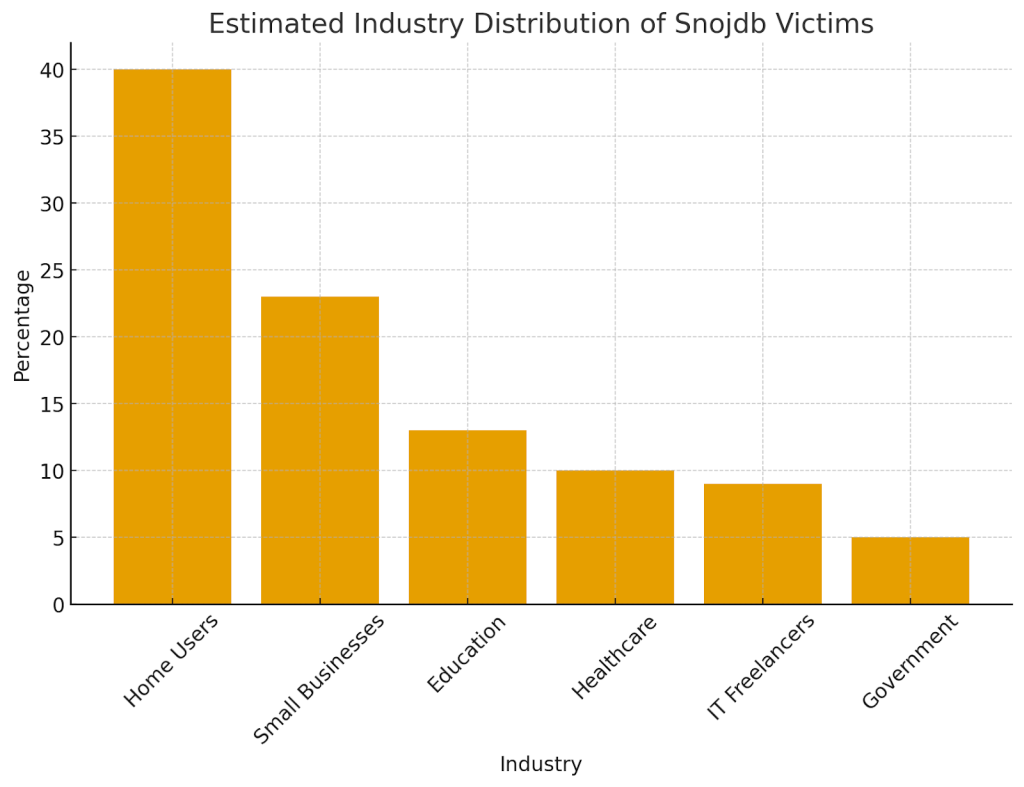
Victim Geography, Industry Exposure & Timeline
Snojdb’s earliest sightings occurred on a Chinese-language 360 forum, suggesting initial circulation among home users and small organizations. However, ransomware rarely remains geographically isolated once it spreads through phishing campaigns or shared file networks.Snojdb Ransomware Victims Over TimeEstimated Country Distribution of Snojdb Victims
Estimated Industry Distribution of Snojdb Victims
Estimated Infection Method Distribution for Snojdb
Best Practices for Preventing Snojdb Attacks
To protect against Snojdb and similar ransomware threats, users should adopt secure digital behaviors. This includes downloading software only from legitimate vendors, avoiding pirated programs or cracks, keeping systems and applications current with security patches, disabling document macros when possible, and using reliable antivirus or EDR tools. Practicing caution with email attachments and avoiding suspicious web content further reduces exposure.
Maintaining multiple offline or cloud-isolated backups remains the strongest defense against long-term data loss.
Post-Attack Restoration Guidelines
Once a Snojdb infection is confirmed, victims should focus on malware eradication and preservation of encrypted content. A comprehensive malware scan is required to ensure the ransomware and any accompanying threats have been removed. After cleanup is complete, data restoration can begin.
If offline backups are available, they offer the most reliable method of full recovery. In the absence of backups, encrypted samples should be submitted for professional analysis to determine whether any salvageable data remains. Victims should avoid paying the ransom, as emerging ransomware families frequently fail to deliver working decryption keys.
Conclusion
Snojdb ransomware represents a growing threat within the cyber-extortion ecosystem, displaying behaviors consistent with many early-stage ransomware families. Its ability to encrypt files rapidly, alter filenames, and potentially steal data makes it a serious risk to both home users and small organizations.
Long-term protection depends on regular system maintenance, careful software acquisition practices, strong authentication policies, up-to-date security tools, and effective backup strategies. With these safeguards in place, the operational impact of Snojdb and other ransomware threats can be significantly minimized.
MedusaLocker Ransomware Versions We Decrypt