Sojusz Ransomware Decryptor
A sophisticated and highly adaptable ransomware variant, identified as Sojusz, has been discovered by security researchers. This malware is particularly dangerous due to its cross-platform capabilities, targeting both Windows and Linux environments, and its ability to encrypt data across a wide range of storage architectures, including NAS, SAN, and DAS. The attack is accompanied by a ransom note demanding payment for the return of critical data. This guide provides a comprehensive, in-depth playbook for understanding the Sojusz threat, utilizing our specialized decryptor, and performing advanced recovery operations across all affected systems and storage types.
| Attribute | Detail |
|---|---|
| Threat Name | Sojusz Ransomware |
| Threat Type | Ransomware, Crypto Virus, Files Locker |
| Platform | Windows, Linux |
| Encrypted Files Extension | Varies by attack; often a unique extension. |
| Ransom Demanding Message | Text file (name varies). |
| Free Decryptor Available? | Yes, our specialized Sojusz Decryptor. |
| Ransom Amount | Varies, typically demanded in cryptocurrency. |
| Cyber Criminal Contact | Provided in the ransom note (varies by attack). |
| Detection Names | Varies by vendor; detected as a generic Trojan/Ransomware. |
Decoding the Threat: The Sojusz Ransomware Family
Sojusz represents a modern evolution in ransomware, designed to infiltrate complex network environments. Its cross-platform nature means it can spread from a compromised Windows workstation to critical Linux servers, and its ability to target network-attached storage makes it a significant threat to business continuity and data integrity. The ransom note typically follows a standard pattern, informing the victim of the encryption, providing contact details, and warning against third-party recovery attempts.
Indicators of Compromise (IOCs) and Attack Behavior
Recognizing the signs of a Sojusz infection is the first critical step. The malware’s ability to traverse different operating systems and storage types is its most dangerous characteristic.
Indicators of Compromise (IOCs):
- File Extension: Files will be renamed with a new, unique extension specific to the attack.
- Ransom Note File: The presence of a text file containing the ransom demand in directories with encrypted files.
- Cross-Platform Encryption: Evidence of encryption on both Windows and Linux machines within the same network.
- Network Storage Encryption: Encrypted files on mapped network drives, NAS shares, or volumes presented from a SAN.
Tactics, Techniques, and Procedures (TTPs) with MITRE ATT&CK Framework:
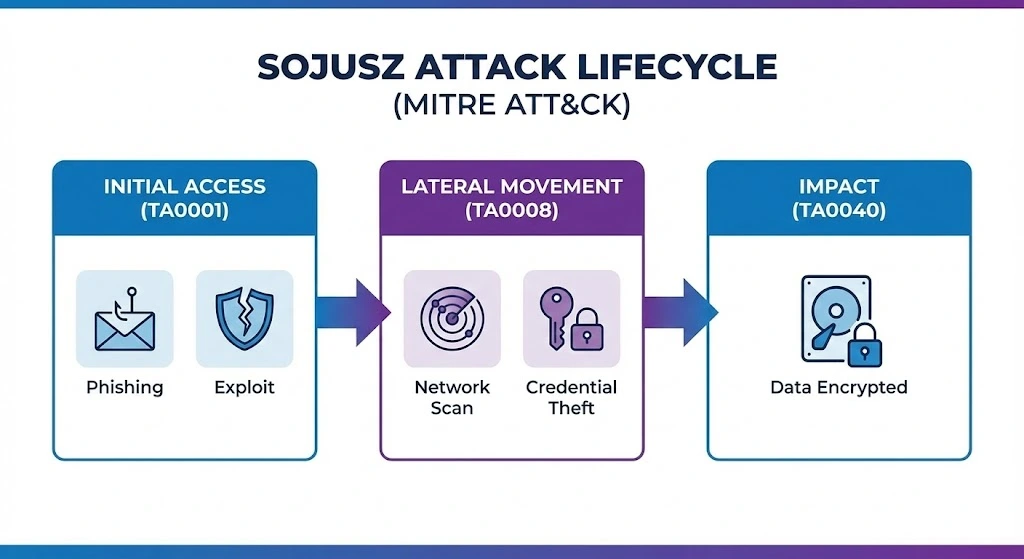
- Initial Access (TA0001): Sojusz gains entry through common vectors like phishing emails, exploiting unpatched software vulnerabilities (especially in remote access tools), and compromised credentials.
- Lateral Movement (TA0008): Once inside, the ransomware moves laterally across the network, using stolen credentials or exploits to infect other machines, including critical Linux servers and accessible storage systems.
- Impact (TA0040): The primary impact is widespread data encryption across multiple platforms and storage architectures, leading to massive operational disruption.
The Recovery Playbook: A Multi-Path Approach to Data Restoration
This core section outlines the primary methods for recovering your Sojusz encrypted data, with a special focus on our decryptor and advanced recovery scenarios.
The Direct Decryption Solution with Our Sojusz Decryptor
The most direct and safest path to recovery is using our specialized tool, developed to counter the Sojusz threat.
Our team has developed a specialized decryptor to counter the Sojusz threat. By leveraging advanced cryptographic analysis and pattern recognition, our tool can often reconstruct the decryption keys without needing to interact with the attackers.
Step-by-Step Guide:
- Step 1: Assess the Infection: Confirm the presence of the unique Sojusz ransom note and identify the new file extension on both Windows and Linux systems.
- Step 2: Secure the Environment: Disconnect all infected devices, including servers and storage appliances, from the network to halt any further spread.
- Step 3: Submit Files for Analysis: Send a few encrypted samples (under 5MB) and the ransom note file to our team. This allows us to confirm the Sojusz variant and build an accurate recovery timeline.
- Step 4: Run the Sojusz Decryptor: Launch the tool with administrative privileges (
sudoon Linux, “Run as Administrator” on Windows). The decryptor connects securely to our servers to analyze encryption markers and file headers. - Step 5: Enter the Victim ID: The unique ID provided in the ransom note is required to generate a customized decryption profile.
- Step 6: Automated File Restoration: Once initiated, the decryptor verifies file integrity and restores data automatically, preserving original filenames and directory structures.
Public Decryption Tools and Repositories
If our tool is not applicable, several public initiatives are invaluable. Always identify the ransomware strain before using any tool, as running the wrong decryptor can cause permanent damage.
- ID Ransomware Service: Use the free ID Ransomware service to upload the ransom note and a sample encrypted file. Find it at ID Ransomware.
- The No More Ransom Project: This is the most important resource, providing a centralized repository of free decryption tools. Find it at The No More Ransom Project.
- Major Security Vendor Decryptors: Check the websites of Emsisoft, Kaspersky, Avast, and Trend Micro for available tools.
In-Depth Recovery Scenarios
Path 2: Advanced Linux System Recovery
When a Linux server is hit by Sojusz, recovery requires a different set of tools and knowledge.
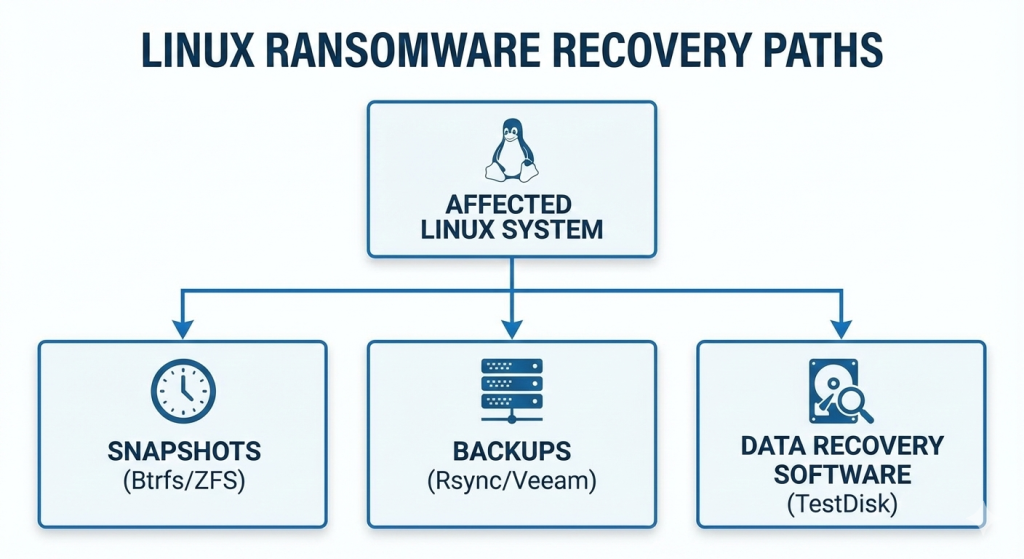
- Btrfs/ZFS Snapshots: If your file system is Btrfs or ZFS, you may have snapshots enabled. These are point-in-time, read-only copies of your file system that can be used to revert data to a state just minutes before the attack. This is often the fastest recovery method for file systems that support it.
- Rsync and Tar: For smaller setups, using
rsyncto sync data to an off-site location ortarto create compressed archives are common methods. If you have recentrsyncbackups ortararchives, you can restore from them. - Enterprise-Grade Backups (Veeam): Veeam provides robust protection for Linux environments, including support for agent-based backups of Linux servers and applications. It can create immutable backups that cannot be altered by the ransomware. Learn more at the official Veeam website.
- TestDisk & PhotoRec: These are powerful, free, and open-source data recovery utilities for Linux. TestDisk can recover lost partitions and repair boot sectors, while PhotoRec is designed to recover specific file types even if the file system is severely damaged. You can find them on the CGSecurity website.
- Foremost: Another console-based file recovery program that can recover files based on their headers, footers, and internal data structures. It is often included in Linux forensic toolkits.
Important Procedure: For the best chance of success, you should shut down the affected server, remove its hard drive, and attach it as a secondary drive to a separate, clean Linux machine. Then, run the data recovery software on that clean machine to scan the secondary drive.
Path 3: System Repair and Diagnostics with Bootable Environments
Sojusz can damage system files or prevent booting. Bootable environments are essential for accessing and repairing your system.
Hiren’s BootCD is a legendary tool for IT professionals. The modern “PE” (Preinstallation Environment) version is a bootable Windows PE that contains a suite of useful tools for system recovery and repair.
- How it Works: You boot your computer from a USB drive or CD containing Hiren’s BootCD. This loads a mini Windows environment that runs entirely from the bootable media, bypassing your infected hard drive.
- Useful Tools: It includes a web browser (to research solutions or download tools), file managers (to access and move files), and tools for resetting Windows passwords, checking the hard drive for errors, and removing malware. It is an invaluable utility for gaining control of a compromised system. You can download it from the official Hiren’s BootCD website.
- MediCat USB: A highly-regarded and extremely comprehensive bootable toolkit designed for PC troubleshooting and repair. It requires a larger USB drive (at least 32GB) due to its size.
- Sergei Strelec’s WinPE: A very popular and powerful alternative in the technical community. It is based on a Windows PE environment and is praised for its extensive collection of tools and compatibility with modern systems.
- SystemRescue: A Linux-based rescue system available as a bootable ISO or USB. It is designed for repairing unbootable computers, recovering data after a crash, and performing system administration tasks like partitioning and cloning. It is a versatile tool for troubleshooting both Linux and Windows systems. Find it at the SystemRescue website.
- Ultimate Boot CD (UBCD): This is a veteran, free bootable recovery disk that consolidates numerous diagnostic, repair, and system maintenance tools into a single interface.
Path 4: Specialized Network Storage Recovery (NAS, SAN, DAS)
Sojusz’s ability to target network storage makes recovery more complex. The approach depends on the storage architecture.
NAS devices (e.g., Synology, QNAP) are prime targets because they are often less secured and contain vast amounts of data.
- Leverage Built-in Features: The most effective method for NAS devices is Snapshots. Brands like Synology and QNAP have a snapshot feature that takes point-in-time, read-only copies of your data. These snapshots are often invisible to ransomware and can be used to revert shared folders to a state just minutes before the attack.
- Cloud Sync Versioning: If your NAS was configured to sync files to a cloud service like Google Drive, Dropbox, or OneDrive, you may be able to use the version history features of those services to restore your files to an unencrypted state.
- Public Decryption Tools: Reiterate the importance of using the No More Ransom Project and vendor tools. You may be able to mount the NAS volumes as a drive on a clean PC and run the decryptor directly on them.
SANs provide block-level storage to servers. Recovery happens at the server level, but the SAN itself offers powerful protection.
- Storage Array Snapshots: Enterprise SANs (from vendors like Dell EMC, NetApp, HPE) have robust snapshot and cloning capabilities. These are the most effective way to recover entire LUNs (Logical Unit Numbers) to a point-in-time before the attack. This is a primary defense mechanism in enterprise environments.
- LUN Masking and Isolation: Immediately isolate the infected servers from the SAN by using LUN masking in the SAN management console to prevent the ransomware from encrypting more volumes.
DAS is storage directly connected to a single server (e.g., via SAS, USB, or internal drives). The recovery process is identical to recovering from the server’s local drives.
- Server-Level Backups: Recovery depends entirely on the backup strategy for the server to which the DAS is attached.
- Data Recovery Software: If no backups exist, you must treat the DAS drives as you would any other hard drive: remove them, connect them to a clean system, and run data recovery software like TestDisk or PhotoRec.
Essential Incident Response and Prevention
A full response includes containment, eradication, and future prevention.
Containment and Eradication
- Isolate All Systems: Immediately disconnect all infected machines, including servers and storage appliances, from the network.
- Remove the Malware: Use a reputable antivirus or anti-malware program to scan for and remove the ransomware executable on all affected systems.
- Change All Credentials: Assume that credentials have been compromised and change passwords for all user accounts, administrators, and service accounts across the entire network.
Hardening Your Defenses with Modern Protection
- Endpoint Protection Platforms (EPP/EDR): Solutions like SentinelOne Singularity™ Endpoint and CrowdStrike Falcon focus on preventing ransomware by identifying and neutralizing threats using behavioral AI.
- Network Segmentation: Segment your network to prevent lateral movement. Ensure that critical storage systems are not accessible from general-purpose user workstations.
- The 3-2-1 Backup Rule: Maintain at least three copies of your data, on two different types of media, with one copy stored off-site or in the cloud. Test your backups regularly.
- Secure Storage Management: Change default passwords on all NAS and SAN management interfaces. Enable snapshot features and ensure they are configured with a retention policy that meets your recovery point objectives (RPO).
Post-Recovery: Securing Your Environment and Ensuring Resilience
This critical phase begins after your files have been restored.
- Step 1: Verify Data Integrity and Completeness: Check restored files for corruption and completeness.
- Step 2: Conduct a Full System Scan: Run a full, deep scan of your entire environment using a reputable antivirus or anti-malware solution.
- Step 3: Fortify All Credentials: Change all user, admin, service, and cloud passwords. Enforce the use of strong, unique passwords for every account.
- Step 4: Patch and Update Everything: Update the OS and all third-party applications on all systems to close security holes.
- Step 5: Reconnect to the Network Cautiously: Monitor for unusual activity upon reconnection.
- Step 6: Implement or Strengthen a 3-2-1 Backup Strategy: Create or improve a robust backup system and test it regularly.
- Step 7: Perform a Post-Incident Analysis: Review how the attack happened. Use this knowledge to improve user training and security policies.
Reporting Obligations
Report the incident to help combat cybercrime and fulfill potential legal obligations.
- Report to Law Enforcement: In the US, file a complaint with the FBI’s IC3. In the UK, report to Action Fraud.
- Report to CISA: The U.S. Cybersecurity & Infrastructure Security Agency (CISA) urges reporting via its portal.
Conclusion
The Sojusz ransomware represents a significant and sophisticated threat due to its cross-platform capabilities and its ability to cripple entire storage infrastructures. However, like all ransomware, it can be defeated with a calm, methodical, and prepared response. The path to resilience begins long before an attack occurs. Investing in a multi-layered security posture that combines advanced endpoint protection, robust network segmentation, and a disciplined 3-2-1 backup strategy that includes immutable snapshots is the most effective defense. Paying the ransom only fuels the criminal ecosystem and offers no guarantee of a positive outcome. By understanding the tactics of threats like Sojusz and preparing accordingly, you can transform a potential catastrophe into a manageable incident, ensuring that your data—and your peace of mind—remain secure.
MedusaLocker Ransomware Versions We Decrypt