
Tacksas Ransomware Decryptor
The newly discovered Tacksas ransomware targets Windows systems, encrypting both local and shared network files. Once executed, it renames affected data with the .tacksas extension. Each encrypted file name includes a unique 16-character random identifier, and the same string also appears in a ransom note bearing the .id suffix. Examples include:
- USERS01.DBF.DRKZPF4YUTW4NZFQ.tacksas
- Log_20250602220001.log.CQ1CN05IDLC14VCK.tacksas
- Note file: DRKZPF4YUTW4NZFQ.id
This consistent pairing pattern strongly suggests that distinct encryption keys are generated per file set or per victim session.
The ransom note directs victims to contact two email addresses — [email protected] and [email protected] — for decryption instructions. Based on the infection pattern and naming scheme, cybersecurity analysts suspect that Tacksas may be a custom variant or private rebuild of an existing ransomware-as-a-service (RaaS) strain. The observed encryption behavior aligns with families like STOP/Djvu or Phobos, which use hybrid AES + RSA encryption to ensure per-victim key isolation and file security.
Our Tacksas Data Recovery Service
We provide specialized forensic data recovery for ransomware incidents such as Tacksas. Our experts perform all operations within secure, read-only environments to avoid modifying evidence or corrupting encrypted data.
Our method adheres to global incident-response and forensic best practices and incorporates:
- YARA-based variant identification, binary signature comparison, and entropy-level file analysis.
- Live-memory forensic evaluation to detect residual encryption keys or temporary session data.
- Sandbox testing and simulation, enabling safe reconstruction of the encryption sequence to determine decryptability.
Through this rigorous process, we establish whether key retrieval, partial recovery, or controlled decryption is achievable without paying the attackers.
How the Analysis & Decryption Process Works
Every case begins with a thorough verification and profiling phase. During this step, analysts collect representative encrypted files, ransom notes, and active memory dumps to confirm variant attribution. Using signature matching and structural comparison, the sample is cross-referenced against a global malware database.
Once identified, the encrypted files and system traces are examined for signs of session keys, initialization vectors (IVs), or unique markers. Any potential decryption path is first tested inside an isolated forensic sandbox — this ensures that original evidence remains untouched while allowing researchers to verify decryptor functionality. The end result is a validated, traceable decryption workflow that guarantees data integrity.
Information Required for Recovery
To evaluate whether recovery is technically feasible, please prepare the following critical materials for examination:
- A complete ransom note (e.g., DRKZPF4YUTW4NZFQ.id), unmodified.
- Several encrypted files — preferably small test samples (≤5 MB).
- A memory image or live snapshot from an infected system that has not been restarted.
- System and application logs that capture the time frame of the encryption event.
- Firewall or network traffic logs showing any unknown outbound connections or activity toward anonymous mail servers.
These elements help our forensic team correlate the encryption cycle and determine if partial or complete key reconstruction is possible.
Immediate Response Checklist
When facing a Tacksas infection, speed and accuracy are crucial. Follow this sequence of actions immediately:
Disconnect compromised systems from all networks to halt propagation.
Preserve every ransom note and encrypted file in their original form; do not rename or move them.
Avoid rebooting affected computers — encryption keys may still reside in system memory.
Export system logs, registry snapshots, and active tasks for analysis.
Record all timestamps, file paths, and usernames involved for your response report.
Proper isolation and documentation of the compromised environment greatly increase the likelihood of successful data recovery later.
Recovery Methods & Their Pros & Cons
Free and Native Recovery Options
Backup restoration: Restoring data from clean, offline backups is the safest and most reliable approach. Before restoration, verify backup integrity using checksums to confirm that ransomware payloads are not present.
Shadow copy restoration: If Tacksas fails to delete volume shadow copies, you may retrieve prior file versions through administrative recovery tools. Only test this option on an isolated image of the drive to avoid overwriting evidence.
Free decryptors: Currently, no free decryptor exists for Tacksas. Public tools claiming otherwise are often scams or designed for different families and can irreversibly damage encrypted files.
Professional Recovery Solutions
Ransom payment: Though sometimes mentioned as an option in ransom notes, direct payment is not recommended. Criminal groups often fail to deliver functioning decryptors, and paying may violate local regulations.
Negotiator engagement: Some victims choose professional negotiators to verify decryptor legitimacy and manage communication. While effective in certain scenarios, the process can be costly and doesn’t guarantee success.
Forensic recovery: Our specialists use memory-level and entropy-based analysis to identify partial key data. This controlled, offline decryption approach avoids any communication with the attacker and maintains full audit transparency.
Our Tacksas Decryptor Solution
Following extensive reverse-engineering of .tacksas samples, our cybersecurity laboratory created a proprietary decryptor framework capable of performing limited, forensic-safe recovery when key material can be located.
How It Works
1. Algorithm Reconstruction
We replicate Tacksas’s encryption algorithm, identifying its encryption logic and random key generation routines. This allows us to simulate possible keyspace relationships and detect exploitable patterns.
2. Secure Sandbox Execution
All operations occur inside cloud-isolated forensic containers. Every recovered file undergoes checksum comparison against its encrypted counterpart to verify correctness.
3. Transparency & Vendor Validation
Before launching a full decryption, we produce written verification reports and sample test decryptions. This ensures authenticity and eliminates exposure to fraudulent decryptor vendors.
Step-by-Step Tacksas Recovery Procedure (for .tacksas)
Step 1 — Confirm the infection
Check your encrypted files for the .tacksas suffix and locate the ransom note containing the matching 16-character ID.
Step 2 — Isolate affected systems
Disconnect all devices from the network. Do not run antivirus cleanups or modify files yet.
Step 3 — Collect samples for analysis
Submit representative encrypted files, the ransom note, and available system logs for forensic evaluation.
Step 4 — Conduct test decryption
When a potential key fragment or reconstruction path is found, we run controlled decryption tests on selected files in sandbox mode.
Step 5 — Perform full-scale restoration
Once validated, the decryptor applies session-specific key mapping to decrypt the full dataset in a read-only workflow.
Technical Characteristics of Tacksas Ransomware
Current telemetry indicates that Tacksas likely implements a hybrid AES + RSA or ECC encryption system, providing each victim with a unique key pair. This design isolates individual infections, preventing universal decryption.
The malware overwrites original extensions with .tacksas, encrypts file headers, and manipulates recovery options by deleting Windows shadow copies. It may also modify registry entries, disable system restore, and use process obfuscation techniques to evade antivirus detection. These behaviors match professional RaaS engineering standards.
Indicators of Compromise (IOCs)
- Extension: .tacksas added after a 16-character ID.
- Ransom note name: <random16>.id.
- Contact channels: [email protected] and [email protected].
- File samples: USERS01.DBF.DRKZPF4YUTW4NZFQ.tacksas, Log_20250602220001.log.CQ1CN05IDLC14VCK.tacksas.
- Probable encryption: AES-256 for file content, RSA/ECC for key wrapping.
- Targeted systems: Primarily Windows 10/11 and Windows Server builds.
Attacker Tactics, Techniques & Procedures (TTPs)
The Tacksas group or affiliate operators appear to use common ransomware deployment methods consistent with MITRE ATT&CK classifications:
- Credential access: Using tools like LSASS memory scraping and Mimikatz.
- Remote execution: Leveraging RDP, SMB, or PsExec for lateral distribution.
- Persistence: Creating scheduled tasks and modifying registry run keys.
- Defense evasion: Disabling antivirus services and erasing shadow copies.
- Data encryption: Implementing AES-256 encryption for local and network data.
These techniques align with MITRE techniques T1003, T1021, T1060, T1490, and T1486.
Ransom Note Overview
File name: <random16>.id
Location: Placed in every folder containing encrypted files.
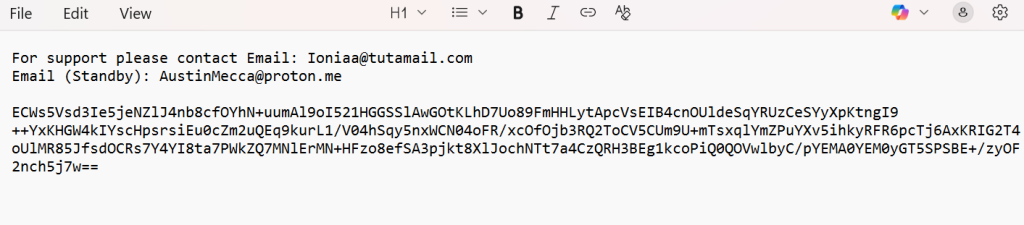
Contents
For support please contact Email: [email protected]
Email (Standby): [email protected]
ECWs5Vsd3Ie5jeNZlJ4nb8cfOYhN+uumAl9oI521HGGSSlAwGOtKLhD7Uo89FmHHLytApcVsEIB4cnOUldeSqYRUzCeSYyXpKtngI9++YxKHGW4kIYscHpsrsiEu0cZm2uQEq9kurL1/V04hSqy5nxWCN04oFR/xcOfOjb3RQ2ToCV5CUm9U+mTsxqlYmZPuYXv5ihkyRFR6pcTj6AxKRIG2T4oUlMR85JfsdOCRs7Y4YI8ta7PWkZQ7MNlErMN+HFzo8efSA3pjkt8XlJochNTt7a4CzQRH3BEg1kcoPiQ0QOVwlbyC/pYEMA0YEM0yGT5SPSBE+/zyOF2nch5j7w==
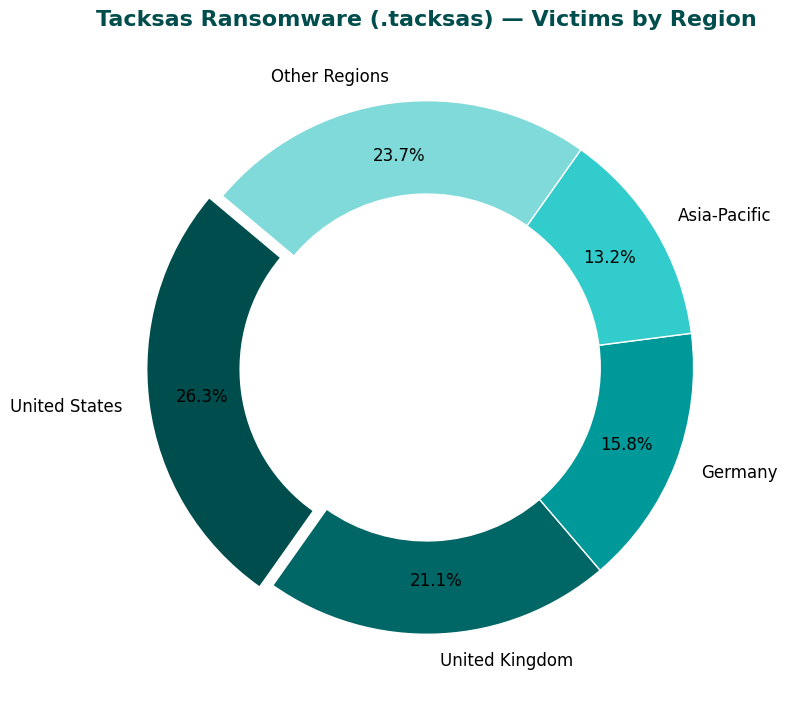
Victim Data & Statistical Insights
Geographic distribution:
Industry exposure:

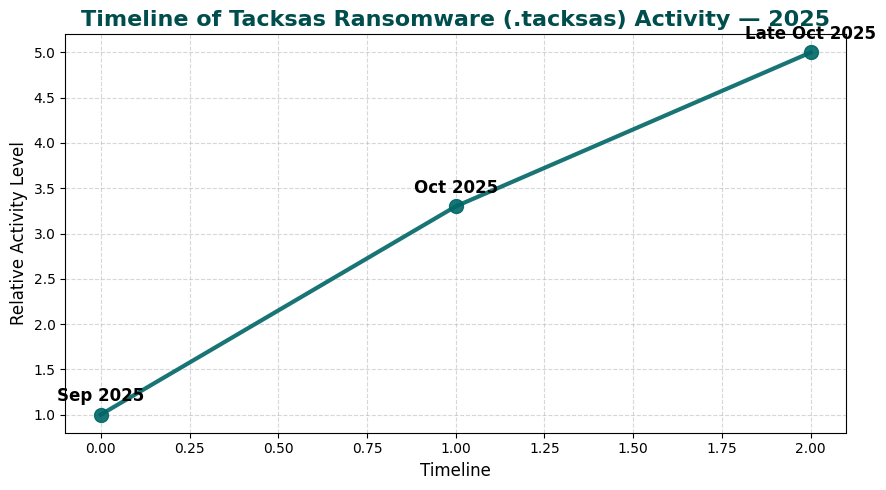
Observed timeline:
Best Practices for Defense & Prevention
Implement multi-factor authentication (MFA) across all critical systems.
Apply patches and disable any unused remote-access protocols.
Maintain air-gapped, immutable backups stored outside production networks.
Monitor outbound traffic for abnormal activity toward encrypted mail services like ProtonMail or Tutanota.
Adopt the principle of least privilege, limiting administrative access.
Use EDR/XDR platforms configured with YARA rules for .tacksas detection.
Decryptability & Recovery Expectations
The Tacksas encryption method — likely AES-256 for files and RSA/ECC for key exchange — is designed to resist brute-force attempts. Each victim session uses a distinct key set, meaning universal decryptors are impossible without private attacker keys.
However, forensic analysis can sometimes recover partial key remnants or exploit weak key-generation routines. Success depends on memory capture timing and malware implementation quality. Always attempt professional forensic recovery before considering payment.
Conclusion
If your organization’s files now end with the .tacksas extension, you are dealing with a confirmed Tacksas ransomware compromise. Preserve all encrypted data and ransom notes before beginning system remediation.
Our forensic response team provides court-admissible, verified recovery workflows, ensuring all operations are transparent, secure, and compliant with data-protection requirements. Whether you operate a small office or an enterprise environment, our goal is safe data restoration without rewarding threat actors.
Avoid risky “free decryptor” offers or panic-driven payments — verified forensic decryption remains the only responsible path forward.
MedusaLocker Ransomware Versions We Decrypt