Atomic Ransomware Decryptor
Leveraging expertise with Makop-based encryption, we’ve reverse-engineered Atomic’s RSA-AES routines to develop a powerful decryptor. Designed for use on Windows, Linux, and VMware ESXi systems, it restores your files swiftly—no ransom payment required.
How the Decryptor Works
AI-Powered Cloud Analysis with Blockchain Verification
Encrypted files are securely processed in our cloud environment, while blockchain-verified hashes guarantee each restored file perfectly matches the original—ensuring data integrity.
Your unique VictimID—embedded in filenames like . [VictimID].[[email protected]].atomic—is automatically matched to the correct decryption key, eliminating guesswork.
Missing your ransom note (+README-WARNING+.txt)? Our premium decryptor recognizes newer variants by detecting key derivation patterns, enabling recovery even without an ID.
Before decryption begins, we conduct a no-risk scan to verify files without altering them. Only verified matches are decrypted, protecting your data.
What You’ll Need
- Ransom note (+README-WARNING+.txt)
- Files with . [VictimID].[email].atomic extension
- Internet access for decryptor operations
- Administrator privileges on Windows, Linux, or ESXi
- (Optional) NVIDIA GPU for accelerated decryption
Immediate Actions Post-Infection
Unplug them from the network to prevent spread via SMB or shared resources.
Retain encrypted files and the ransom note. Also collect logs, file hashes, and memory images for analysis.
Avoid starting encrypted VMs or backup systems further—this could trigger additional encryption.
Atomic acts fast and may steal or leak data. A professional response significantly increases the chance of successful recovery.
Recovery Methods for Atomic Ransomware
Atomic is a destructive Makop variant—it encrypts files quickly, appends . [VictimID].[email].atomic, and threatens data release. Here’s a breakdown of effective recovery techniques.
Older Atomic versions have weak key generation. Community tools exploit these flaws to generate AES keys and decrypt files. These are only effective on pre-2023 infections.
Safest and most reliable: restore from offline or segmented backups. Verify snapshots, wipe infected machines, and rebuild environments from clean images.
Use pre-infection snapshots in VMware, Proxmox, or similar systems. Ensure the snapshot is clean, isolated, and date-verified. This method offers speedy recovery if the snapshot remains untainted.
Open-source tools utilize CUDA-enabled GPUs to brute-force timestamp seeds used by Atomic. Effective on newer variants, this Linux-based tool works best with RTX 3060+ cards, but requires scripting skills and may take considerable time.
Ransoms may unlock files tied to your VictimID. But decryptors aren’t guaranteed, may carry malware, and payment carries legal and ethical risks.
Experts can mediate with attackers, often negotiate lower ransoms, and verify decryptor functionality through test files. However, fees vary, and success isn’t assured.
Our Protected Atomic Decryptor
- Deep Engineered Core: Extracts AES keys by dissecting Makop’s hybrid encryption model.
- Secure Cloud Processing: Files are decrypted in sandboxed environments; logs are provided for your review.
- No Retained Data: Connections are secure, and no files are stored after your session ends.
Step-by-Step Guide to Recovery
- Confirm Infection
Look for files named . [VictimID].[[email protected]].atomic alongside +README-WARNING+.txt. - Secure Your Network
Disconnect infected systems to prevent spread. - Submit to Analysis
Send our team an encrypted sample plus the ransom note. We’ll identify the variant and propose a timeline. - Execute the Decryptor
- Run the tool as an administrator
- Select the folder with encrypted files
- Input the exact VictimID
- Launch decryption
- Run the tool as an administrator
- Cleanup After Decryption
Run antivirus and EDR scans, rebuild or clean any persistent environments, and restore from sanctioned backups. Continue to monitor your network for hidden threats.
Offline vs Online Decryption
- Offline Mode: Ideal for air-gapped systems; transfer the tool via secure storage and decrypt locally.
- Online Mode: Upload encrypted files securely to our cloud for faster, expert-run recovery.
About Atomic Ransomware
Atomic is a destructive Makop branch that quickly encrypts files with strong RSA-AES combinations and adds . [VictimID].[email].atomic extensions. Victims receive a ransom note threatening to leak stolen data. Typically targeting SMBs through phishing, rogue software, and malicious ads, encryption generally completes within minutes after execution.

Atomic Ransomware: Trends in Timeline, Geography, and Industry
- Timeline: Evolving from early Makop into stronger, data-leaking variants during 2022–2025.

- Geography: Likely impacts in North America, Europe, and Asia where ransomware remains prevalent.

- Industries: Manufacturing, healthcare, education, government, IT organizations, and small enterprises appear most affected.

Indicators of Compromise (IOCs)
- Filenames formatted as . [VictimID].[attacker-email].atomic
- Ransom note: +README-WARNING+.txt
- Attacker contact emails: [email protected] / [email protected]
- Deleted Windows shadow copies (vssadmin delete shadows usage)
- Suspicious TOR IP or cloud transfers
- Malware artifacts in temporary folders
Inside the Atomic Ransom Note: Threats, Tactics, and Warnings
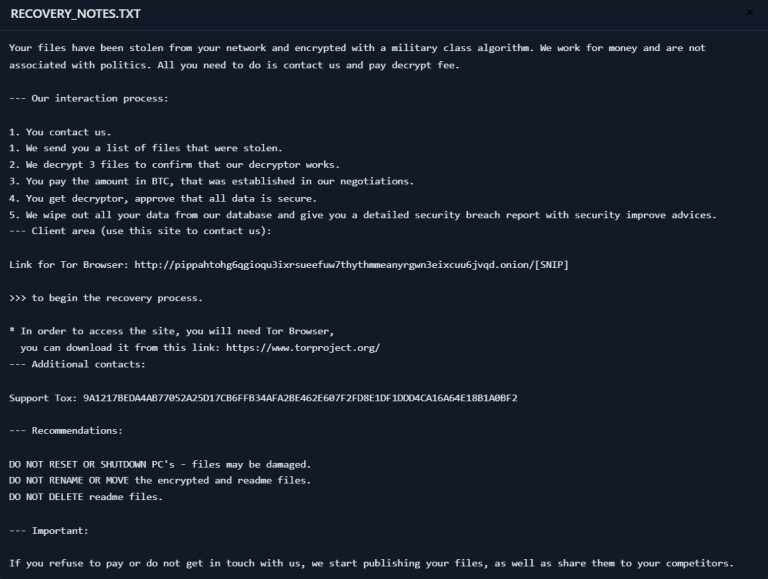
The ransom note contains the following message:
*/!\ WE RECENTLY CONDUCTED A SECURITY AUDIT OF YOUR COMPANY /!*
All your important files have been encrypted!
Your data is safe — it is simply encrypted (using RSA + AES algorithms).
WARNING:
ANY ATTEMPTS TO RECOVER FILES USING THIRD-PARTY SOFTWARE
WILL RESULT IN IRREVERSIBLE DATA LOSS.
DO NOT MODIFY the encrypted files.
DO NOT RENAME the encrypted files.
No publicly available software can help you. Only we can restore your data.
We have copied confidential data from your servers, including:
Personal data of employees and clients (passports, addresses)
Financial documents, accounting reports, tax declarations
Contracts with suppliers and clients (including NDAs)
Full client databases with payment histories
All data is stored on our secure offshore servers.
If no agreement is reached:
We will begin leaking data on:
Twitter/X (mentioning your clients and partners)
Darknet forums (for sale to competitors/hackers)
Major media outlets
Tax authorities (full financial reports + evidence of violations)
Important information:
The attack was designed to look like an internal crime. This means:
Your cyber insurance will not apply (if you have one)
Law enforcement will first suspect your employees or tax evasion.
We offer a one-time payment — with no further demands.
Our terms:
Your data holds no value to us — it is only a guarantee of payment.
We do not want to bankrupt your company.
FREE DECRYPTION AS A GUARANTEE
Before making a payment, you may send up to 2 files for free decryption.
The total size of the files must not exceed 1 MB (unarchived).
Files must not contain sensitive or important information (e.g., databases, backups, multi-page documents, large Excel spreadsheets, etc.).
If a file contains important data or a lot of text, you will receive only a screenshot of the decrypted file.
Contact us at:
Tactics, Techniques & Toolset Analysis
Initial Access
Attackers typically rely on phishing emails, cracked software installers, and vulnerable RDP/VPN connections to gain entry, often using malvertising and Trojanized content.
Credential Theft & Lateral Movement
Once inside, they deploy Mimikatz to extract Windows credentials from memory, facilitating domain-level access. LaZagne helps harvest stored passwords from browsers, email apps, and network tools.
Reconnaissance
SoftPerfect Network Scanner maps out live hosts and open ports, while Advanced IP Scanner helps identify RDP-enabled systems and shared resources crucial for lateral spread.
Defense Evasion & Persistence
Atomic exploits legitimate utilities—such as Zemana AntiMalware via driver vulnerabilities—to disable security tools without triggering alerts.
Data Exfiltration
Before encryption, FileZilla or WinSCP is used to transfer data to attacker servers. RClone and MegaCMD automate uploads to cloud storage, while Ngrok and AnyDesk enable remote persistence and hidden access.
Encryption & Recovery Prevention
Using scripts, Atomic invokes powerful commands like vssadmin and wmic to delete shadow copies and logs, then encrypts files using its strong RSA-AES combination.
Mitigation & Best Practices
To protect against Atomic ransomware:
- Enforce multi-factor authentication (especially for RDP/VPN)
- Keep systems and applications fully patched
- Block unsigned driver installations
- Segment networks and keep backups offline
- Implement continuous monitoring via SOCs or MDR services
Conclusion
Atomic ransomware can appear formidable—but with the right knowledge, tools, and speed, it’s recoverable. Avoid unreliable decryptors and pressure tactics from attackers. Whether you choose backup restoration, free tools, GPU-based research tools, or our cloud decryptor, act swiftly and decisively.
MedusaLocker Ransomware Versions We Decrypt