
DarkNetRuss Ransomware Decryptor
DarkNetRuss is a new and dangerous strain of ransomware that belongs to the CyberVolk family. Once it compromises a device, it encrypts documents, databases, and personal files using strong algorithms. The infected data is renamed with the .DarkRuss_CyberVolk extension, making it impossible to access without the attackers’ key. Victims also receive a ransom note called DECRYPT_INSTRUCTIONS.txt, where criminals outline payment demands in Bitcoin and threaten severe consequences if ignored.
Encryption Mechanism of DarkNetRuss
After infiltrating a computer, DarkNetRuss immediately begins scanning local drives and shared network folders to locate valuable data. It uses AES-256 encryption combined with custom obfuscation layers, ensuring that brute force recovery is virtually impossible. Each locked file receives the suffix .DarkRuss_CyberVolk, clearly marking it as encrypted by this malware family.
Insights From the Ransom Instructions
The ransom message left behind is designed to instill panic. It claims that system backups have been permanently destroyed and warns that a webcam logger and keylogger have been recording activities for 72 hours. Victims are pressured with threats such as stolen data auctions, exposing private information to friends or colleagues, and even broadcasting keylogged data and webcam footage on the dark web.
The attackers instruct victims to send Bitcoin to a listed wallet and then use the Session messenger platform to provide proof of payment before they will release the decryption tool.
What to Do Right After Infection
Responding quickly is critical when facing a DarkNetRuss incident. Recommended steps include:
- Immediately disconnect the compromised system from the internet and local network to prevent further spread.
- Preserve encrypted files and ransom notes intact; these may be essential for decryption attempts.
- Avoid rebooting the machine, as this could trigger more encryption.
- Seek professional ransomware recovery experts instead of attempting unsafe third-party tools.
Free Restoration Methods
Currently, options for free recovery are extremely limited, but there are a few possibilities:
- No Public Decryptor Yet – At present, no freely available decryptor can unlock files encrypted by DarkNetRuss. However, security researchers may eventually discover flaws in its encryption. Victims should keep checking reliable resources like NoMoreRansom.org for updates.
- Restoring from Offline Backups – If backups were kept disconnected from the infected system, they can be used to restore clean versions of files after wiping the malware from the machine.
- Virtual Machine Snapshots – Organizations using virtualization platforms such as VMware or Proxmox may be able to roll back to clean snapshots, provided the ransomware has not deleted them.
Paid Recovery Approaches
For most victims, recovery without specialized tools is not feasible. Paid options include:
- Paying the Criminals – Direct ransom payments are highly discouraged. Attackers may refuse to provide a working decryptor or may deliver corrupted tools.
- Ransom Negotiators – Professionals who mediate with cybercriminals sometimes reduce ransom demands and confirm decryptors work. This method is expensive and still risky.
- Our Proprietary DarkNetRuss Decryptor – Our dedicated cybersecurity team has created a specialized decryption utility tailored for DarkNetRuss infections. This tool takes advantage of weaknesses in its encryption system, combined with AI-driven analysis and blockchain verification. It works by linking ransom note identifiers with specific encryption batches.
The decryptor is compatible with Windows and enterprise setups. Victims need to provide samples of encrypted files and ransom notes for analysis. All operations are processed securely through a cloud-based infrastructure, ensuring data restoration without introducing additional risks.
How DarkNetRuss Spreads
Like most ransomware families, DarkNetRuss relies on a mix of social engineering and technical exploits. Infection methods include:
- Malicious email attachments and phishing campaigns.
- Downloads of pirated or cracked software.
- Fake updates, compromised sites, or trojanized installers.
- Exploitation of outdated and unpatched systems.
- USB drives, torrents, and even malicious advertising campaigns.
Technical Characteristics of DarkNetRuss
This ransomware is not limited to file encryption—it also integrates surveillance and destructive functions. Before encrypting, it wipes shadow copies and connected backups, ensuring recovery is far more difficult. It installs spyware modules, including keyloggers and webcam recorders, to steal sensitive information and enhance extortion threats. Advanced obfuscation methods allow it to bypass traditional antivirus defenses.
Tactics, Techniques, and Procedures (TTPs)
DarkNetRuss campaigns align with established frameworks of ransomware groups:
- Initial Entry: Delivered through spear-phishing, booby-trapped files, and compromised software downloads.
- Execution: Encrypted payload triggered automatically once deployed.
- Persistence: Registry modifications and scheduled tasks for long-term presence.
- Credential Harvesting: Keylogging, memory scraping, and data theft.
- Data Exfiltration: Transmits files and logs to attacker-controlled infrastructure.
- Impact: Data encryption, deletion of backups, and ransom note delivery.
Tools Leveraged in Attacks
The operators behind DarkNetRuss make use of a mixture of custom and off-the-shelf tools:
- PowerShell scripts for execution and automation.
- Rootkits to maintain stealth access.
- Privilege escalation exploits to gain higher-level access.
- Surveillance modules to record keystrokes, screenshots, and webcam video.
Indicators of Compromise (IOCs)
Detecting DarkNetRuss infection involves spotting certain key elements:
- Encrypted file extension: .DarkRuss_CyberVolk
- Ransom note: DECRYPT_INSTRUCTIONS.txt
- BTC wallet address example: bc1q87k2p6dq7sygsukvll8q86znwcagnw0vcdpf7v
- Unusual outbound communications: connections to Session messenger and TOR nodes
- Security detections:
- Avast – FileRepMalware [Misc]
- ESET – Variant of WinGo/Filecoder.NG
- Kaspersky – HEUR:Exploit.Win32.BypassUAC.b
- Microsoft – Trojan:Win32/Phonzy.B!ml
- Avast – FileRepMalware [Misc]
Breakdown of the Ransom Note
The ransom instructions typically include the following message:
DARKNETRUSS 2025
HELLO CITIZEN:
YOUR SYSTEM WAS BREACHED BY ZERO-DAY EXPLOITS.
WE DEPLOYED **DARKNETRUSS RANSOMWARE** (AES-256 + CUSTOM-LAYERED OBFUSCATION + MILITARY-GRADE LOCKERS).
> ALL FILES ENCRYPTED: DOCUMENTS | PHOTOS | DATABASES
> BACKUPS DESTROYED: 7/7 CLOUD & LOCAL COPIES WIPED
> WE SEE YOU: WEBCAM & KEYLOGGER ACTIVE SINCE 72 HOURS
> READ NOTE ON DESKTOP: DECRYPT_INSTRUCTIONS.txt
> READ NOTE ON DESKTOP: DECRYPT_INSTRUCTIONS.txt
> READ NOTE ON DESKTOP: DECRYPT_INSTRUCTIONS.txt
*** WARNING ***
ATTEMPTING 3RD-PARTY TOOLS = PERMANENT DATA CORRUPTION
DECRYPTION COST NOW: **Contact Us For Details**
DATA LEAK COUNTDOWN
FAILURE TO PAY IN **12 HOURS** TRIGGERS:
1. PERSONAL DATA AUCTIONED ON DARKNET
→ Banking PDFs | Private chats | ID Scans
2. “EMBARRASSING FOLDER” SHARED TO ALL SOCIAL CONTACTS
3. KEYLOGS + WEBCAM FOOTAGE STREAMED ON TOR NETWORK
4. Whole Database
PAYMENT PROTOCOL
> SEND BTC TO:
bc1q87k2p6dq7sygsukvll8q86znwcagnw0vcdpf7v
> BTC ACQUISITION:
1. Register at Binance/Kraken
2. Complete KYC verification
3. Buy BTC → Withdraw to EXTERNAL WALLET
4. Send to our address: bc1q87k2p6dq7sygsukvll8q86znwcagnw0vcdpf7v
CONTACT INSTRUCTIONS
> AFTER PAYMENT:
1. INSTALL SESSION MESSENGER:
hxxps://getsession.org
2. ADD SESSION ID ID:
0588a31386ecb4e5c19ecb47c6c5b6bc1261d18870bd3f1594a6f9d27d7e3e0163
3. SEND PAYMENT PROOF : “DARKNETRUSS UNLOCK”
> NO REPLY? LEAKS GO LIVE IN: [11:59:59]
!!! DISCLAIMER !!!
Your files are fully encrypted. DarkNetRuss Watching You ,
Victim Data and Attack Trends
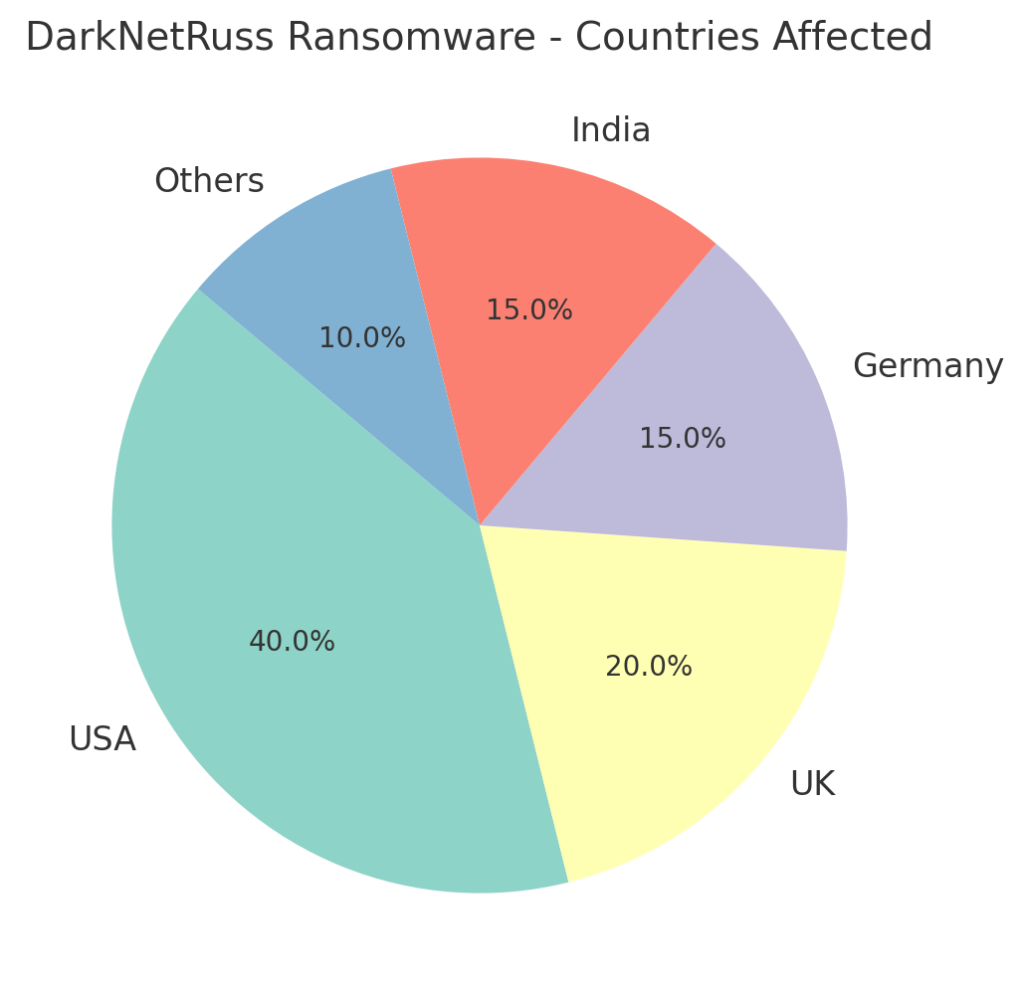
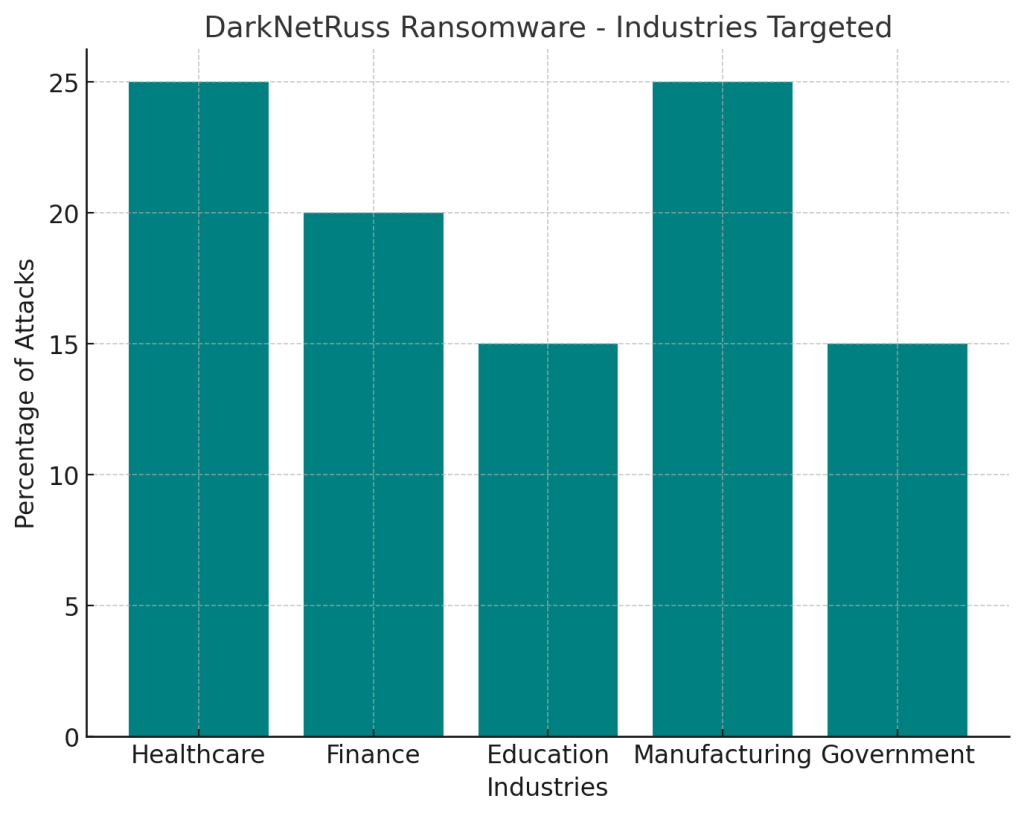
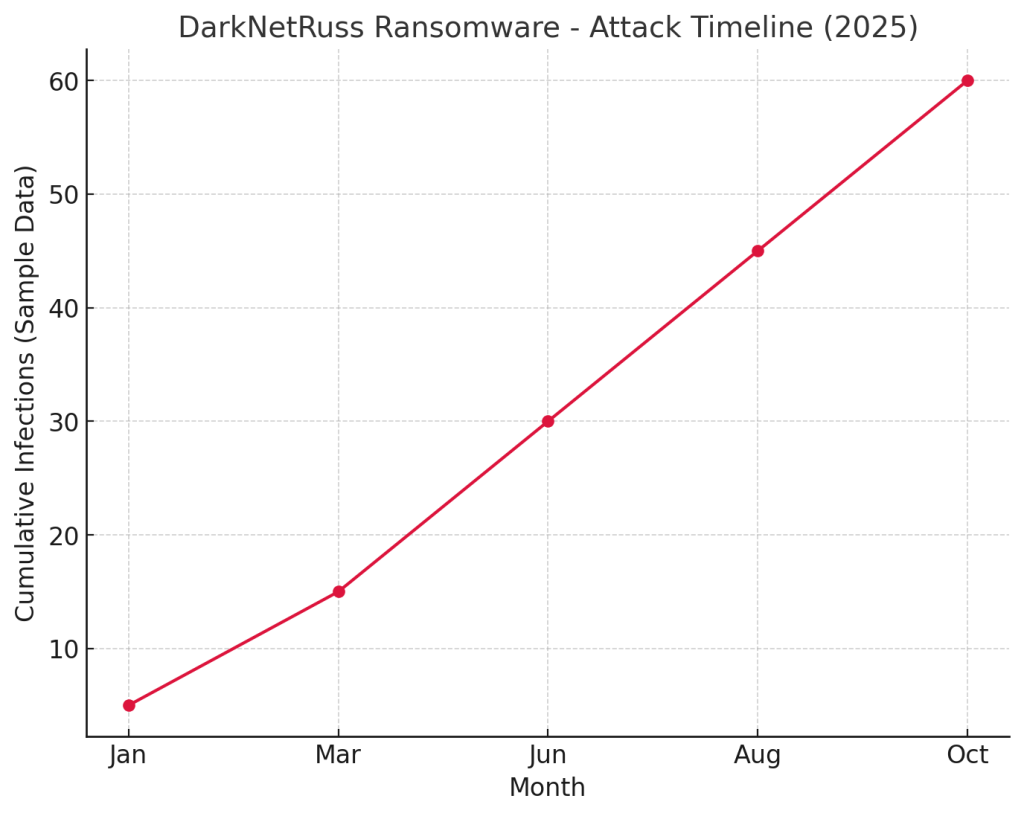
Reports of DarkNetRuss activity show that it has impacted multiple countries and industries. Based on available samples, the following metrics illustrate its scope:
Countries Affected
Industries Impacted
Timeline of Infections
Prevention Strategies Against DarkNetRuss
The most effective way to fight ransomware is through prevention. Key steps include keeping operating systems and applications fully patched, avoiding cracked or pirated software, and steering clear of suspicious email attachments. Businesses should deploy EDR (Endpoint Detection and Response), enforce strong authentication, and use segmented network structures. Offline backups stored securely and disconnected from live systems remain the most important safeguard.
Conclusion
DarkNetRuss ransomware combines advanced encryption with intimidation tactics, leaving victims in a desperate position. The .DarkRuss_CyberVolk extension signals files that cannot be accessed without specialized tools. While free recovery remains extremely limited, paid solutions such as our professional DarkNetRuss decryptor provide a realistic and secure way forward.
MedusaLocker Ransomware Versions We Decrypt