
Babyk Ransomware Decryptor
After months of forensic research and code analysis, our incident response division has successfully reverse-engineered key components of ransomware strains utilizing the .bSobOtA1D and .babyk extensions. These infections stem from LockBit 3.0 Black and Babuk Locker variants—two of the most disruptive ransomware families currently active.
Our proprietary decryptor platform is designed to accurately identify, analyze, and restore encrypted files in Windows, Linux, and VMware ESXi environments. Every process is built with integrity verification and reliability in mind, ensuring that data recovery is fast, secure, and verifiable—reducing downtime and minimizing financial loss for affected organizations.
How Our Babuk Decryptor Works
Hybrid Signature Analysis
Each encrypted sample is analyzed for cryptographic markers, file headers, and ransom note identifiers.
The decryptor automatically detects whether the infection originates from a LockBit 3.0 or Babuk build.
This dual-signature logic is critical, since some victims experience double encryption, where both ransomware families lock files sequentially.
AI-Driven Key Reconstruction
Our machine-learning engine compares encrypted data patterns against an internal library of ransomware encryption fingerprints.
By examining entropy levels, initialization vectors, and known algorithmic flaws found in earlier LockBit or Babuk releases, the system attempts to reconstruct partial keys where possible, significantly improving the odds of successful decryption.
Encrypted Cloud Sandbox
All decryption operations occur in an isolated, read-only cloud sandbox.
Each file processed undergoes cryptographic verification to ensure the decrypted result maintains full hash integrity (SHA256).
This guarantees a tamper-proof process that never overwrites or modifies original data until recovery is confirmed.
Dual-Stage Algorithm
When the infection is identified as LockBit 3.0 Black, the decryptor initiates an AES/ChaCha20-RSA hybrid recovery cycle.
If both LockBit and Babuk components are present, the tool performs a two-phase decryption — removing the LockBit layer first, followed by the Babuk layer, to restore the original data sequence.
Requirements
To perform successful recovery, please have the following ready:
- A copy of the ransomware note (for example: <random_ID>.README.txt or How_To_Restore_Your_Files.txt).
- Several encrypted samples (preferably small files under 1 MB).
- Local or domain administrative privileges.
- Internet access for optional cloud verification.
- All logs and ransomware-related files preserved intact — do not delete ransom notes or infected data, as these are essential for mapping encryption keys.
Immediate Steps to Take After a .bSobOtA1D / .babyk Attack
Disconnect Infected Systems
Immediately sever the compromised devices from the network.
LockBit and Babuk both propagate quickly across connected drives, mapped folders, and shared credentials.
Preserve Every Artifact
Do not rename, alter, or erase encrypted files.
Retain ransom notes, network traces, and malware executables. These provide forensic indicators that determine variant lineage and potential decryptor compatibility.
Power Down with Care
Avoid restarting or reimaging the machine before a professional assessment.
Some ransomware variants execute further encryption or wipe data upon reboot.
Consult a Qualified Recovery Team
Unauthorized tools and community “fixes” can irreversibly damage encrypted files.
Engage verified recovery professionals for a safe diagnostic and decryption strategy.
How to Decrypt .bSobOtA1D / .babyk Files and Recover Lost Data
These extensions indicate a hybrid compromise by LockBit 3.0 Black and Babuk Locker.
Both employ advanced hybrid cryptography, but certain versions contain implementation flaws that make partial decryption feasible under professional analysis.
Decryption and Recovery Options
Free Recovery Tools
Occasionally, cybersecurity vendors or law-enforcement operations release free decryptors for older or faulty LockBit variants.
Always verify tool authenticity via NoMoreRansom.org or trusted antivirus providers like Avast and Kaspersky.
Early Babuk builds from 2021–2022 had weak encryption key generation.
The public Babuk decryptor can sometimes restore .babyk files from these outdated versions.
However, recent Babuk 2.0 builds remain undecryptable without private keys.
Backup Restoration
If offline or immutable backups exist, they are your safest recovery path.
Validate snapshot integrity before initiating system restoration, as LockBit often corrupts or deletes shadow copies to disable easy rollback.
Virtual Machine Snapshots
When dealing with VMware ESXi or Hyper-V environments, reverting to pre-attack snapshots can quickly restore operations.
Always confirm that attackers did not delete or tamper with stored snapshots before performing a rollback.
Negotiated Recovery
If decryption is impossible through known methods, professional negotiators can assist in communication with attackers.
They verify decryptor authenticity via test file recovery and manage payment protocols securely while maintaining compliance with local regulations and insurance procedures.
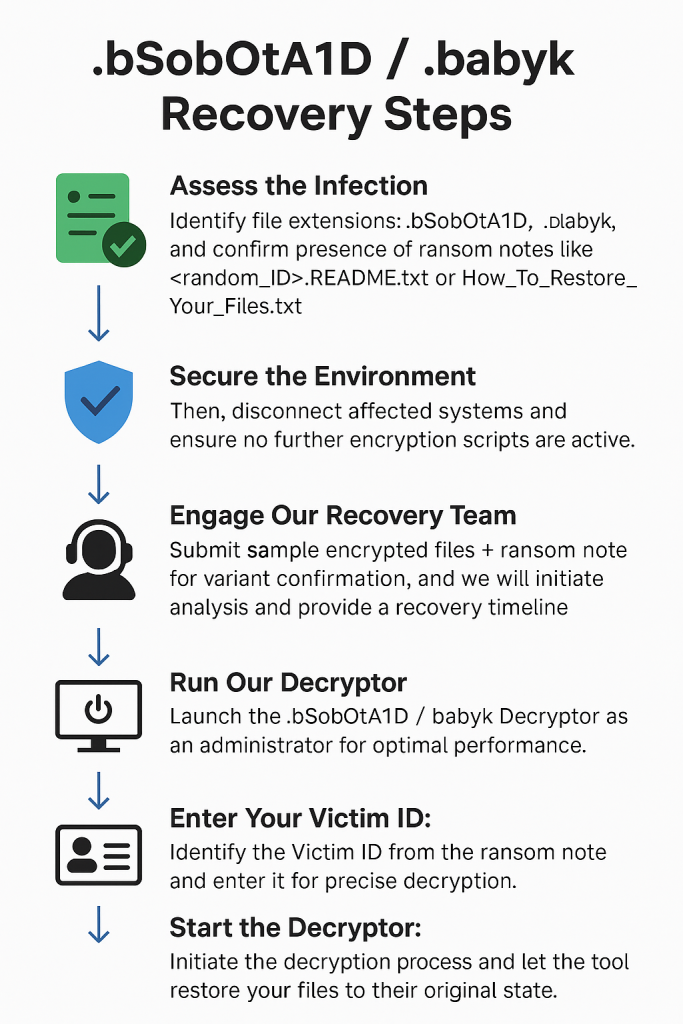
Step-by-Step .bSobOtA1D / .babyk Recovery Guide Using Our Decryptor
Assess the Infection
Check if files end in .bSobOtA1D or .babyk, and locate ransom notes such as <random_ID>.README.txt or How_To_Restore_Your_Files.txt.
Secure the Environment
Disconnect affected systems and confirm that no active encryption processes are still running.
Engage Our Recovery Experts
Submit both the ransom note and several encrypted samples for analysis.
Our team will identify your variant and create a customized recovery plan.
Run the Decryptor
Execute the .bSobOtA1D / .babyk Decryptor with administrative privileges.
A stable internet connection enables live key-matching through our secure network.
Enter the Victim ID
Copy the Victim ID from the ransom note and input it into the decryptor interface for precise matching.
Start the Decryption
Click Start, and allow the decryptor to process your files.
Recovered data will be restored in its original directories.
Offline vs Online Modes
- Offline Mode: Ideal for isolated or high-security environments where no internet is allowed.
- Online Mode: Provides faster recovery with live expert oversight.
Our decryptor supports both approaches, ensuring compatibility for organizations of all sizes.
Technical Profile: .bSobOtA1D / .babyk Ransomware
Suspected Families
- .bSobOtA1D → LockBit 3.0 Black (LockBit Black)
- .babyk → Babuk Locker / Babuk-derived variant
Common Ransom Note Filenames
- LockBit: <random_ID>.README.txt
- Babuk: How_To_Restore_Your_Files.txt, RestoreFiles.txt, Help_Readme.txt, Recover_Your_Files.html
Ransom Note Contents
- Unique victim identifier.
- TOR or Onion chat link for negotiation.
- Promise of test decryption for sample files.
- Threat of data exposure on leak sites (double extortion).
Encryption Techniques
- LockBit 3.0: Combines ChaCha20 for file encryption and RSA-2048 for key protection.
- Babuk: Uses Elliptic Curve Diffie-Hellman (ECDH) plus ChaCha8 for performance and robustness.
- When both infections coexist, files may be encrypted twice—requiring sequential decryption layers.
Tools, TTPs & MITRE ATT&CK Mapping
| Tactic | Technique / Tools Observed |
| Initial Access | Exploited RDP, VPN, or Citrix vulnerabilities (e.g., CVE-2023-4966) |
| Credential Access | Mimikatz, LaZagne, PowerShell key dump |
| Execution | Cobalt Strike, PowerShell loaders, custom scripts |
| Persistence | Scheduled tasks, registry run entries |
| Lateral Movement | PsExec, Group Policy Objects, SMB shares |
| Defense Evasion | Zemana driver abuse, BYOVD, disabling antivirus |
| Exfiltration | RClone, WinSCP, Mega.nz, Ngrok tunnels |
| Impact | Hybrid encryption, deletion of shadow copies |
Known Indicators of Compromise (IOCs)
| Type | Indicators / Description |
| Extensions | .bSobOtA1D, .babyk |
| Ransom Note Files | <random_ID>.README.txt, How_To_Restore_Your_Files.txt |
| Registry Keys | HKCU\Software\LockBit\, HKLM\Software\Babuk\ |
| Processes Terminated | sqlservr.exe, vssvc.exe, msftesql.exe, backup.exe |
| Network Traces | Outbound TOR or C2 traffic |
| Encryption Pattern | 9-character random ID appended to filenames (LockBit signature) |
Mitigation and Prevention
- Apply Patches and Updates promptly, especially for RDP, VPN, and Citrix gateways.
- Enforce Multi-Factor Authentication for all privileged and remote accounts.
- Maintain Offline or Immutable Backups separated from production networks.
- Monitor Outbound Traffic for suspicious TOR relay connections.
- Deploy EDR/XDR Solutions with behavioral ransomware detection.
- Regularly Conduct IR Simulations to improve response readiness and limit spread.
Ransom Note Analysis: What It Reveals
Typical message excerpt:
“All your files have been encrypted using a unique key.
Visit our portal on TOR: [onion address].
You may decrypt one or two files for free.
Altering or renaming data may cause permanent damage.”
Such text mirrors LockBit’s professionalized ransom templates and Babuk’s extortion model—both reference private keys stored on hidden servers and emphasize urgency to push victims into paying.
Activity Trends and Statistics
- LockBit 3.0 Black continues to dominate global RaaS incidents throughout 2025.
- Babuk derivatives have re-emerged across Linux and ESXi infrastructure attacks.
- Hybrid cases (like .bSobOtA1D + .babyk) often occur when affiliates use multiple encryptors in tandem or chain one after another.
Conclusion
The .bSobOtA1D / .babyk ransomware blend represents a formidable combination of LockBit 3.0’s automation and Babuk’s multi-platform reach.
Even though modern encryption renders many files irrecoverable without the proper private key, professional recovery workflows — focusing on forensics, secure containment, and verified decryption tools — frequently enable partial or full restoration.
Trust only reputable recovery specialists and validated decryptors to avoid secondary damage.
MedusaLocker Ransomware Versions We Decrypt