
GoodGirl Ransomware Decryptor
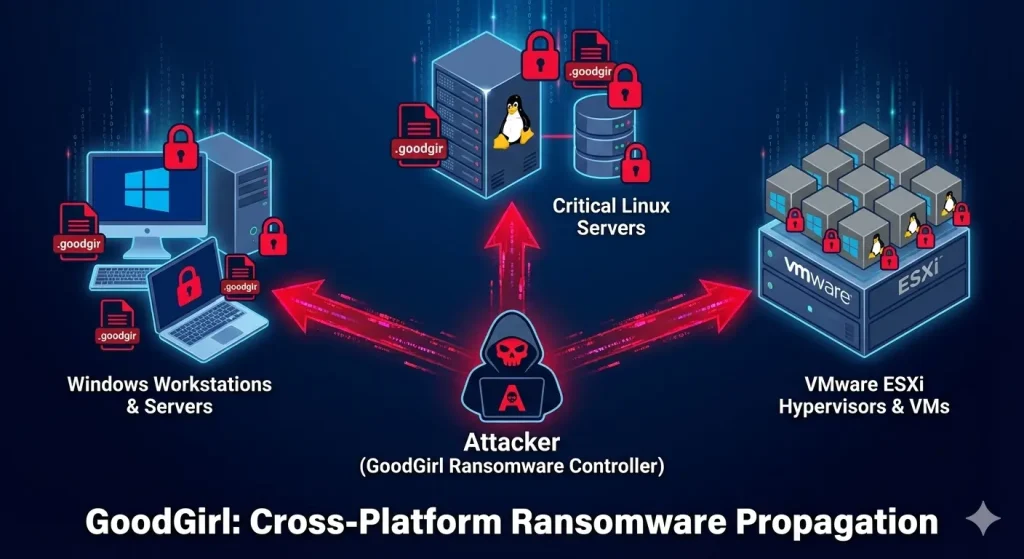
The emergence of GoodGirl ransomware marks a significant escalation in the threat landscape. Far from being a simple file-locker, GoodGirl is a sophisticated, multi-platform menace capable of paralyzing entire digital ecosystems. Its ability to seamlessly target and encrypt data on Windows workstations, critical Linux servers, and the backbone of modern enterprise—VMware ESXi hypervisors—places it in the highest tier of cyber threats. This is not merely an inconvenience; it is a targeted assault on business continuity, data integrity, and operational stability.
Deconstructing the GoodGirl Threat
Before launching into recovery, a deep understanding of the enemy is paramount. GoodGirl’s deceptive name belies its technical prowess and destructive potential.
| Attribute | Detail |
|---|---|
| Threat Name | GoodGirl Ransomware |
| Threat Type | Ransomware, Crypto Virus, Files Locker |
| Platform | Windows, Linux, VMware ESXi |
| Encrypted Files Extension | [attacker_email].goodgir |
| Ransom Demanding Message | #Read-for-recovery.txt |
| Free Decryptor Available? | Yes, our specialized GoodGirl Decryptor. |
| Ransom Amount | Varies, typically demanded in cryptocurrency. |
| Cyber Criminal Contact | [email protected] |
| Detection Names | Avast (Win64:MalwareX-gen [Ransom]), ESET (Win64/Filecoder.Proton.A Trojan), Kaspersky (HEUR:Trojan-Ransom.Win32.Generic), Microsoft (Ransom:Win64/Akira.CCDR!MTB). |
The Ransom Note: A Study in Psychological Manipulation
The #Read-for-recovery.txt file is a masterclass in concise psychological manipulation. It is designed to create a sense of urgency and dependency while pre-empting common communication failures.
Email 1: [email protected]
Email 2: [email protected]

Send messages to both emails at the same time

So send messages to our emails, check your spam folder every few hours

ID: -

If you do not receive a response from us after 24 hours, create a valid email, for example, gmail,outlook
Then send us a message with a new email
Analysis of Tactics:
- Redundancy: Providing the same email address twice is a strange but effective tactic to reinforce the contact method in the victim’s mind.
- Pre-emptive Problem Solving: By instructing the victim to check their spam folder and create a new email account, the attackers are actively managing the communication channel to ensure their ransom demands are heard. This portrays a false sense of professionalism and reliability.
- Urgency: The 24-hour timeframe creates pressure, discouraging the victim from taking the time to explore alternative recovery options.
Indicators of Compromise (IOCs) and Attack Behavior (TTPs)
Recognizing the attack is the first step toward containment.
IOCs:
- File Extension: The most obvious indicator is the appended extension in the format
[attacker_email].goodgir(e.g.,1.jpg.[[email protected]].goodgir). - Ransom Note File: The presence of
#Read-for-recovery.txtin directories containing encrypted files. - Desktop Wallpaper: The desktop wallpaper is changed to a ransom demand message.
- Cross-Platform Encryption: Evidence of encryption on Windows, Linux, and on virtual machine files (
.vmdk,.vmx,.vmem) on an ESXi host. - ESXi-Specific Artifacts: On an ESXi host, you may find encrypted files in the datastore directories and potentially a modified
welcomemessage or a note in the root directory.
MITRE ATT&CK TTPs:
- Initial Access (TA0001): GoodGirl gains entry through common vectors like phishing emails, exploiting unpatched software vulnerabilities (especially in remote access protocols like RDP), and using compromised credentials purchased on the dark web.
- Lateral Movement (TA0008): Once inside a network, the ransomware uses tools like PsExec or SMB exploits to spread laterally. It actively scans for open network shares and credentials stored in memory to access other machines, including critical Linux servers and ESXi hypervisors.
- Impact (TA0040): The primary impact is widespread data encryption. On ESXi, it doesn’t just encrypt files; it shuts down virtual machines, encrypts their configuration and disk files, and can even encrypt the ESXi host’s own file system, rendering the management interface inaccessible.
The Recovery Playbook – A Multi-Path Approach
This is the core of your response. We will explore every viable path to data restoration, from the ideal scenario to the last resort.
The Direct Decryption Solution
The most direct path to recovery is using a tool specifically designed to reverse the encryption.
Our team has developed a specialized decryptor to counter the GoodGirl threat across all its targeted platforms. This tool is the result of deep cryptographic analysis of the GoodGirl strain.
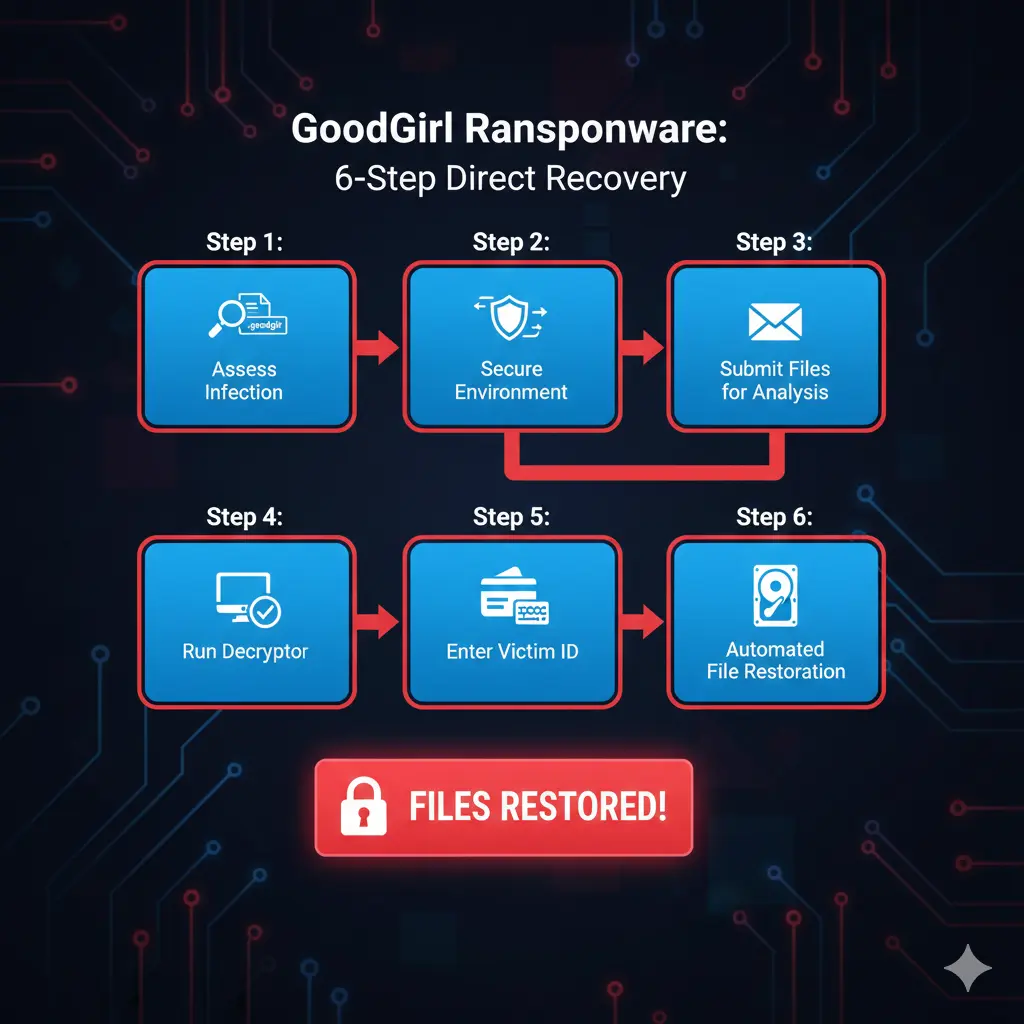
Step-by-Step Guide:
- Step 1: Assess the Infection: Confirm the presence of the
#Read-for-recovery.txtfile, the changed wallpaper, and identify the unique file-naming pattern (.goodgirextension) on Windows, Linux, and ESXi systems. - Step 2: Secure the Environment: CRITICAL: Disconnect all infected devices, including servers and ESXi hosts, from the network to halt any further spread. Do not reboot systems unless absolutely necessary, as this can cause data loss.
- Step 3: Submit Files for Analysis: Send a few encrypted samples (under 5MB) and the ransom note file to our team. This allows us to confirm the GoodGirl variant and build an accurate recovery timeline.
- Step 4: Run the GoodGirl Decryptor: Launch the tool with administrative privileges (
sudoon Linux, “Run as Administrator” on Windows, or via SSH on ESXi). The decryptor connects securely to our servers to analyze encryption markers and file headers. - Step 5: Enter the Victim ID: The unique ID provided in the ransom note is required to generate a customized decryption profile.
- Step 6: Automated File Restoration: Once initiated, the decryptor verifies file integrity and restores data automatically, preserving original filenames and directory structures.
If our tool is not applicable, several public initiatives are invaluable. Always identify the ransomware strain before using any tool, as running the wrong decryptor can cause permanent damage.
- ID Ransomware Service: Use the free ID Ransomware service to upload the ransom note and a sample encrypted file. Find it at ID Ransomware.
- The No More Ransom Project: This is the most important resource, providing a centralized repository of free decryption tools. Find it at The No More Ransom Project.
- Major Security Vendor Decryptors: Check the websites of Emsisoft, Kaspersky, Avast, and Trend Micro for available tools.
In-Depth Recovery Scenarios by Platform
Here we detail the specific recovery methods for each platform GoodGirl targets.
Advanced Linux System Recovery
When a Linux server is hit by GoodGirl, recovery requires a different set of tools and knowledge.
- Btrfs/ZFS Snapshots: If your file system is Btrfs or ZFS, you may have snapshots enabled. These are point-in-time, read-only copies of your file system that can be used to revert data to a state just minutes before the attack. This is often the fastest recovery method for file systems that support it.
- Rsync and Tar: For smaller setups, using
rsyncto sync data to an off-site location ortarto create compressed archives are common methods. If you have recentrsyncbackups ortararchives, you can restore from them. - Enterprise-Grade Backups (Veeam): Veeam provides robust protection for Linux environments, including support for agent-based backups of Linux servers and applications. It can create immutable backups that cannot be altered by the ransomware. Learn more at the official Veeam website.
- TestDisk & PhotoRec: These are powerful, free, and open-source data recovery utilities for Linux. TestDisk can recover lost partitions and repair boot sectors, while PhotoRec is designed to recover specific file types even if the file system is severely damaged. You can find them on the CGSecurity website.
- Foremost: Another console-based file recovery program that can recover files based on their headers, footers, and internal data structures. It is often included in Linux forensic toolkits.
Important Procedure: For the best chance of success, you should shut down the affected server, remove its hard drive, and attach it as a secondary drive to a separate, clean Linux machine. Then, run the data recovery software on that clean machine to scan the secondary drive.
VMware ESXi Hypervisor Recovery
An attack on an ESXi host is a critical business continuity event. GoodGirl encrypts the virtual machine files, effectively taking all hosted VMs offline.
- VMware vSphere Data Protection: If you were using a dedicated backup solution for vSphere, this is your primary recovery path. These solutions take image-level backups of VMs that can be restored to a new, clean host.
- Veeam Backup & Replication for VMware: Veeam is a market leader in this space, offering powerful, agentless backup of VMs with features like instant recovery and immutable backups. This is the gold standard for protecting virtualized environments.
- Restoring from Snapshots: If you took snapshots of your VMs before the attack, you can revert to them. However, be aware that GoodGirl may have deleted or corrupted these snapshots.
- Using a Linux Live CD: You can boot the ESXi host with a Linux live environment, mount the VMFS datastore (where the VM files are stored), and then use Linux data recovery tools like
PhotoRecto attempt to carve out unencrypted files from the encrypted.vmdkvirtual disks. This is a highly complex and low-probability operation. - Do Not Pay the Ransom: ESXi ransomware attacks are notoriously unreliable. Even after payment, attackers often fail to provide a working decryptor, or the decryptor itself may corrupt the VM files, making them unbootable.
Specialized Network Storage Recovery (NAS, SAN, DAS)
GoodGirl’s cross-platform nature means it is fully capable of targeting network storage, making recovery more complex. The approach depends on the storage architecture.
NAS devices (e.g., Synology, QNAP) are prime targets because they are often less secured and contain vast amounts of data.
- Leverage Built-in Features: The most effective method for NAS devices is Snapshots. Brands like Synology and QNAP have a snapshot feature that takes point-in-time, read-only copies of your data. These snapshots are often invisible to ransomware and can be used to revert shared folders to a state just minutes before the attack.
- Cloud Sync Versioning: If your NAS was configured to sync files to a cloud service like Google Drive, Dropbox, or OneDrive, you may be able to use the version history features of those services to restore your files to an unencrypted state.
- Public Decryption Tools: You may be able to mount the NAS volumes as a drive on a clean PC and run our GoodGirl decryptor directly on them.
SANs provide block-level storage to servers. Recovery happens at the server level, but the SAN itself offers powerful protection.
- Storage Array Snapshots: Enterprise SANs (from vendors like Dell EMC, NetApp, HPE) have robust snapshot and cloning capabilities. These are the most effective way to recover entire LUNs (Logical Unit Numbers) to a point-in-time before the attack.
- LUN Masking and Isolation: Immediately isolate the infected servers from the SAN by using LUN masking in the SAN management console to prevent the ransomware from encrypting more volumes.
DAS is storage directly connected to a single server (e.g., via SAS, USB, or internal drives). The recovery process is identical to recovering from the server’s local drives.
- Server-Level Backups: Recovery depends entirely on the backup strategy for the server to which the DAS is attached.
- Data Recovery Software: If no backups exist, you must treat the DAS drives as you would any other hard drive: remove them, connect them to a clean system, and run data recovery software like TestDisk or PhotoRec.
Data Repairing and Rebuilding Techniques
Recovery is not just about decrypting files. It’s about restoring data integrity and rebuilding systems to a functional state.
Decryption Data Integrity Verification
After running a decryptor, your work is not over. The decryption process, while restoring the file content, can sometimes introduce minor corruptions.
- Checksum Verification: If you have pre-attack checksums (e.g., MD5, SHA-256) for critical files, you can run a checksum utility on the decrypted files and compare them to the original values. This is the most reliable way to verify integrity.
- Application-Level Testing: Open a representative sample of decrypted files in their native applications. For example, open several Word documents, Excel spreadsheets, and PDFs. Look for formatting errors, missing content, or application crashes. For databases, run a consistency check (e.g.,
DBCC CHECKDBfor Microsoft SQL Server).
File and Database Repair Techniques
If corruption is detected, you must move to a repair phase.
- Microsoft Office File Repair: Microsoft Office has a built-in “Open and Repair” feature. In Word, for example, go to
File > Open, select the file, click the dropdown arrow on the “Open” button, and choose “Open and Repair.” - Third-Party File Repair Tools: For severely corrupted files, specialized tools exist. For example, Stellar Repair for Word, Excel Repair Toolbox, or a variety of PDF repair tools can often recover data from files that won’t open in their native applications.
- Database Repair: This is a highly specialized field.
- MySQL: Use the
mysqlcheckutility with the--repairflag. - Microsoft SQL Server: The primary tool is
DBCC CHECKDB. It can identify and often repair corruptions. In severe cases, you may need to restore from a backup and then replay transaction logs up to the point of failure. - Oracle: Oracle has a powerful suite of recovery tools, including RMAN (Recovery Manager) and the
DBMS_REPAIRpackage.
- MySQL: Use the
System and Application Rebuilding
In many cases, especially with server and ESXi infections, the cleanest and safest path forward is to rebuild from scratch.
- The “Bare Metal” Rebuild Principle: For any critical server (Windows, Linux, or ESXi), the most secure recovery method is to:
- Wipe the server’s physical or virtual disks completely.
- Reinstall the operating system from a clean, known-good source.
- Harden the new OS installation with all current security patches.
- Reinstall applications from clean installers.
- Restore data from your verified, clean backups.
- ESXi Rebuild: This involves reinstalling the ESXi hypervisor on the host, reconfiguring networking and storage, and then restoring your VMs from your dedicated backup solution. Do not attempt to “clean” an infected ESXi host; it cannot be trusted.
- Configuration Management: To speed up the rebuilding process, use configuration management tools like Ansible, Puppet, or Chef. These tools allow you to automate the entire server build and hardening process, ensuring consistency and reducing the chance of human error.
Essential Incident Response and Prevention
A full response includes containment, eradication, and future prevention.
Containment and Eradication
- Isolate All Systems: Immediately disconnect all infected machines, including servers, ESXi hosts, and storage appliances, from the network.
- Remove the Malware: Use a reputable antivirus or anti-malware program to scan for and remove the ransomware executable on all affected systems.
- Change All Credentials: Assume that credentials have been compromised and change passwords for all user accounts, administrators, and service accounts across the entire network, including ESXi and vCenter.
Hardening Your Defenses with Modern Protection
- Endpoint Protection Platforms (EPP/EDR): Solutions like SentinelOne Singularity™ Endpoint and CrowdStrike Falcon focus on preventing ransomware by identifying and neutralizing threats using behavioral AI.
- Network Segmentation: Segment your network to prevent lateral movement. Ensure that critical storage systems and ESXi management interfaces are not accessible from general-purpose user workstations.
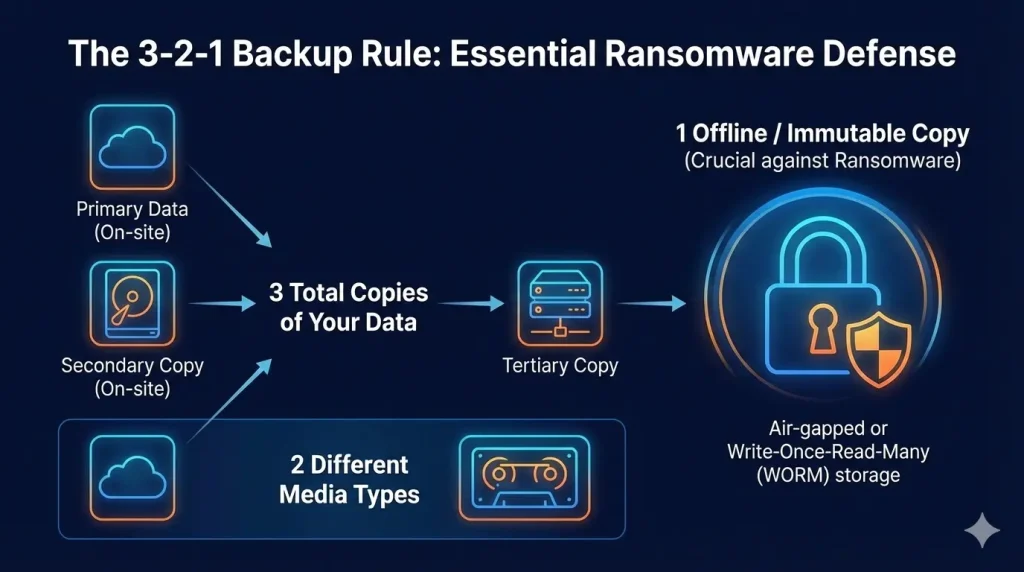
- The 3-2-1 Backup Rule: Maintain at least three copies of your data, on two different types of media, with one copy stored off-site or in the cloud. Test your backups regularly.
- Secure Storage and Virtualization Management: Change default passwords on all NAS, SAN, and ESXi management interfaces. Enable snapshot features and ensure they are configured with a retention policy that meets your recovery point objectives (RPO).
Post-Recovery: Securing Your Environment and Ensuring Resilience
This critical phase begins after your files have been restored.
- Step 1: Verify Data Integrity and Completeness: Check restored files for corruption and completeness.
- Step 2: Conduct a Full System Scan: Run a full, deep scan of your entire environment using a reputable antivirus or anti-malware solution.
- Step 3: Fortify All Credentials: Change all user, admin, service, and cloud passwords. Enforce the use of strong, unique passwords for every account.
- Step 4: Patch and Update Everything: Update the OS and all third-party applications on all systems to close security holes.
- Step 5: Reconnect to the Network Cautiously: Monitor for unusual activity upon reconnection.
- Step 6: Implement or Strengthen a 3-2-1 Backup Strategy: Create or improve a robust backup system and test it regularly.
- Step 7: Perform a Post-Incident Analysis: Review how the attack happened. Use this knowledge to improve user training and security policies.
Reporting Obligations
Report the incident to help combat cybercrime and fulfill potential legal obligations.
- Report to Law Enforcement: In the US, file a complaint with the FBI’s IC3. In the UK, report to Action Fraud.
- Report to CISA: The U.S. Cybersecurity & Infrastructure Security Agency (CISA) urges reporting via its portal.
Conclusion
The GoodGirl ransomware represents a significant and sophisticated threat due to its strong encryption, manipulative ransom note, and dangerous ability to cripple entire storage and virtualized infrastructures. However, like all ransomware, it can be defeated with a calm, methodical, and prepared response. The path to resilience begins with a multi-layered security posture that combines advanced endpoint protection, robust network segmentation, and a disciplined 3-2-1 backup strategy that includes immutable snapshots for both servers and network storage devices. Paying the ransom only fuels the criminal ecosystem and offers no guarantee of a positive outcome. By understanding the tactics of threats like GoodGirl and preparing accordingly, you can transform a potential catastrophe into a manageable incident, ensuring that your data—and your peace of mind—remain secure.
MedusaLocker Ransomware Versions We Decrypt