
Coinbase Cartel Ransomware Decryptor
Discovering that your organization has been targeted by a ransomware-style extortion group is a moment that freezes the entire business. Everything feels like it changes at once — your inbox fills with alerts, unexplained activity appears in logs, and suddenly you learn that your company’s name, website, revenue, and internal data have been posted on a dark-web leak portal maintained by a threat group identifying themselves as Coinbase Cartel.
The shock becomes even more disorienting when files or references appear with a suffix like:
businessdata.xlsx.[ID-7BD214A9][[email protected]].cbcl
Even if no encryption has taken place locally, Coinbase Cartel structures their messaging to create the illusion of total catastrophe. Their leak sites display staged data samples, descriptions of stolen information, and countdowns until public release — each component designed to exert emotional pressure. The psychological effect is immediate: organizations fear reputational fallout, possible regulatory penalties, contractual consequences, and the erosion of hard-earned trust.
Yet despite how devastating these scenarios appear, they are not the end of your business, and they do not force you into ransom negotiations. A data-extortion attack by Coinbase Cartel is serious, but with a structured response, proper containment, in-depth forensic analysis, and professional guidance, most victims are able to regain control, restore stability, and move forward without paying extortion demands.
This guide provides a full-scale, enterprise-ready framework for understanding how Coinbase Cartel operates, how to identify the scope of exposure, how to evaluate risks with precision, and how to implement a coordinated, high-confidence recovery plan. It is written for organizations that require clarity at every level — technical, legal, executive, operational, and reputational.
At the center of this process is our dedicated response and analysis platform, Coinbase Cartel .cbcl Decryptor — a fully engineered forensic and remediation environment that enables victims to determine what data was accessed, how far attackers moved, which systems require hardening, and how to rebuild secure operations without engaging with criminals.
Recover Your Data, Reputation & Stability with the Coinbase Cartel .cbcl Decryptor
Traditional ransomware locks down your infrastructure by encrypting files and demanding payment in exchange for keys. Coinbase Cartel’s operations differ significantly; their power resides in data theft and the threat of public disclosure. Their leak portals frequently display victims sorted by industry and revenue, often accompanied by claims of stolen files, intellectual property, customer data, or financial documents. These claims may be embellished or partially true — but the emotional impact they seek to create is always the same: urgency, fear, and desperation.
Coinbase Cartel leverages two powerful psychological triggers:
- The fear of regulatory exposure, especially when customer data or compliance-bound information appears at risk.
- The fear of reputational fallout, where media attention or competitor awareness could translate into real business harm.
Our Coinbase Cartel .cbcl Decryptor is designed to counter both of these forces. Although it is not a decryptor in the cryptographic sense, the platform serves as a comprehensive incident-response engine that includes:
- A forensic reconstruction system capable of correlating leaked artifacts with internal data structures.
- A data exposure-mapping engine that determines which customers, employees, departments, or jurisdictions are affected.
- A communications strategy framework to guide you through internal, public, regulatory, and partner messaging.
- A security-hardening component that prevents attackers from re-entering and mitigates ongoing risks.
The purpose of this system is not simply to respond to an immediate crisis, but to help you reclaim stability and reassert control over your infrastructure, reputation, and business continuity.
How the Coinbase Cartel .cbcl Decryptor Works
Because Coinbase Cartel attacks function differently than conventional ransomware, our system is built around forensic interpretation, identity analysis, and data exposure assessment rather than decryption of encrypted binaries. The platform focuses on reconstructing the attacker’s pathway through your environment and forming a structured, factual understanding of what happened and how it can be fixed.
Reverse-Engineered Incident Intelligence
Coinbase Cartel, like several modern extortion groups, tends to compromise:
- cloud services and SaaS platforms,
- identity systems and single-sign-on portals,
- CRM and ERP databases,
- cloud storage buckets and collaboration platforms,
- CI/CD pipelines or repository systems.
Their methods often involve credential theft, misconfigured integrations, OAuth token compromise, phishing, and voice-based social engineering (vishing). Once inside a target environment, the attackers look for high-value data that can be exfiltrated quietly.
Our reverse-engineering process compiles and analyzes:
- attacker leak-site descriptions,
- sample data provided by Coinbase Cartel,
- associated timestamps,
- internal system logs,
- access histories and token usage,
- repository and storage activity,
- API call patterns.
This forensic work produces a detailed map of:
- attacker entry points,
- lateral movement paths,
- compromised credentials,
- exfiltrated datasets,
- potential secondary exposure,
- systems requiring remediation.
This mapping becomes the foundation of your recovery plan.
Cloud-Isolated Evidence Processing
Every artifact — from screenshots to leaked files to metadata — is processed within a contained cloud forensic environment. This ensures:
- complete isolation from your production systems,
- full trace logging and chain-of-custody,
- controlled handling of sensitive information,
- accurate classification of exposed data,
- legal defensibility and auditability.
Within this environment, Coinbase Cartel .cbcl Decryptor categorizes data into classes such as personally identifiable information (PII), financial documents, internal communications, intellectual property, and authentication secrets.
Fraud Prevention & Verification
Not every claim made by Coinbase Cartel represents the full truth. They frequently mix legitimate stolen data with assumptions or inflated claims. Our verification layer distinguishes:
- confirmed data exposure,
- potential but unverified exposure,
- and unsupported or fabricated attacker claims.
This measured, factual approach ensures the organization responds responsibly and proportionally rather than based on fear, assumption, or attacker manipulation.
Step-by-Step Recovery Guide by Our Coinbase Cartel .cbcl Decryptor
Assess the Incident and Confirm Attribution
Begin by confirming that your organization appears on a verified Coinbase Cartel leak portal. Identify unique markers such as your company name, sector, domain, geographic information, and any .cbcl references. Confirm whether sample data matches internal systems and schemas.
Secure and Stabilize the Environment
Immediately revoke credentials, rotate keys, terminate unauthorized sessions, and isolate affected systems. Attackers sometimes maintain access for extended periods, especially in cloud platforms, so sealing access quickly is critical even when no encryption has occurred.
Submit Evidence for Forensic Analysis
Provide leak screenshots, data samples, logs, and known suspicious activity. These inputs allow the Decryptor platform to begin reconstructing the timeline, systems accessed, data extracted, and the identity attack chain.
Build a Forensic & Business Impact Profile
The Decryptor analyzes leaked content alongside internal logs to determine which datasets are confirmed compromised, whether sensitive categories of data were disclosed, and what regulatory and contractual obligations apply.
Execute a Coordinated Response Plan
Working with legal, compliance, communications, and IT leadership, you form an actionable plan covering containment, notifications, public statements, technical recovery, customer support, and monitoring.
Long-Term Hardening
Secure your environment against recurrence by strengthening IAM, reducing privilege exposure, improving monitoring, securing cloud configurations, removing stale integrations, and implementing zero-trust practices.
What Should You Do If You’ve Been Infected by Coinbase Cartel .cbcl?
A Coinbase Cartel incident triggers fear, uncertainty, and operational stress — but the response must be calm, structured, and evidence-driven. Begin by preserving all relevant materials: logs, emails, credentials, screenshots, leak samples, and cloud activity reports. Avoid deleting or overwriting anything; even unexpected details may prove vital for forensic or legal reconstruction.
Restrict access aggressively by revoking tokens, rotating credentials, disabling compromised accounts, and segmenting systems. Even if data was only stolen and not encrypted, attackers may retain active sessions.
Refrain from responding directly to the extortion email or leak page instructions. Engaging prematurely may reveal information, weaken your position, or escalate attacker demands. Professional guidance ensures each step supports containment and long-term stability.
Finally, prepare internal and external communications rooted in verified facts. Staff, partners, and regulators must receive clear, accurate information rather than speculation. Our incident-response specialists help organizations craft such communication.
Keep Calm — Our Experts Support You Through Every Stage
Coinbase Cartel attacks extend beyond technical compromise; they affect brand reputation, business continuity, legal exposure, and stakeholder trust. That’s why our assistance includes:
- forensic reconstruction of the attacker’s movements,
- analysis of exposed datasets,
- remediation strategies tailored to your operational environment,
- regulatory reporting support,
- guidance for customer and partner communication,
- recommendations for security architecture improvements,
- and long-term resilience planning.
Our team handles your incident with discretion, professionalism, and focused expertise so you can navigate extortion attempts without succumbing to panic or manipulation.
What Is Coinbase Cartel Ransomware?
Coinbase Cartel is an emerging, aggressive extortion group specializing in data theft and exposure-based pressure, not necessarily on-device encryption. Their attacks involve infiltrating corporate cloud systems, extracting whatever valuable information they can reach, and then posting victims on Tor leak sites with claims of massive data theft. The .cbcl suffix serves as a consistent naming standard for internal tracking and threat-identification documentation.
Coinbase Cartel stands out due to:
- its focus on data-rich cloud and SaaS environments,
- its frequent use of staged leaks to amplify fear,
- its patterns of social engineering and credential abuse,
- and its broad cross-sector targeting, including logistics, tech, manufacturing, and real estate.
Their intent is straightforward: convert stolen data into financial gain by leveraging it against victims.
Coinbase Cartel .cbcl Encryption & Data-Extortion Model
Although Coinbase Cartel rarely deploys traditional file-encryption malware, their operational mechanics follow a predictable three-stage pattern:
Data Exfiltration as the Foundation
They focus on high-value datasets: customer information, financial spreadsheets, legal agreements, confidential internal reports, and source code repositories. These datasets are exfiltrated quietly before the victim even knows the intrusion occurred.
Proof-of-Theft and Staged Threats
After exfiltration, Coinbase Cartel posts limited samples on their leak site. These samples prove legitimacy and build pressure, often accompanied by a threat countdown to full disclosure.
Metadata Correlation
Leaked files often contain internal structures — directory paths, document headers, internal versioning — enabling analysts to trace the data to specific repositories, servers, or accounts.
Indicators of Compromise (IOCs) for Coinbase Cartel .cbcl
File-level indicators include .cbcl extensions associated with compromised documents, unexpected archive creation, and unusual replication of directory structures.
Network-level indicators include unauthorized logins via VPN, cloud admin portals, or remote access systems, often from foreign or unrecognized locations.
Behavioral indicators include sudden large-scale data exports, API requests for bulk retrieval, script execution linked to data harvesting, and administrative setting changes consistent with access preparation.
Key Features & Modus Operandi of Coinbase Cartel
Coinbase Cartel typically:
- Gains unauthorized access through identity-based vectors.
- Navigates internal systems quietly and strategically.
- Extracts valuable corporate data.
- Publishes evidence of theft to a leak portal.
- Demands payment in exchange for silence.
- Executes staged releases if victims refuse.
This approach, similar to data brokerage, underscores the importance of communication, containment, and strong IAM controls.
Preventive Measures Against Coinbase Cartel .cbcl Attacks
Organizations should reinforce IAM with MFA, reduce over-privileged accounts, audit cloud and SaaS configurations, enhance monitoring for anomalies, strengthen CI/CD and repository protections, and train staff to recognize vishing and social engineering attempts.
Strong data governance, segmentation, and access reviews reduce exposure and limit the severity of potential breaches.
Recovery from a Coinbase Cartel .cbcl Incident
Recovery involves stabilizing compromised systems, assessing access vectors, restoring clean environments, validating integrity, analyzing exposure, coordinating notifications, and building long-term monitoring and hardening strategies.
Payment is not a solution. Structured, evidence-based remediation is.
Ransom Note Behavior & Leak Page Structure
Coinbase Cartel uses leak pages as their ransom note. These pages display your organization’s name, industry, revenue, website, and claims of data theft. They may include sample files or screenshots for credibility.
Their intimidation derives from public exposure, not encryption.
Targeting Across Platforms: Windows, Linux, Cloud, SaaS & RDP
Coinbase Cartel’s flexibility allows them to engage multiple layers of an organization: Windows servers, Linux-based systems, cloud platforms, SaaS portals, and RDP/VPN entry points. They adapt to the environment based on where the most valuable data resides.
Communications Guidance — Internal & External
Internal communication must be factual, composed, and aligned. Staff should know what happened and what to watch for, without speculation.
External statements must reflect verified information and align with legal counsel. Transparency, containment, and accountability are the pillars of responsible communication.
Long-Term Hardening & Prevention
Long-term security requires:
- MFA across all systems,
- attack surface reduction,
- cloud configuration audits,
- CI/CD pipeline hardening,
- data governance modernization,
- routine audits and red-teaming,
- executive-level incident planning.
Security maturity is not a single decision but an ongoing discipline.
Victim Distribution & Incident Analytics
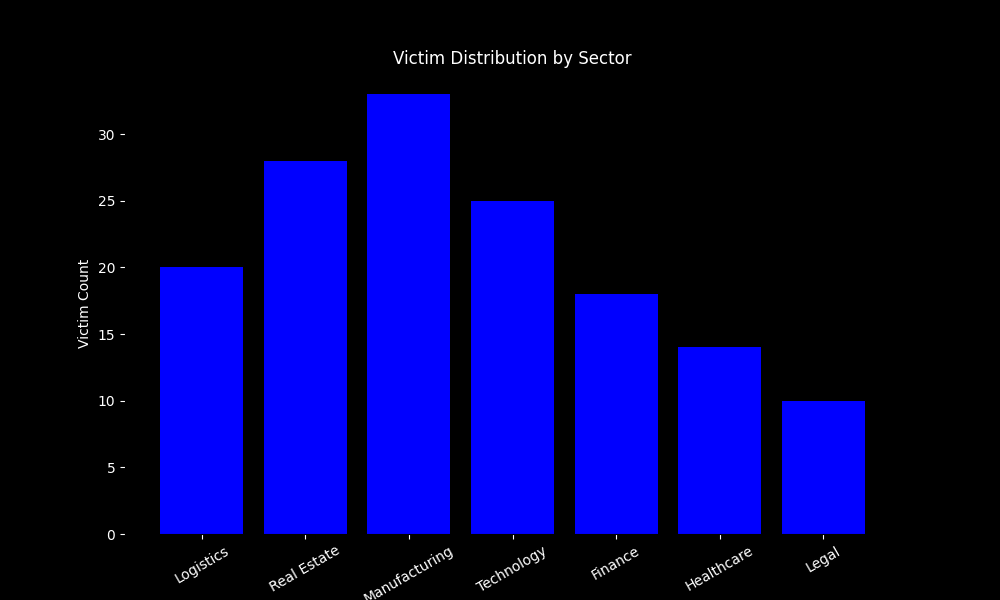
Coinbase Cartel victims span numerous industries and regions, reflecting opportunistic but targeted operations. Organizations in sectors such as logistics, manufacturing, technology, legal services, marketing, and real estate appear frequently, indicating that the group prioritizes data-rich and cloud-reliant environments.Activity charts
Victim Distribution by Country

Victim Distribution by Sector
Conclusion
Coinbase Cartel leverages uncertainty, fear, and information asymmetry to push victims into rash decisions. But with structured forensic analysis, coordinated communication, and expert response, organizations can regain control, restore stability, and fortify their security posture.
Coinbase Cartel .cbcl Decryptor provides an end-to-end framework to transform panic into clarity, chaos into action, and uncertainty into a managed, accountable recovery process.
MedusaLocker Ransomware Versions We Decrypt