
X77C Ransomware Decryptor
The C77L / X77C ransomware family, sometimes appearing under the marker EncryptRansomware, is a formidable strain that locks files and renames them with extensions such as .BAK, .[[email protected]].8AA60918, .[[email protected]].40D5BF0A, .[ID-BAE12624][[email protected]].mz4, and .[ID-80587FD8][[email protected]].3yk.
At present, no free universal decryptor has been released for its latest versions. However, our recovery framework combines AI-powered cryptanalysis, forensic study of encrypted data, and advanced mapping of encryption routines to give businesses the best chance of regaining access to their files. This approach emphasizes safety, speed, and accuracy in restoration.
How It Works
AI-Driven Cryptanalysis
Encrypted samples are carefully inspected in a controlled environment. AI models, trained on the behavior of various ransomware encryption flaws, attempt to emulate how C77L/X77C generates keys, often linked to the victim machine’s volume serial number.
ID Mapping from Ransom Note
Every ransom note associated with this family provides a Decryption ID. This unique identifier—such as 82807732 in one documented case—is tied directly to the volume serial number and is crucial for matching a victim’s encrypted batch to its specific session keys.
Universal Key Option
When a ransom note is missing or damaged, we deploy a fallback service. This brute-force mapping system is particularly useful with extensions like .BAK, which are believed to stem from customized builds of the ransomware.
Controlled Execution
Before decryption attempts begin, files are scanned in read-only mode. Many encrypted files start with embedded tags such as “EncryptRansomware”, “EncryptedByC77L”, or “LockedByX77C”. These indicators guide recovery efforts and reduce the risk of file corruption.
Requirements
Successful recovery attempts require certain elements to be available:
- A ransom note, such as Restore-My-Files.txt, #Recover-Files.txt, or READ-ME.txt
- One or more encrypted files (.BAK or related)
- Internet connectivity for analysis and forensic submissions
- Administrator privileges, either local or domain-level
Immediate Steps After a C77L/X77C Ransomware Attack
Disconnect Infected Machines
Once detected, disconnect compromised systems immediately. This ransomware can spread through shared directories and networked drives.
Preserve Evidence
Do not delete ransom notes, encrypted files, or logs. Store everything, including hashes (SHA-256, MD5), for forensic purposes.
Avoid Reboots
C77L/X77C has been observed executing further payloads after restarts. Shut down systems safely and leave files untouched.
Consult a Recovery Professional
Unverified “miracle decryptors” from random sources are a common trap. Seek recognized experts for recovery guidance to minimize permanent data loss.
How to Decrypt and Recover Files Encrypted by C77L/X77C
This ransomware uses a hybrid encryption method—AES-256 in CBC mode for file contents, combined with RSA-2048 to encrypt session keys. The RSA private keys remain in the attackers’ possession, which means brute-forcing is essentially impossible. Recovery paths instead rely on backup restoration, forensic mapping, or carefully managed negotiations.
Recovery Paths for C77L/X77C Infections
Free Options
The cleanest way to restore systems is from offline backups. Always verify the integrity of snapshots through checksums or trial mounts. Using immutable or WORM (Write-Once-Read-Many) storage enhances resilience against such attacks.
Occasionally, Windows Volume Shadow Copies survive. Tools like ShadowExplorer or the built-in Previous Versions option may offer partial recovery. However, C77L/X77C often deletes these during execution.
Paid and Negotiated Options
- Validation: Criminals issue a decryptor based on the ransom note’s Decryption ID.
- Risks: Decryptors may malfunction, result in partial recovery, or install hidden malware.
- Ethics/Legal: Payment fuels the ransomware economy and may breach local regulations.
Negotiators act as intermediaries, managing all communication. They can demand proof of decryption, negotiate lower ransom amounts, and reduce risk of fraud—but their fees are significant.
Our Advanced C77L/X77C Decryptor
We have built a specialized recovery tool for C77L/X77C cases that incorporates:
- Reverse-Engineered Logic: Using insights from community research on file markers and crypto schemes.
- Cloud-Based Processing: Encrypted files are processed within sandboxed, monitored environments.
- Offline Solutions: Air-gapped workflows are available for organizations that cannot risk online submissions.
Step-by-Step Recovery with Our Decryptor
- Identify the Infection
Confirm encrypted extensions (.BAK, .mz4, .3yk, etc.) and ransom note type. - Secure Systems
Stop all malicious processes and isolate affected machines. - Provide Files for Analysis
Share the ransom note and encrypted samples with the recovery team. - Decrypt Safely
Run the decryptor in administrator mode, enter the victim’s Decryption ID (e.g., 82807732), and begin structured decryption.
Offline vs. Online Decryption
- Offline Methods: Suited for air-gapped environments or classified data. Files are transferred via secure drives.
- Online Methods: Faster and supported by live experts. Requires encrypted transfer channels and full audit logs.
Understanding C77L/X77C Ransomware
C77L/X77C, recognized by tags like “EncryptRansomware”, is a dangerous ransomware family. It is notable for:
- Combining AES-256-CBC and RSA-2048
- Applying rare extensions (.BAK, [email].[hex])
- Delivering ransom notes threatening data leaks in 72 hours
- Embedding Decryption IDs derived from system volume serial numbers
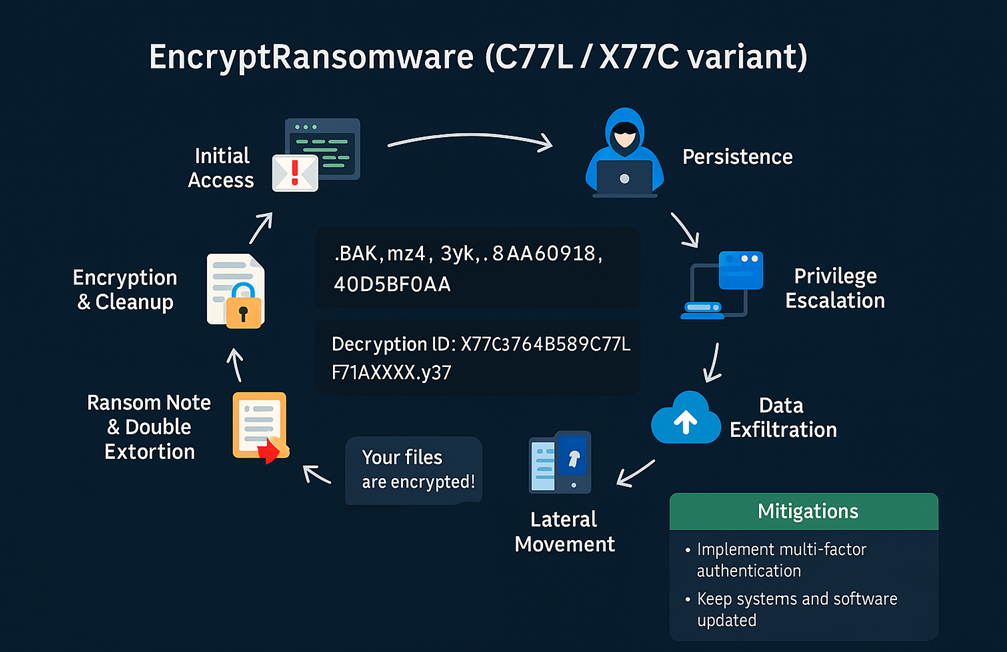
The Attack Cycle of C77L/X77C
Entry Points
- Phishing messages with infected attachments
- Exploiting outdated software or unpatched systems
- Weak Remote Desktop Protocol (RDP) credentials
Tools and Tactics
- Data Wiping: Shadow copies are deleted via vssadmin commands.
- Double Extortion: Attackers claim to have stolen data and threaten leaks.
- Persistence: Registry Run entries and scheduled tasks are sometimes used.
- Markers: Encrypted files usually contain headers like “EncryptRansomware”.
Indicators of Compromise (IOCs)
- File Extensions: .BAK, .[[email protected]].8AA60918, .[[email protected]].40D5BF0A, .mz4, .3yk
- Ransom Notes: Restore-My-Files.txt, #Recover-Files.txt, READ-ME.txt, READ-ME-Nullhexxx.txt
- Attacker Emails: [email protected], [email protected], [email protected], [email protected], [email protected]
- Sample Hash: SHA-256 a4d7396ba6044d8899472c933a49c240674a8b7f9cb13ea1652801f728879b82
Mitigation Strategies
- Secure Remote Access: Enforce multi-factor authentication (MFA) for RDP/VPNs.
- Patch Management: Keep operating systems and devices fully updated.
- Principle of Least Privilege: Minimize user rights across the network.
- Reliable Backups: Maintain offline and cloud snapshots with immutability settings.
- 24/7 Monitoring: Implement endpoint detection and logging for early anomaly detection.
Facts and Current Insights
- Most commonly targets: Windows desktops, servers, and shared storage
- Known extensions: .BAK, .mz4, .3yk, .8AA60918, .40D5BF0A, plus email-tagged suffixes
- Decryption IDs: Generated from volume serial numbers, like 82807732
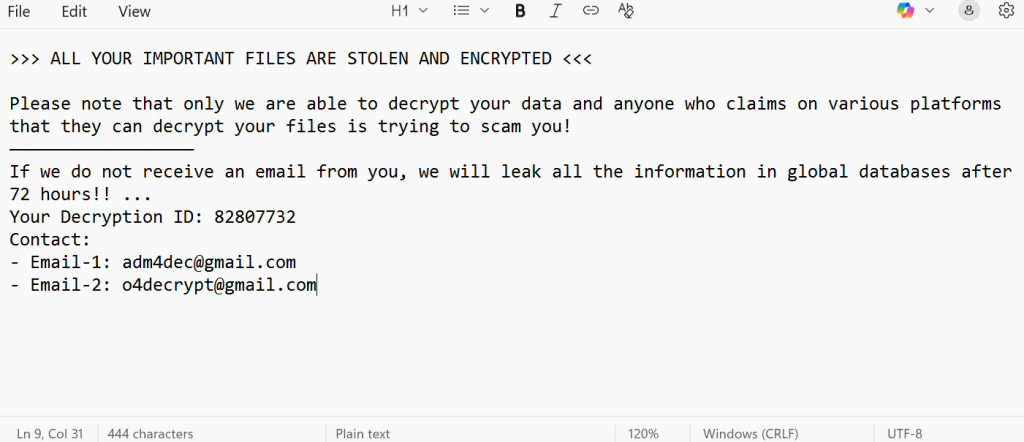
Ransom Note Analysis
C77L/X77C ransom notes typically open with bold threats, such as:
>>> ALL YOUR IMPORTANT FILES ARE STOLEN AND ENCRYPTED <<<
Please note that only we are able to decrypt your data and anyone who claims on various platforms that they can decrypt your files is trying to scam you!
——————————————————
If we do not receive an email from you, we will leak all the information in global databases after 72 hours!! …
Your Decryption ID: 82807732
Contact:
– Email-1: [email protected]
– Email-2: [email protected]
Conclusion
C77L/X77C is among the toughest ransomware families due to its strong cryptography and aggressive extortion methods. Since public decryption is not currently possible, the most effective approach is to preserve evidence, seek professional guidance, and rely on trusted backups. With proper planning and rapid response, the damage can be contained, and data recovery becomes achievable.
MedusaLocker Ransomware Versions We Decrypt