
Cracker Ransomware Decryptor
The Cracker (Beast) ransomware family represents a deeply disruptive form of malware designed to destroy workflows, undermine business continuity, and coerce victims into rapid payment. What begins as an ordinary moment on a workstation—a user opening a daily report, synchronizing files, or interacting with a seemingly harmless attachment—can escalate instantly into chaos as familiar documents, images, and archives suddenly refuse to open. Moments earlier, a file like 1.jpg appeared harmless; now it displays an unnervingly long name such as:
1.jpg.{CA496D18-588F-995D-31E9-880B5ACAC94E}.cracker
This abrupt transformation signals that the ransomware has completed its encryption cycle. But Cracker’s intrusion does not end with the encryption itself. Almost immediately, victims encounter README.TXT, a text file positioned across directories that demands attention. Inside is a forceful communication from the attackers, declaring absolute authority over the victim’s files and insisting that the only viable path toward restoration is to contact them within a strict 24-hour window. The purpose of this imposed deadline is not technical—it is psychological. Deadlines create fear, urgency, and emotional instability, making victims more susceptible to extortion.
Yet despite the intimidation woven into this attack, Cracker (Beast) is not all-powerful. Victims can reclaim control when they approach the situation with structured discipline rather than panic. This guide is built to help you understand the mechanics, behavior, and operational flow of Cracker; to provide a clear incident-response blueprint; and to support the recovery process without engaging in ransom negotiations.
Central to this framework is Cracker Decryptor, a dedicated recovery and forensic analysis platform engineered to assist victims in restoring operational stability, understanding the depth of the compromise, and rebuilding systems with confidence.
Regain Control With the Cracker .cracker Decryptor
Cracker’s power extends beyond cryptography. Its ransom note is crafted to manipulate emotions. The attackers cite “weak security” to attribute blame to the victim, emphasize that third-party tools will be ineffective, and warn that involving recovery specialists will increase costs. These statements are strategic manipulation tools designed to isolate victims and limit their perceived options. The malware relies heavily on psychological leverage, not just encryption.
The offer to decrypt “one simple file” free of charge is a hallmark of coercive ransomware operations. This test-decryption tactic serves one purpose: to build misplaced trust. Victims frequently assume that attackers will provide full restoration in exchange for payment, but real-world studies and case handling show that many victims never receive functional decryptors—or receive tools that corrupt data further.
The Cracker Decryptor platform gives victims a safe, structured alternative, grounded in forensic precision. It provides:
• A technical understanding of how Cracker modifies, encrypts, and tags files.
• A controlled and isolated environment for examining compromised data.
• A guided restoration plan that prioritizes system integrity and long-term resilience.
• Full incident-mapping that helps prevent reinfection and guides system hardening.
Rather than acting under pressure, Cracker Decryptor enables an informed, measured, and secure recovery.
How the Cracker .cracker Decryptor Works
Cracker requires more than basic malware removal. Its operational patterns, encryption design, and GUID-based tagging system demand a recovery approach centered on forensic validation, precise file analysis, and behavior-based interpretation.
The decryptor begins by parsing the altered filenames. The appended GUID is more than random noise—it serves as a victim-specific identifier tied to the attacker’s internal decryption model. Combined with encrypted file headers and signature traces, this identifier helps analysts determine the structure of the encryption routine.
After evaluating structural consistency and variant-specific markers, the Decryptor reconstructs a map of how the attack unfolded, which encryption method was used, whether any files remain partially recoverable, and which system processes may still require cleanup. This comprehensive mapping shapes the recovery approach and allows the victim to understand the scope of the incident before any restoration attempt takes place.
Understanding Cracker (Beast): Attacker Lifecycle & Operational Behavior
Ransomware attacks do not occur spontaneously—they follow a predictable flow, shaped by attacker tools, infrastructure, and strategic objectives. Understanding Cracker’s lifecycle allows victims and analysts to pinpoint weaknesses, identify propagation routes, and respond intelligently.
Initial Access & Entry Point
Cracker’s entry mechanism mirrors many modern ransomware campaigns. Its most common gateways include deceptive emails carrying malicious attachments, fraudulent Office documents that prompt users to enable macros, and archive files disguised as common business forms such as invoices, contracts, or shipping documents. In some cases, Cracker is delivered by a previous malware infection—particularly trojans, loaders, or infostealers. The attackers often count on users downloading cracked software, freeware bundles, or updates from unverified sites, providing additional infection vectors. This phase sets the stage for the ransomware to embed itself into the system undetected.
Pre-Execution Validation
Once Cracker is launched, it does not immediately begin encryption. First, it checks its surroundings. The malware may inspect system characteristics to determine whether it resides inside an analysis sandbox or virtual machine. It may look for debugging tools, active monitoring utilities, or forensic software known to disrupt or reveal ransomware behavior. If Cracker suspects observation, it may halt execution entirely to avoid exposure—showing the attackers’ interest in evading detection.
Privilege & Encryption Preparation
If the environment passes its safety checks, Cracker initiates an in-depth reconnaissance of system resources. It surveys file directories, identifies storage volumes, catalogs user folders, and locates file types considered high-value (such as documents, images, databases, archives, and project files). It may also check for synchronization paths—like OneDrive or Dropbox directories—as well as removable devices and mapped drives. During this preparation stage, the malware may kill processes that lock files (such as database engines or document editors) to ensure smooth encryption.
Targeting Servers & Shared Resources
Cracker becomes more dangerous when deployed on systems with access to shared corporate resources. It may enumerate mapped network drives, probe file servers, detect permissive SMB shares, or identify NAS systems lacking recent security hardening. While Cracker does not perform advanced lateral movement typical of large-scale enterprise ransomware, it does propagate opportunistically wherever permissions allow. Consequently, any accessible network resource becomes a potential encryption target.
Encryption Execution
With its targets identified, Cracker begins encrypting files. It uses robust cryptographic algorithms that render data unusable without the attacker’s private key. Each filename undergoes transformation: the original name remains, followed by a GUID for victim identification, then the .cracker extension. This naming pattern supports the attacker’s decryption management and ensures that files cannot be restored without the precise corresponding key. The encryption routine is designed to be irreversible without attacker involvement.
Ransom Delivery & Psychological Manipulation
Following encryption, Cracker deposits README.TXT into affected directories. The note delivers a forceful message:
YOUR FILES ARE ENCRYPTED
All your files have been encrypted due to weak security.
Only we can recover your files. You have 24 hours to contact us. To contact us, you need to write to the mailbox below.
To make sure we have a decryptor and it works, you can send an email to:
[email protected] and decrypt one file for free.
We accept simple files as a test. They do not have to be important.
Warning.
* Do not rename your encrypted files.
* Do not try to decrypt your data with third-party programs, it may cause irreversible data loss.
* Decrypting files with third-party programs may result in higher prices (they add their fees to ours) or you may become a victim of fraud.
* Do not contact file recovery companies. Negotiate on your own. No one but us can get your files back to you. We will offer to check your files as proof.
If you contact a file recovery company, they will contact us. This will cost you dearly. Because such companies take commissions.
We accept Bitcoin cryptocurrency for payment.
Email us at:
[email protected]
Cleanup & Persistence (Variant Dependent)
Some Cracker (Beast) variants attempt post-encryption cleanup. These measures may include erasing shadow copies to prevent volume restoration, clearing Windows event logs, modifying registry entries, or deploying secondary malware such as credential stealers or remote-access tools. Because these actions vary by build, a complete forensic sweep is essential to ensure ongoing threats are removed and the system is structurally clean.
Cracker (Beast) Ransomware Infection Summary Table
| Category | Details |
| Ransomware Name | Cracker (Beast) |
| Primary File Extension | .cracker |
| Filename Pattern | filename.{GUID}.cracker |
| Ransom Note Name | README.TXT |
| Attacker Email | [email protected] |
| Payment Requested | Bitcoin |
| Core Behavior | Strong AES-based file encryption with GUID tagging |
| Symptoms of Infection | Encrypted files, renamed extensions, ransom note present |
| Type of Damage | Permanent loss without backups; risk of supplementary malware |
| Typical Detection Names | Win32/Filecoder.Beast.A, Trojan-Ransom.Win32.Generic |
| Spread Vectors | Phishing, malicious attachments, trojans, P2P, cracked software |
| Primary Targets | Windows workstations, servers, and network shares |
Step-by-Step Cracker (Beast) Recovery Guide with Cracker Decryptor
Assess the Infection
First verify the presence of .cracker files and the GUID suffix. Confirm that README.TXT appears consistently throughout encrypted directories. These elements together confirm the Cracker (Beast) variant and guide the recovery approach.
Secure the Environment
Disconnect infected systems from networks immediately. This blocks additional encryption attempts and protects shared resources. Terminate active processes and isolate removable media to prevent secondary impact.
Engage Our Recovery Team
Provide several encrypted files and the ransom note for variant confirmation. These samples allow analysts to identify the specific Cracker strain and begin preparing a structured recovery timeline.
Run the Cracker Decryptor
Launch the decryptor with administrator privileges. The tool securely communicates with our servers to evaluate the encryption logic and begin file restoration when technically possible.
Enter Your Victim ID
The GUID embedded in each encrypted filename is essential. Input this identifier so the Decryptor can construct a recovery profile customized to your case.
Start the Decryption Process
Begin the restoration. The Cracker Decryptor handles all decryption workflows automatically and restores viable files to their functional state.
What Should You Do if You’ve Been Infected?
The first priority is to prevent further damage. Avoid modifying encrypted files, renaming them, or experimenting with unverified tools. These actions can irreversibly corrupt recovery chances.
Preserve everything: logs, ransom notes, suspicious emails, network traces, removable devices, and system states. This evidence is crucial for internal review, legal compliance, and forensic clarity.
Do not contact attackers without expert support. Even simple messages can reveal information and influence extortion dynamics. Maintain control, seek professional guidance, and approach recovery through containment, analysis, and disciplined execution.
Cracker Ransomware Decryption, Recovery & File Restoration
Cracker’s cryptographic model is intentionally designed to make unauthorized decryption impossible. As a result, file recovery typically depends on:
- evaluating encryption boundaries and block-level patterns,
- determining if fragments remain partially intact,
- analyzing file types for feasible reconstruction,
- identifying untouched or shadow-copied data,
- restoring from backups where available,
- and removing all malware components prior to restoration.
Even when direct decryption is not possible, system restoration and secure rebuilding remain achievable with proper methodology.
Targets: Windows, Network Shares & Removable Media
Cracker primarily targets Windows systems. However, if the infected device has access to mapped drives, server shares, external USB devices, or NAS storage, the ransomware may encrypt files stored across these locations. Inadequate segmentation or outdated security configurations elevate the risk of multi-system impact.
Communications Guidance for Cracker Incidents
Clear internal communication ensures that employees do not inadvertently worsen the situation by experimenting with files or restarting affected systems.
Externally, communication must be cautious and evidence-based. Regulatory, legal, and contractual obligations must be respected, and messaging must reflect confirmed findings rather than assumptions. Consistency prevents confusion and preserves organizational credibility.
Long-Term Hardening & Prevention
Effective protection against ransomware requires consistent practice. Organizations should implement robust email filtering, comprehensive MFA deployment, timely OS and software patching, and strict privilege governance. Behavioral monitoring helps detect anomalies early, while cloud-security posture audits ensure misconfigurations are addressed.
Backups should be maintained in multiple locations—offline, immutable, and regularly tested—to guarantee viability during crises. Good habits reduce vulnerability; great habits build resilience.
Victim Statistics & Threat Analytics
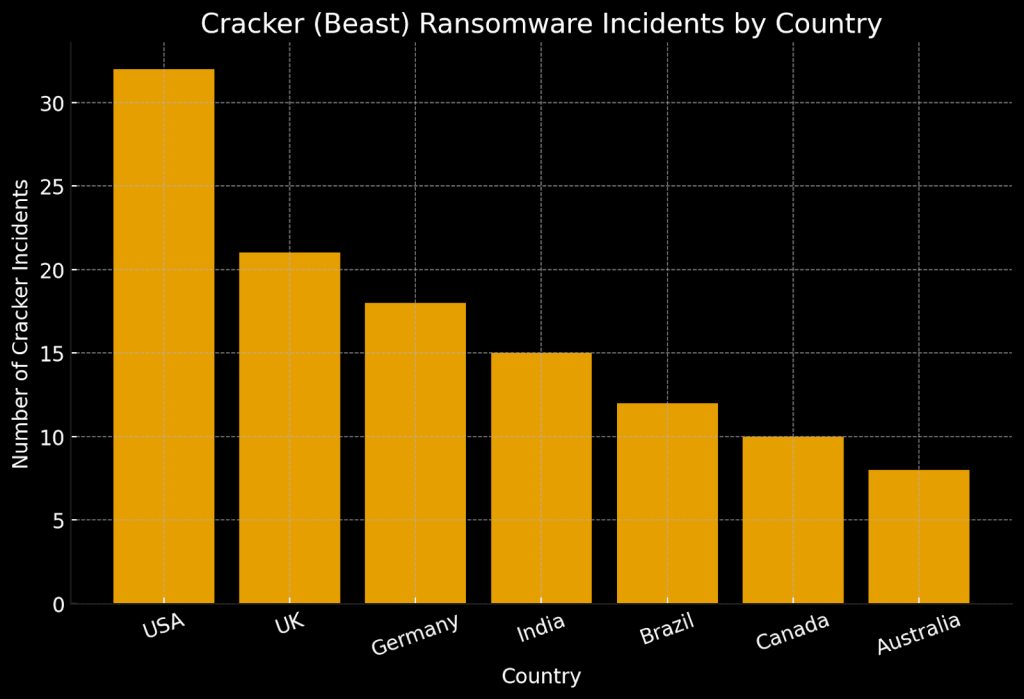
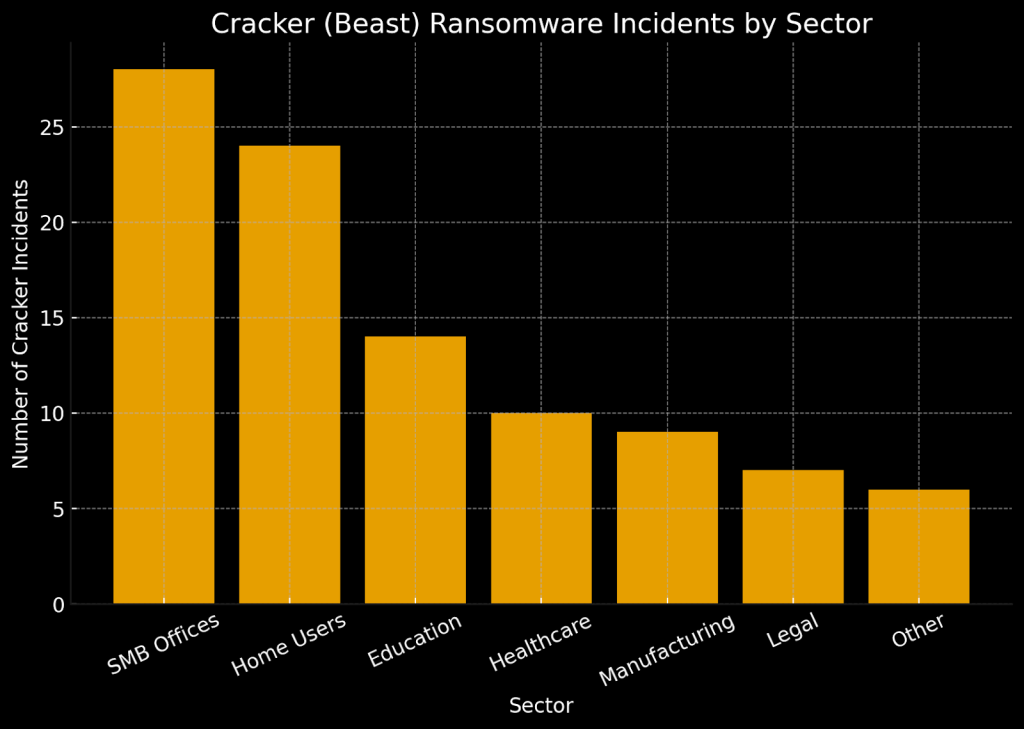
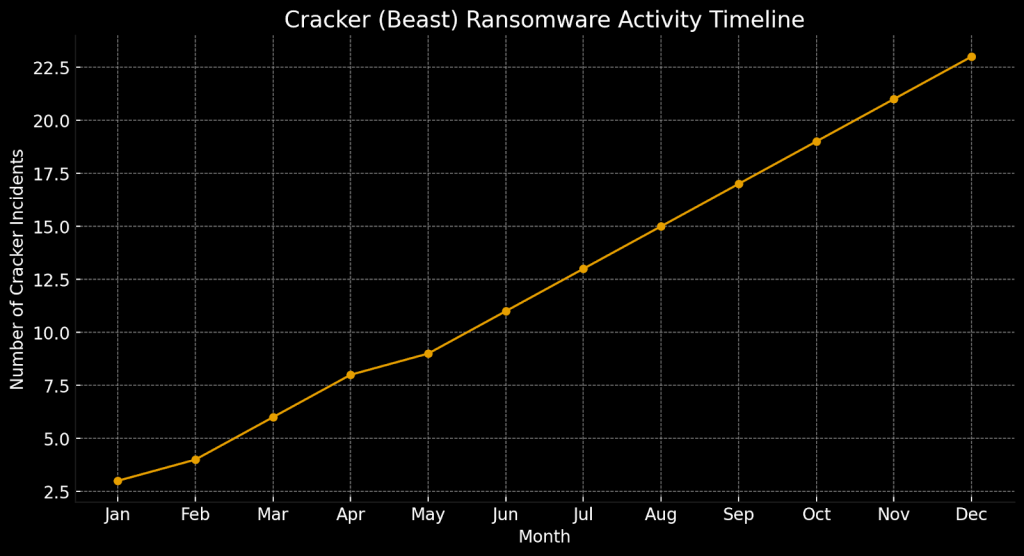
Cracker (Beast) tends to impact environments where cybersecurity maturity is uneven—home systems, small offices, and mid-sized businesses remain the most affected. Weak email filtering, outdated platforms, and insufficient backups contribute to infection frequency.
- Incidents by Country
- Incidents by Sector
- Cracker Activity Timeline
Conclusion
Cracker (Beast) ransomware depends on urgency, fear, and pressure to force victims into impulsive decisions. But organizations that respond with structure, clarity, and professional assistance consistently regain control.
The Cracker Decryptor platform provides technical insight, guided restoration workflows, and comprehensive support to help victims rebuild securely and confidently.
Ransomware recovery is not just about restoring encrypted files. It is a process of reestablishing trust, strengthening defenses, and reinforcing operational integrity.
MedusaLocker Ransomware Versions We Decrypt