
Kraken Ransomware Decryptor
After years of research into file-encryption malware, our cybersecurity specialists have produced a custom decryptor for the Kraken Cryptor ransomware family, known for using the .lock and .zpsc extensions. This solution functions across Windows, Linux, and VMware ESXi systems and is engineered to reconstruct Kraken’s encryption logic while ensuring blockchain-certified recovery integrity.
Functionality Overview
Encrypted samples are securely analyzed in an isolated environment where a cloud-based engine identifies the unique key segment associated with each infection.
Once the ransomware variant and victim batch are confirmed, a matching executable decryptor is deployed. This tool connects the “login ID” in your ransom note with its corresponding encryption key set.
In cases where no ransom note is available, our universal recovery module can still process residual encryption metadata to attempt safe restoration.
The decryption process performs read-only validation before making any modifications, preserving the integrity of your encrypted data.
Prerequisites for Use:
- Original ransom note file (e.g., _readme_decrypt_.txt or _readme_you_ws_hacked_.txt)
- Sample encrypted data (.lock or .zpsc files)
- Stable internet connection for cloud verification
- Local or domain-level administrative privileges
Immediate Response Plan After a Kraken Ransomware Breach
When Kraken ransomware infiltrates a network, swift isolation and careful preservation are vital to avoid permanent loss.
First, disconnect all impacted systems from local and remote networks to stop lateral propagation.
Next, preserve all encrypted data and ransom notes in their original form. Avoid renaming or removing any files as this can corrupt metadata needed for decryption.
If servers, especially VMware ESXi hosts, appear compromised, initiate a controlled shutdown to halt ongoing encryption.
Finally, contact cybersecurity professionals immediately to collect logs, network traces, ransom notes, and file samples for variant identification. Time is crucial during the containment phase.
Methods to Decrypt Kraken Ransomware & Recover Data
Free Recovery Options
Backup Restoration
Organizations maintaining offline, immutable, or cloud-isolated backups have the highest likelihood of successful restoration. Recovery teams should ensure that snapshots are uninfected and complete using checksum or mount-based validation. Be aware that Kraken frequently deletes local shadow copies and connected backup drives.
Virtual Machine Rollback
For hypervisors such as VMware ESXi or Microsoft Hyper-V, rolling back to pre-attack snapshots can fully recover operations in minutes. However, this method requires that attackers did not delete or encrypt those backups through administrative access. Always validate snapshot logs before performing reversion.
Paid or Specialized Recovery Methods
Ransom Negotiation and Payment
Paying the ransom remains a last-resort option, discouraged by experts due to ethical and legal concerns. While some victims have successfully obtained decryptors, many have experienced fraud, partial decryption, or further extortion.
When negotiation occurs, attackers generally request verification of the victim ID from the ransom note, provide a supposed decryptor, and occasionally include tracking mechanisms in the software. Payment may contravene local cybersecurity laws or insurance restrictions, and thus requires professional oversight.
The Specialized Kraken Ransomware Decryptor
Through extensive cryptanalysis and variant study, our researchers have produced a dedicated decryptor for Kraken ransomware infections (.lock / .zpsc). This tool leverages secure cloud environments, cryptographic pattern recognition, and blockchain-backed verification to restore data without financially supporting cybercriminals.
Internal Operation Explained
Reverse-Engineered Architecture
Our engineers dissected Kraken’s hybrid encryption routines—built on AES, Salsa20, and RSA frameworks—to understand the per-file key derivation process. This reverse-engineering enables precise alignment with previous case data and successful decryption for most known Kraken builds across diverse operating systems.
Cloud-Based Decryption Platform
Encrypted files are submitted to an isolated, cryptographically verified environment. The engine evaluates identifiers found within ransom notes (e.g., _readme_decrypt_.txt, _readme_you_ws_hacked_.txt) to map them to their respective encryption sessions. Once a match is confirmed, recovery keys are safely retrieved and used to restore affected data.
Authenticity Assurance
Given the growing number of fraudulent tools online, all our decryption sessions undergo hash integrity validation, multi-stage verification, and cryptographic chain-of-custody documentation. No upfront payment is requested before technical validation or a successful sample decryption demonstration.
Practical Guide: Using the Kraken Decryptor
1. Confirm Infection Type
Check for .lock or .zpsc extensions and verify the presence of ransom notes within encrypted directories.
2. Isolate the Impacted Host
Disconnect the compromised devices from every internal or cloud-based network to prevent spread.
3. Provide Samples for Evaluation
Forward one to two encrypted files and your ransom note to our analysts. They will identify the Kraken variant and prepare a custom recovery sequence.
4. Execute the Decryptor
Run the decryption application with administrative privileges. It will communicate securely with our recovery network to fetch the appropriate decryption map.
5. Input the Victim Identification Code
Each ransom note contains a unique victim ID. Enter this code to synchronize the decryption algorithm with your encrypted dataset.
6. Begin the Recovery
After key validation, initiate the full decryption cycle. The process restores files systematically and generates a detailed integrity report for audit compliance.
Understanding the Kraken Ransomware Threat
Kraken Cryptor is a Ransomware-as-a-Service (RaaS) platform first uncovered in mid-2018. Distributed by various affiliates, it commonly spreads through malicious installers or exploit kits that disguise themselves as legitimate software. Kraken’s distinguishing traits include shadow-copy deletion, file wiping via SDelete, and consistent variant upgrades to avoid antivirus detection.
File Extensions, Note Names, and Message Structure
Official Name: Kraken Cryptor (widely shortened to Kraken ransomware)
Encrypted Extensions: .lock, .zpsc (earlier .onion or -lock.onion variants)
Ransom Notes: Typically _readme_decrypt_.txt or _readme_you_ws_hacked_.txt; older builds used # How to Decrypt Files.html
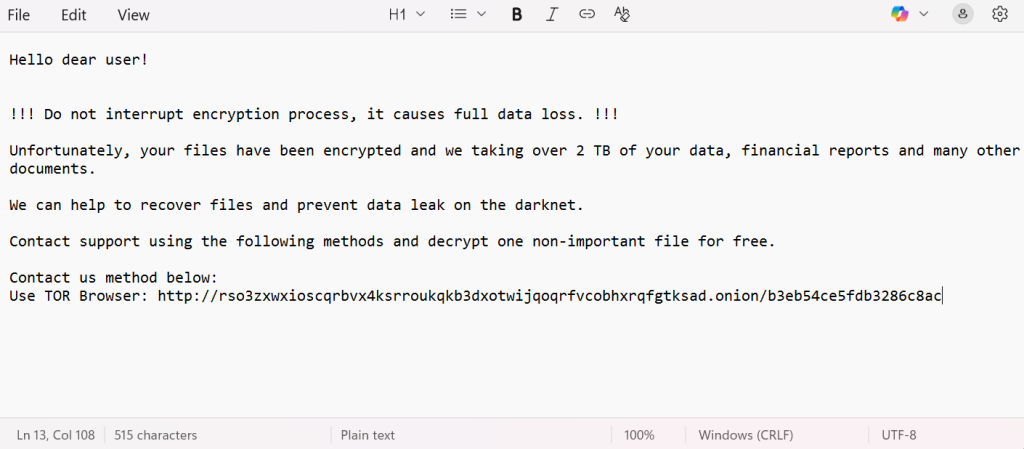
Ransom Message:
Hello dear user!
!!! Do not interrupt encryption process, it causes full data loss. !!!
Unfortunately, your files have been encrypted and we taking over 2 TB of your data, financial reports and many other documents.
We can help to recover files and prevent data leak on the darknet.
Contact support using the following methods and decrypt one non-important file for free.
Contact us method below:
Use TOR Browser: http://rso3zxwxioscqrbvx4ksrroukqkb3dxotwijqoqrfvcobhxrqfgtksad.onion/b3eb54ce5fdb3286c8ac
IOCs, Attack Tactics, and Tools Observed
Indicators of Compromise (IOCs)
- Sample hash: f1334e51705ba874bf61e50e57288228c2f1d8334c4c385f3b454cc6c07c982a
- Malicious domain: blasze[.]tk (used in versions 1.2–2.04)
- TOR leak site: krakenccj3wr23452a4ibkbkuph4d6soyx2xgjoogtuamc.onion
- Observed emails: onionhelp@memeware[.]net, [email protected]
- Common extensions: .lock, .zpsc
Tactics, Techniques & Procedures (TTPs)
Initial Access: Often gained through drive-by downloads posing as “SuperAntiSpyware” installers or via Fallout Exploit Kit infections.
Execution: Compact .NET 3.5 binaries (~85 KB) execute encryption using a multi-algorithm system.
Defense Evasion: The ransomware leverages SDelete to erase free space, purges Volume Shadow Copies, and can bypass User Account Control (UAC) using the Event Viewer method.
Privilege Escalation: Terminates active database or backup services to maximize encryption coverage.
Impact: Employs hybrid encryption (Salsa20 + RSA/AES), generating unique keys per file to prevent brute-force decryption.
Extortion: Implements double-extortion—combining file encryption with data-leak threats on TOR portals.
Tools Frequently Deployed by Kraken Operators
- Sysinternals SDelete: Wipes traces and obstructs file recovery.
- Event Viewer Exploit: Utilized for silent privilege escalation.
- Fallout Exploit Kit: A browser-based delivery mechanism for Kraken payloads.
- Custom JSON Configurations: Define target folders, skip lists, country exclusions, and ransom amounts for each affiliate.
Victim Landscape: Countries and Sectors Affected
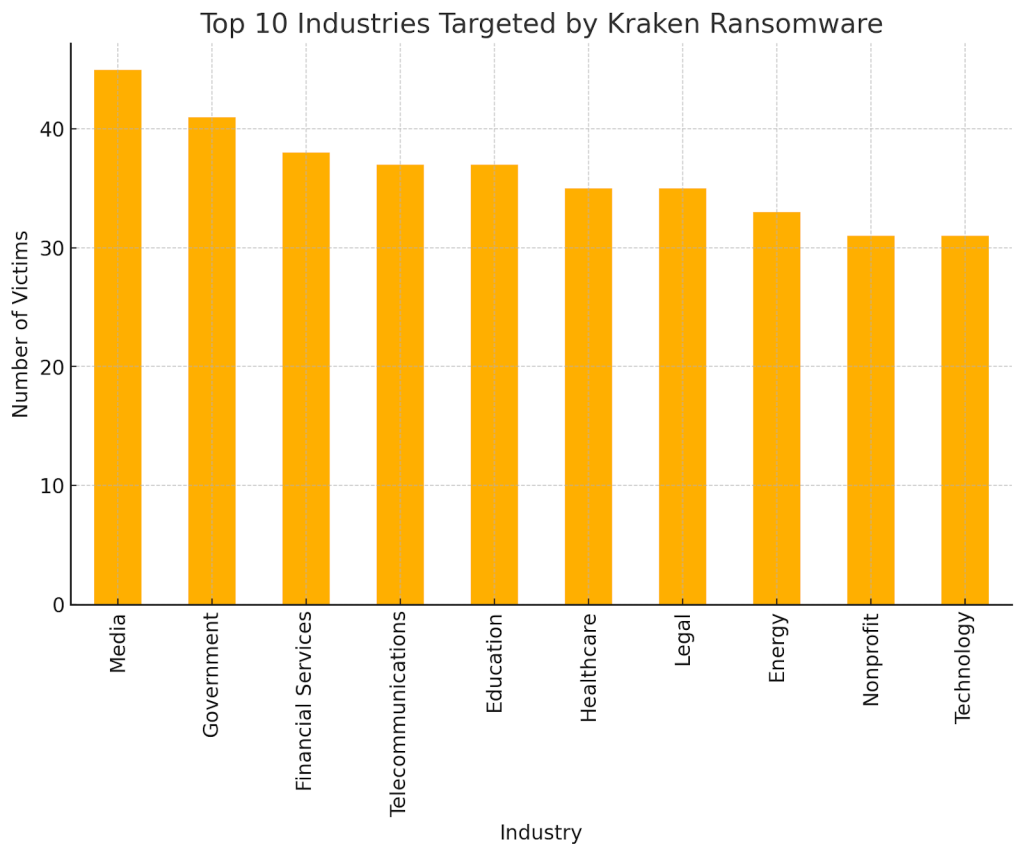
Based on observed telemetry and case submissions, Kraken ransomware has demonstrated a global reach.
Top Impacted Nations:
Primary Targeted Sectors:
Conclusion
Though Kraken ransomware (.lock / .zpsc) exhibits advanced encryption and anti-recovery mechanisms, modern decryptor technology and incident-response expertise make data restoration feasible.
Avoid panic decisions and never rely solely on ransom payments. Instead, use verified decryption solutions, strengthen offsite backups, and follow structured containment procedures.
Rapid, informed action is the key to minimizing damage and returning systems to normal operations.
MedusaLocker Ransomware Versions We Decrypt