
Shinra .jj3 Ransomware Decryptor
Our security engineers have meticulously dissected the encryption mechanism behind the Proton/Shinra ransomware family, including its .jj3 variant. Through in-depth reverse engineering and cryptographic testing, we developed a professional-grade decryptor specifically optimized for this family’s encryption style.
Compatible across Windows, Linux, and VMware ESXi systems, this decryptor delivers both speed and safety. It operates in controlled environments, uses forensic-grade read-only analysis before recovery, and ensures complete integrity verification so you can restore your files confidently.
Our recovery methodology isn’t experimental — it’s engineered for enterprises that value precision, documentation, and risk-free execution.
How the Proton/Shinra .jj3 Ransomware Decryptor Operates
AI-Powered and Forensically Verified Workflow
Encrypted data is processed inside a secure, sandboxed cloud environment that isolates your files from all external access. Advanced AI-driven analytics identify the ransomware variant, evaluate embedded metadata, and test cryptographic key derivations.
Every step is logged using blockchain-style integrity verification to provide an unalterable audit trail of the decryption process.
Victim ID Mapping and Variant Matching
Each Proton/Shinra infection leaves a unique hexadecimal victim ID inside the ransom note. This identifier, such as 4B6AD950C4F51021EEDF5AB5A9FE646D, helps match your encrypted dataset to known variant families. Our decryptor uses this ID to automatically align recovery parameters with the correct key mapping or pattern.
Universal Mode (When Ransom Note Is Missing)
If the ransom note was deleted or lost, we can initiate a universal decryptor scan. This advanced mode analyzes multiple encrypted samples to identify overlapping encryption keys, potential timestamp derivations, and variant fingerprints — a technique derived from hybrid cryptanalysis.
Fail-Safe Execution
No original file is modified until a complete integrity validation has been done. The tool performs an initial read-only verification phase, ensuring data remains untouched until you approve active decryption. After that, a controlled recovery process restores file structure and metadata.
Requirements Before Starting Recovery
To perform an accurate recovery assessment, we’ll need the following:
- A ransom note file (commonly howtorecover.txt, HowToRecover.txt, or #Restore-files.txt).
- Several encrypted samples (example: bce0yUQslW.jj3).
- Administrator permissions on a test system.
- A stable internet connection for cloud-assisted processing (optional for offline mode).
- Any available forensic evidence — such as event logs, memory dumps, or the malicious binary itself.
These assets allow our decryptor and analysts to pinpoint variant behavior, determine encryption structure, and map your infection against known Proton/Shinra signatures.
Immediate Actions to Take Following a Proton/Shinra .jj3 Attack
Disconnect the Affected Devices
The first and most vital step is isolating infected systems from the network to prevent the ransomware from spreading or exfiltrating more data. Disconnect Ethernet and Wi-Fi connections instantly.
Identify and Document Everything
Take note of ransom note contents, victim ID, and any email or Telegram contact mentioned. Capture screenshots before making any changes.
Example attacker contact details often include [email protected] or Telegram handle @joedecryption.
Preserve All Files
Never delete or rename encrypted files. The random naming pattern (like bce0yUQslW.jj3) may be critical for key analysis. Also, store the ransom note in multiple copies — it may contain vital decryption metadata.
Avoid Rebooting or Formatting
System reboots can clear crucial memory artifacts, while formatting can destroy forensic evidence or file structure necessary for decryption.
Seek Professional Assistance
Unverified “DIY” decryptors from unknown forums often corrupt files permanently. Reach out to an experienced recovery team that can verify variant authenticity and decrypt safely, if possible.
Preserving Digital Evidence
- Keep all ransom notes intact for analysis.
- Collect encrypted file samples and calculate their cryptographic hashes (SHA256 preferred).
- If possible, perform a memory capture — volatile memory may contain encryption keys or process artifacts.
- Secure event logs, system registry hives, and any related logs from security tools.
- Store everything in write-protected or read-only media for safekeeping and compliance.
This evidence not only helps with technical recovery but is also crucial for reporting to authorities or insurance carriers.
Shutting Down Compromised Systems Properly
If ransomware activity is ongoing and encryption has stopped, safely power down the affected systems after preserving memory data. Do not reboot multiple times, as it might trigger hidden scripts or cause encryption tasks to resume. Always coordinate shutdown procedures with cybersecurity professionals.
Engage a Trusted Ransomware Recovery Specialist
Professional recovery teams follow forensic best practices and employ controlled environments for analysis. Partnering with experts ensures the following:
- Each step of decryption or restoration is logged and auditable.
- Data integrity is preserved through verifiable cryptographic checksums.
- The team validates variant identity using secure, sandboxed replication.
We specialize in such containment-first recoveries, using both in-house research and partnerships with top-tier threat intelligence labs.
Decrypting Proton/Shinra (.jj3) Files and Recovering Your Data
Proton/Shinra .jj3 ransomware relies on hybrid encryption, which combines a symmetric cipher (fast encryption) with an asymmetric public key (for protection of the session key). Without the attacker’s private key, decryption is mathematically complex.
However, recovery may still be possible under certain conditions:
- A weak encryption variant was used.
- Cryptographic mistakes were made by the attackers.
- A previously leaked or recovered key applies to your specific variant.
Our decryptor automatically tests for these edge cases and employs an intelligent failover analysis that safely identifies any recoverable patterns within encrypted data blocks.
Proton/Shinra .jj3 Recovery Methods Explained
Free or Community Decryptors
Some public decryptors — such as those from Emsisoft or Avast — can recover files for specific Proton/Shinra variants with flawed cryptography.
However, most .jj3 strains remain unsupported. If a free decryptor stalls or displays “Starting…” indefinitely, it’s likely incompatible with your variant.
Backup Restoration
Offline or immutable backups are the most reliable path to total recovery. Ensure they’re uninfected before restoring, and verify integrity through checksum comparison.
Virtual Machine Snapshots
If you use VMware or Hyper-V, revert to pre-attack snapshots after verifying that the management interfaces weren’t compromised. Secure isolation is key — always test snapshots in a sandbox first.
GPU-Accelerated Brute Force
Advanced GPU decryption attempts can sometimes recover symmetric keys if the ransomware used weak random seeds. However, Proton/Shinra typically employs strong key derivations, so success rates are low unless encryption flaws exist.
Paid Options
Paying the Ransom
Paying may unlock decryption, but this option carries immense risks:
- No Guarantee: Attackers may not send a working decryptor.
- Partial Recovery: Some files may remain corrupted even after payment.
- Legal Concerns: Payments can violate anti-money laundering or sanction regulations.
If payment is the only option under consideration, it should only proceed under professional supervision with documented verification of a successful test decrypt.
Third-Party Negotiation
Negotiators serve as intermediaries between the victim and the attackers, aiming to reduce ransom demands and verify decryptor legitimacy.
They handle:
- Secure communication via TOR or encrypted email.
- Proof-of-decryption verification before payment.
- Legal documentation and audit logs for compliance and insurance.
However, negotiation services come at a cost — often a percentage of the ransom — and success is not guaranteed. Choose negotiators with verifiable past outcomes and strong confidentiality agreements.
Our Specialized Proton/Shinra .jj3 Decryptor
Our proprietary Proton/Shinra recovery solution offers multiple decryption models tailored to variant complexity:
- Reverse-Engineered Utility: Our engineers analyze the variant’s encryption module to identify flaws, leaked keys, or exploitable weaknesses.
- Cloud-Based Decryption (Optional): Files are processed in an isolated sandbox cluster where proprietary algorithms analyze encryption signatures. Results are validated with checksum-based integrity tests.
- Anti-Fraud Assurance: We validate all decryptors before execution, preventing fake tool damage or data loss.
This solution has already restored encrypted environments in corporate, educational, and industrial sectors.
Step-by-Step Recovery Using Our Proton/Shinra .jj3 Decryptor
- Identify the Infection — Confirm the .jj3 extension and presence of howtorecover.txt.
- Secure the Environment — Disconnect systems, isolate storage, and capture all logs and memory.
- Submit Samples — Provide encrypted files and ransom notes to begin analysis.
- Variant Confirmation — Our AI engine matches your infection with known Proton/Shinra profiles.
- Test Decryption — We perform a controlled decrypt of small files to confirm viability.
- Full Recovery — Once validated, the decryptor proceeds in stages, restoring entire directories safely.
You will receive a complete post-decryption report with before/after checksums.
Offline vs Online Recovery
Offline Recovery works best in air-gapped environments where data confidentiality is paramount. Analysts transfer copies of encrypted files to secured offline systems equipped for brute-force or manual key recovery.
Online Recovery leverages secure cloud computing for parallel key analysis. It’s faster and provides real-time monitoring but uses encrypted transfer channels for security. Our framework supports both, depending on your infrastructure and compliance requirements.
What is Proton/Shinra .jj3 Ransomware?
Proton/Shinra is a sophisticated ransomware family known for its double extortion approach — it not only encrypts files but also steals data before locking systems.
The .jj3 variant adds random 10-character prefixes to filenames (e.g., bce0yUQslW.jj3) and leaves ransom notes like howtorecover.txt. These notes instruct victims to contact the attackers via email or Telegram and reference a unique hexadecimal ID for identification.
This ransomware disables recovery mechanisms, deletes Volume Shadow Copies, and manipulates registry entries to display warnings. It’s been observed targeting individuals and organizations worldwide since late 2024.
Links and Lineage: Shared Traits with Other Ransomware
Although Proton/Shinra operates as a separate threat group, forensic similarities connect it with tactics once used by major ransomware syndicates like Conti, Royal, and BlackBasta.
It employs familiar negotiation patterns, encryption phrases, and command-line behaviors, suggesting code reuse or affiliate overlap among former members of established groups.
Operational Breakdown: How Proton/Shinra Functions
Initial Access Vectors
- Phishing Emails: The primary delivery method uses malicious attachments or embedded macros.
- Remote Access Exploitation: Attackers exploit unsecured RDP sessions or VPNs lacking MFA.
- Unpatched Vulnerabilities: Exposed endpoints and outdated network devices often serve as entry points.
Tools, TTPs, and MITRE ATT&CK Mapping
- Credential Access: Tools like Mimikatz and LaZagne harvest cached passwords (MITRE T1003).
- Reconnaissance: Network scanners (SoftPerfect, Advanced IP Scanner) and domain enumeration tools (AdFind).
- Defense Evasion: Use of wevtutil to wipe event logs and BYOVD (Bring Your Own Vulnerable Driver) to bypass security products.
- Exfiltration: Utilities such as RClone, WinSCP, and Mega.nz are used for stealthy data transfers.
Encryption and Data Wiping
Proton/Shinra uses AES or ChaCha20 for data encryption combined with RSA/ECC for key protection. It also runs commands like vssadmin delete shadows /all /quiet to erase restore points. In several cases, it modifies the registry’s legal notice fields to display ransom messages before login.
Known Proton/Shinra (.jj3) Indicators of Compromise
- Encrypted Filename Format: [random10chars].jj3
- Ransom Note: howtorecover.txt
- Email Contact: [email protected]
- Telegram Handle: @joedecryption
- Victim ID Example: 4B6AD950C4F51021EEDF5AB5A9FE646D
- Registry Keys: Modifications in HKLM\Software\Microsoft\Windows\CurrentVersion\Policies\System\legalnotice*
- System Behavior: Termination of SQL, Word, and other processes; clearing of event logs; shadow copy deletion.
Tracking these indicators helps identify infection spread and confirm variant lineage.
Mitigation Strategies and Preventive Measures
- Mandatory MFA: Apply multi-factor authentication on all remote access services.
- Frequent Patching: Keep VPNs, firewalls, and OS components updated.
- Isolated Backups: Maintain air-gapped, immutable backups with retention policies.
- Network Segmentation: Divide networks to limit lateral movement.
- Strict Driver Policies: Prevent unsigned drivers and disable BYOVD exploits.
- 24/7 Monitoring: Implement continuous SOC or MDR services to detect anomalies in real time.
Facts and Insights About Proton/Shinra (.jj3)
This ransomware family has impacted numerous organizations worldwide, using constantly evolving extensions such as .jj3, .blue, .griffin, and .crypticsociety.
Its operators engage in data theft, file encryption, and extortion, often offering discounts for fast communication. Despite superficial rebrands, the underlying encryption and tactics remain consistent — robust and professional.
Dissecting the Ransom Note
A typical .jj3 ransom message includes:
Warning: Your files have been stolen and encrypted.
If you want your files back, contact us at the email addresses shown below:
Email: [email protected]
Telegram: @joedecryption
# In subject line please write your personal ID
ID: 4B6AD950C4F51021EEDF5AB5A9FE646D
Warning: You will receive a discount if you contact us within 24 hours of decryption – Strictly try to avoid scam brokers or decryption companies, as they will only waste your money.
Check Your Spam Folder: After sending your emails, please check your spam/junk folder
regularly to ensure you do not miss our response.
No Response After 24 Hours: If you do not receive a reply from us within 24 hours,
please create a new, valid email address (e.g., from Gmail, Outlook, etc.)
and send your message again using the new email address.
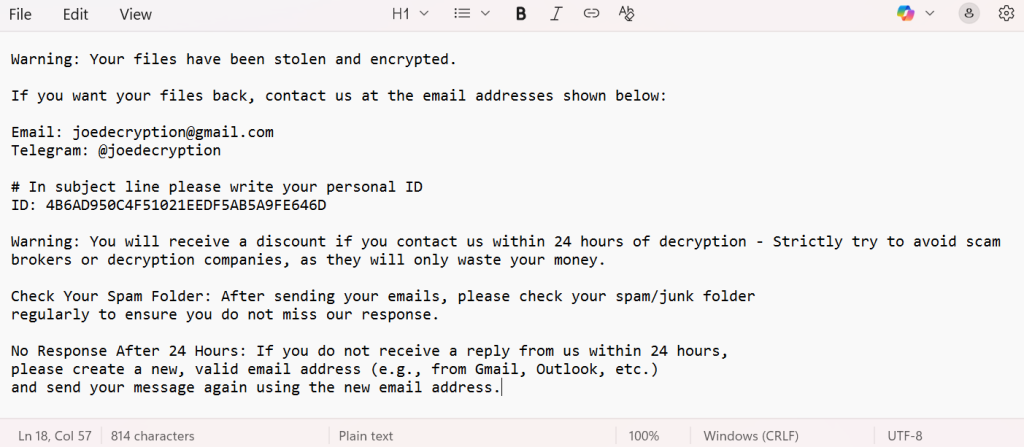
The note’s structure aims to legitimize the attackers and psychologically pressure victims to comply.
Conclusion
Proton/Shinra .jj3 ransomware is highly destructive, combining encryption and data theft. However, recovery is achievable with proper strategy and expert guidance. The most effective approach includes:
- Isolating systems and preserving evidence.
- Validating backups and restoring safely.
- Checking reputable decryptor databases.
- Avoiding unverified or fraudulent recovery tools.
- Working with certified forensic and recovery experts.
Our decryptor and recovery service have successfully restored numerous environments affected by similar ransomware variants. Each case is handled confidentially and with verifiable documentation.
MedusaLocker Ransomware Versions We Decrypt