Kryptos Ransomware Decryptor
This comprehensive recovery guide for Kryptos (.kryptos) ransomware provides actionable insight for cybersecurity professionals, IT administrators, and enterprises facing encryption-related disruptions. Crafted in a confident, operational tone, it mirrors the rigor of an incident-response playbook while preserving clarity for decision-makers. The information below is derived from trusted ransomware intelligence feeds and industry-standard recovery procedures current as of October 8, 2025.
Our Kryptos Decryption Service: Precision Recovery, Built for Enterprise
Our dedicated response team specializes in handling Kryptos ransomware incidents through forensic-grade processes, proprietary tools, and verified recovery techniques. We employ a combination of offline analysis, controlled testing, and secure orchestration to maximize successful restoration while safeguarding production systems.
We never deploy random decryptors from unverified sources — instead, we conduct sample validation within isolated research environments, ensuring any decryption is accurate and risk-free.
Step-by-Step Overview of the Kryptos Recovery Process
- Forensic Intake and Isolation – We begin by gathering ransom notes, encrypted file samples, and forensic data from compromised environments. Each artifact is carefully contained and analyzed in a sandboxed lab.
- Variant and Algorithm Analysis – Our specialists reverse-engineer the Kryptos encryption logic to identify potential flaws such as predictable key generation, reused entropy, or timestamp-derived seeds.
- Test Decryption Validation – Before executing recovery at scale, we verify the decryptor’s accuracy on duplicated file samples. This ensures the restored data remains intact and unaffected.
- Hybrid Processing Capabilities – For extensive infrastructures, we can conduct air-gapped (offline) recovery or leverage cloud-backed processing through verified cryptographic integrity systems with full audit trails.
- Reinforce and Recover – After decrypting and validating the data, we perform a post-restoration hardening phase: rotating credentials, patching vulnerabilities, and reinforcing backup and segmentation frameworks.
Prerequisites for Kryptos Recovery Evaluation
To begin a structured Kryptos recovery assessment, we require the following items and data points:
- The ransom note or screenshot displaying communication instructions.
- Multiple encrypted file samples (maintaining their original names).
- Endpoint and Sysmon logs, as well as detailed process chains from infected systems.
- Network telemetry and firewall logs, especially indicators of exfiltration.
- Backup and snapshot inventories for potential rollback planning.
- Administrative or technical contacts authorized to facilitate restoration workflows.
Immediate Response Checklist After a Kryptos Attack
1. Isolate Impacted Systems: Disconnect affected endpoints or servers immediately to contain the encryption process and prevent further spread.
2. Preserve Critical Evidence: Retain ransom notes, encrypted data, and logs. Do not modify or delete files — any change could impact decryption viability.
3. Capture Memory Data: If possible, extract live memory snapshots to preserve keys or temporary encryption seeds that may assist recovery.
4. Gather Logs and Backups: Collect endpoint, Sysmon, and firewall logs, and catalog all accessible backups.
5. Engage Professional Response Teams: Activate your incident response provider or internal IR division. External cybersecurity partners should be vetted and compliant with enterprise data-handling standards.
6. Avoid Public Decryptors: Many publicly available tools contain malware or corrupt data during use. Only utilize decryptors validated by trusted incident-response firms.
How to Decrypt and Recover from Kryptos (.kryptos)
Free Recovery Options
- Security Vendor Tools: Keep an eye on official cybersecurity vendors or the No More Ransom Project for any future Kryptos-specific decryptors. At this time, no public tools have been confirmed.
Backup Restoration
Restoring from clean, offline, or immutable backups remains the most reliable method of data recovery. Always validate backup consistency through checksum testing before reintroducing data to production environments.
VM Snapshot Rollback
If pre-encryption snapshots exist, revert affected systems to those versions. Prior to rollback, verify snapshot integrity and confirm they weren’t manipulated by threat actors.
Researcher-Based Decryption Techniques
In some cases, cryptographic vulnerabilities (such as predictable key material or weak randomization) can enable partial or full brute-force recovery using GPU acceleration. Our team can assess your Kryptos samples to determine feasibility.
Ransom Payment as a Last Resort
Paying the ransom is highly discouraged. It presents no guarantee of recovery, risks further compromise, and can violate legal or insurance conditions. Should an organization consider it, it must involve legal counsel and insurance representatives and request proof-of-decryption beforehand.
Third-Party Negotiation Services
Professional negotiators can serve as intermediaries to validate decryptor authenticity and manage communication over TOR channels securely. Select firms with a verifiable history of responsible ransomware handling.
Our Enterprise Kryptos Response Framework
Our advanced recovery process goes beyond decryption to encompass a full forensic and operational restoration pipeline, ensuring systems are both recovered and secured post-incident.
- Comprehensive Variant Analysis: Lab testing and YARA rule creation tailored to your infection strain.
- Controlled Proof-of-Decrypt: File samples tested in sandboxed labs with cryptographic integrity validation.
- Remediation and Hardening: Implementation of patching, network segmentation, and privilege rotation.
- Strategic Postmortem Review: Full vulnerability assessment and improvement roadmap after recovery.
Offline vs. Online Recovery Approaches
- Offline Recovery (Preferred): Executed within fully air-gapped labs to eliminate network risk and prevent external communication with threat actor infrastructure.
- Cloud-Assisted Recovery: Designed for large-scale workloads using encrypted transmission and blockchain-based data validation for traceable assurance.
Understanding Kryptos (.kryptos)
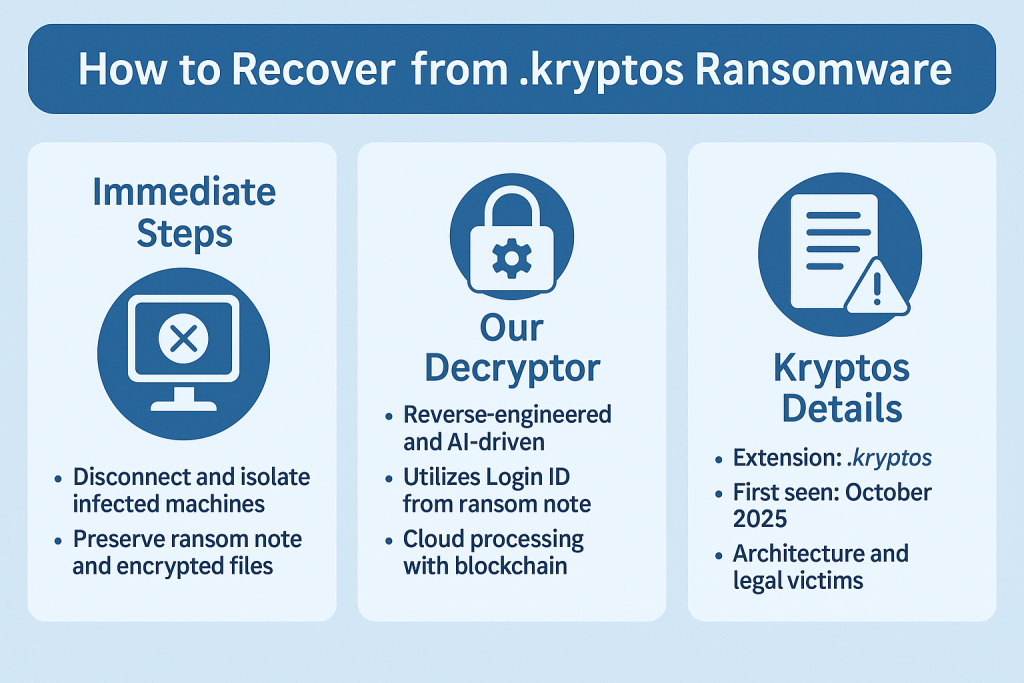
First identified on October 8, 2025, Kryptos emerged on public ransomware monitoring networks with a newly established Tor leak site and three verified victims spanning the United States, Australia, and Canada. The campaign follows a double-extortion model — stealing sensitive data before encryption to pressure victims into payment.
Organizations impacted include sectors like architecture, legal services, and finance — all indicating Kryptos’ focus on mid- to large-scale enterprises.
Common Tools, Techniques, and Procedures (TTPs)
Our incident analysis recommends hunting for the following MITRE ATT&CK-aligned tactics and tools commonly linked to modern RaaS operations:
- Initial Compromise: Exploited RDP and VPN credentials or vulnerable perimeter devices. (T1078, T1210)
- Credential Access: Mimikatz, LaZagne, and similar utilities for harvesting cached or memory-resident credentials. (T1003)
- Lateral Movement: Use of PsExec, SMB shares, and WMI to spread within networks. (T1021)
- Data Theft: Outbound exfiltration via Rclone, WinSCP, FTP, or cloud drives such as Mega. (T1567, T1048)
- Encryption and Cleanup: Rapid file modification, deletion of Volume Shadow Copies, and task scheduling for persistence. (T1486, T1490)
- Persistence Mechanisms: Creation of rogue services and scheduled tasks for re-entry.
Indicators of Compromise (IOCs)
- Dark Web Indicators: The Kryptos leak site is active on the Tor network and has publicly listed three victim entities.
- Hash and Network Artifacts: If you encounter .kryptos encrypted files, compute SHA256, MD5, and SHA1 hashes immediately and share with cybersecurity vendors or ISACs for intelligence correlation.
Best Practices and Mitigation Framework
- Harden External Access: Apply MFA for VPN and RDP access, restrict administrative exposure to internal IP ranges only.
- Patch Regularly: Focus on edge devices (VPNs, firewalls, Fortinet, ASA) and known exploited vulnerabilities.
- Strengthen Backup Systems: Implement immutable backups with offsite retention and routine restoration testing.
- Enhance Monitoring: Leverage EDR and SIEM tools to detect mass file changes, shadow copy deletion, and lateral movement.
- Enforce Least Privilege: Reduce privileged accounts and enable network segmentation to limit propagation.
- IR Preparedness: Maintain an updated incident response plan with legal, insurance, and law enforcement contacts readily available.
What to Extract from the Kryptos Ransom Note
If you have located the ransom note associated with a Kryptos infection, collect the following data points for investigation and decryption assistance:
- The entire text of the note and visual screenshots.
- Victim login ID, TOR contact links, or communication credentials.
- Cryptocurrency wallet addresses or transaction instructions.
- Sample filenames, appended extensions (e.g., .kryptos), and their cryptographic hashes.
- Timestamps marking file modification and ransom note creation.
Conclusion
Kryptos (.kryptos) signifies a modern RaaS operation with an active extortion infrastructure. Its appearance on major leak trackers confirms active campaigns and potential data exfiltration threats.
Immediate containment, disciplined evidence handling, and professional incident management are critical.
Once ransom notes, encrypted samples, or logs are available, our team will:
- Derive verified IoCs and generate YARA-based detection rules.
- Map threat behaviors to MITRE ATT&CK and supply SIEM/EDR detection templates.
- Validate decryption methods within a secured environment to enable reliable recovery.
Time is crucial in these cases — swift evidence preservation and collaboration dramatically increase recovery success rates.
MedusaLocker Ransomware Versions We Decrypt