
PGGMCixgx Ransomware Decryptor
Since its first discovery in April 2025, the PGGMCixgx ransomware strain has steadily gained attention in cybersecurity forums. Infected systems typically display files renamed with the .PGGMCixgx extension and a ransom note titled PGGMCixgx.README.txt.
Victims are instructed to install TOX Messenger and reach out to the attacker using a unique TOX ID:
F59A1FE3F212FE3F7774232E455BE6F7EF9B34EDB616A89B7E457A1DCD4AA0603A9D9ECE1978
Unlike older families that rely on Tor portals or email for negotiations, this ransomware exclusively uses TOX, a decentralized peer-to-peer chat application, to hide its tracks. Our team of researchers has been analyzing encrypted samples and has built a decryptor framework that has already restored files in isolated tests—without establishing any direct contact with the criminals.
How the Recovery Process Works
AI and Pattern Recognition
Our technology compares encrypted files against their original versions (where backups exist) to identify unique encryption traits left by PGGMCixgx.
Parsing of Ransom Note IDs
The long TOX string embedded in ransom notes may act as a campaign marker. Our systems analyze this metadata to link your case with the specific encryption batch.
Universal Variant Handling
Even if the ransom note has been deleted or lost, our in-house decryptor is capable of running universal recovery attempts by detecting common logic within the encryption scheme.
Read-Only Safeguards
Before performing any modifications, our solution runs in read-only mode to verify file compatibility, guaranteeing safe operation before actual recovery begins.
What You’ll Need for Recovery
Starting the restoration process after a PGGMCixgx infection requires:
- The ransom note itself (PGGMCixgx.README.txt)
- Several encrypted files (ideally three or more for accurate analysis)
- Event logs or network activity records from the time of infection
- Administrative privileges on the affected system
Immediate Response Actions After a PGGMCixgx Attack
Network Isolation
Disconnect compromised devices from the network right away to prevent ransomware from reaching mapped drives or shared resources.
Preserve Evidence
Do not delete ransom notes, encrypted samples, or suspicious executables. Retain logs, network traces, and file hashes for future analysis or legal reporting.
Avoid Multiple Reboots
Restarting an infected machine repeatedly may trigger hidden scripts that cause additional encryption damage.
Engage Experts Quickly
Do not risk using random decryptor tools from unreliable sources. Engage with recognized recovery specialists who have already studied PGGMCixgx.
Decrypting PGGMCixgx and Restoring Data
The ransom message victims encounter states:
YOUR FILES ARE ENCRYPTED!
The only way to decrypt them is buying our decryptor.
Download and install TOX messenger: https://tox.chat/
Add TOX ID: F59A1FE3F212FE3F7774232E455BE6F7EF9B34EDB616A89B7E457A1DCD4AA0603A9D9ECE1978

This message is crafted to intimidate victims into compliance. However, alternative recovery routes exist that do not involve ransom payments.
Available Recovery Options for PGGMCixgx
Free Solutions
Restoring From Backups
Offline and cloud-based backups remain the safest approach. If attackers failed to access or wipe them, systems can be rebuilt by restoring data from recent snapshots. Always validate integrity before restoring using checksums.
Encrypted vs. Original File Comparison
Where an original copy of a file is available, analysts can attempt to derive encryption logic through comparison, sometimes enabling partial decryption efforts.
Paid Recovery Routes
Direct Payment
The ransom note includes only a TOX contact ID and no direct wallet address. Victims must engage through TOX to receive payment instructions. Paying comes with no assurance—decryptors may not be delivered, or worse, may corrupt data further. In addition, compliance risks exist for organizations subject to regulations.
Professional Negotiators
Some companies hire intermediaries to negotiate with threat actors. These negotiators aim to lower demands and validate any decryptor before payment. However, their fees can be substantial, and results are inconsistent.
Our Custom-Built PGGMCixgx Decryptor
After analyzing numerous infected samples and ransom notes, we created a dedicated tool tailored to PGGMCixgx.
- Reverse-Engineering Methodology: File encryption mechanisms were dissected from captured binaries.
- Cloud-Backed Security: Encrypted data is processed in contained, sandbox environments to prevent cross-contamination.
- Flexible Deployment: Available in offline mode for air-gapped networks, as well as online mode with real-time assistance.
Step-by-Step Guide to Recovering From PGGMCixgx
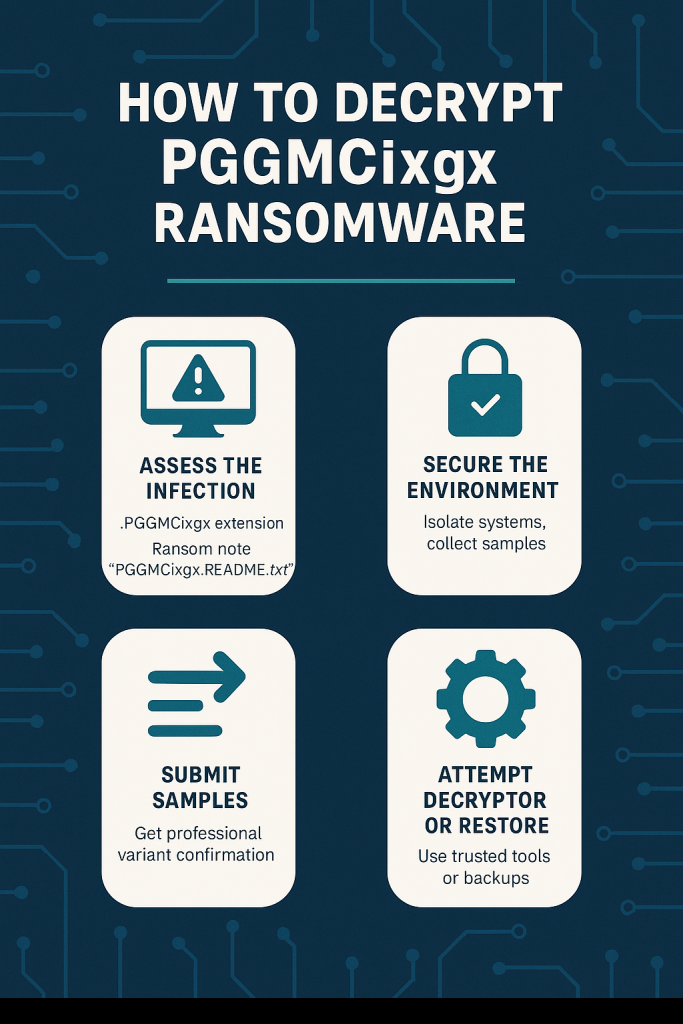
- Assess the Infection
Identify .PGGMCixgx extensions and ransom notes named PGGMCixgx.README.txt. - Secure the Environment
Disconnect systems, collect ransom note and encrypted samples. - Engage Our Recovery Team
Submit sample encrypted files + ransom note for variant confirmation, and we will initiate analysis and provide a recovery timeline. - Run Our Decryptor
Launch the Decryptor as an administrator for optimal performance. An internet connection is required as the tool connects to our secure servers. - Enter Your Victim ID:
Identify the Victim ID from the ransom note and enter it for precise decryption.
- Start the Decryptor:
Initiate the decryption process and let the tool restore your files to their original state.
Offline vs. Online Decryption Techniques
Offline Approaches are recommended for environments where sensitive data cannot leave internal networks. Analysts can work with portable copies of encrypted files to attempt safe decryption.
Online Approaches provide faster resolution. Victims submit encrypted samples over secure channels, enabling experts to test and return decrypted results with greater efficiency.
Understanding the PGGMCixgx Ransomware Threat
The PGGMCixgx family is a new ransomware variant that surfaced in April 2025, first observed in security discussion forums such as 52pojie and 360 Community.
Notable Characteristics
- Contact relies solely on TOX messenger.
- The ransom note is extremely brief, offering no direct crypto addresses or Tor portals.
- Analysts suspect it may be either an early-stage project or a fork of an existing ransomware family.
Techniques, Tools, and MITRE ATT&CK Mapping
Although samples are still under study, the following patterns are suspected:
- Impact Phase: Encrypts user data, renaming files with .PGGMCixgx.
- Persistence: Potential use of registry startup entries or scheduled tasks.
- Defense Evasion: Likely deletion of shadow copies using native Windows utilities.
- Communication: Negotiation and extortion carried out solely over TOX (aligned with ATT&CK T1102.002).
Known Indicators of Compromise (IOCs)
- File Extension: .PGGMCixgx
- Ransom Note: PGGMCixgx.README.txt
- TOX Identifier:
F59A1FE3F212FE3F7774232E455BE6F7EF9B34EDB616A89B7E457A1DCD4AA0603A9D9ECE1978 - Key Strings Found in Notes: “YOUR FILES ARE ENCRYPTED!”, “buying our decryptor”, “tox.chat”
Mitigation Strategies and Best Practices
To defend against PGGMCixgx and similar ransomware threats:
- Maintain offline, immutable backups regularly tested for recovery.
- Apply critical patches and updates to VPNs, RDP, and exposed services.
- Disable unused remote access points to shrink the attack surface.
- Use network segmentation to limit lateral spread.
- Deploy continuous monitoring tools such as SOC or MDR services to identify threats early.
Conclusion
The PGGMCixgx ransomware may use a minimalistic ransom note and rely only on TOX communication, but its consequences are no less serious. Encrypted files ending in .PGGMCixgx cannot be opened without decryption.
The safest road to recovery continues to be through clean backups or professional recovery experts. Directly contacting attackers through TOX carries risks with no guarantee of success. Swift isolation, evidence preservation, and professional guidance remain the best defense.
MedusaLocker Ransomware Versions We Decrypt