Yyt204 Ransomware Recovery
Yyt204 Ransomware (Makop Family): Complete Enterprise Recovery Guide
Quick Navigation
- 1. Executive Summary: The Yyt204 (Makop) Threat
- 2. Threat Intelligence & Technical Specifications
- 3. Anatomy of a Makop Attack (The RDP Kill Chain)
- 4. The Complete Ransom Note Analysis
- 5. Phase 1: Detection & Threat Hunting (Scripts Included)
- 6. Phase 2: Immediate Containment Protocol
- 7. Phase 3: Cryptographic Triage & Recovery Strategies
- 8. Phase 4: Post-Incident Hardening & RDP Resilience
1. Executive Summary: The Yyt204 (Makop) Threat
Identified in late November 2026 malware telemetry, Yyt204 ransomware is an aggressive new iteration of the enterprise-focused Makop ransomware family (frequently flagged alongside Phobos heuristics by antivirus engines). Unlike consumer-targeted crypto-lockers, Makop variants specifically hunt corporate networks—combining manual Remote Desktop Protocol (RDP) intrusions with high-pressure double extortion.
Upon breaching an organization’s perimeter, the Yyt204 payload encrypts workstations, file servers, and SQL databases, appending a distinctive filename structure consisting of a unique 8-character hexadecimal victim ID, an empty bracket pair (leaving the legacy email slot blank), and the .yyt204 extension. For example, a critical document named audit_2026.xlsx is renamed to audit_2026.xlsx.[2AF20FA3].[].yyt204. Following encryption, the malware alters the desktop wallpaper and drops a detailed ransom note titled +README-WARNING+.txt.
Because the operators omitted email addresses from the filename, they funnel all extortion communications exclusively through decentralized, metadata-resistant messaging platforms: SimpleX Chat and qTox. Threat actors claim to have exfiltrated SQL databases, audit reports, financial statements, and backups, imposing a 4-day deadline before disclosing or selling stolen data to supervisory agencies and media, and a 7-day deadline before permanently destroying decryption keys. No free public decryptor exists for Yyt204. This playbook provides IT administrators and incident responders with a NIST SP 800-61 roadmap to contain the breach, verify exfiltration claims, and execute a verified clean-room recovery.
2. Threat Intelligence & Technical Specifications
Understanding Yyt204’s Makop lineage, empty-bracket naming structure, and decentralized chat infrastructure is critical for rapid triage and accurate threat attribution.
| Threat Designation | Yyt204 Ransomware (Makop Family Variant) |
|---|---|
| Encrypted File Extension Pattern | .[VictimID].[].yyt204 (e.g., .[2AF20FA3].[].yyt204 — empty email brackets) |
| Ransom Note & Wallpaper | +README-WARNING+.txt and forced desktop wallpaper (“Your files were encrypted! Please contact us for decryption.”) |
| Free Decryptor Available? | No. Secure cryptography requires the attacker’s private key. |
| Actor Contact Channels | SimpleX Chat: hxxps://smp10.simplex.im/a#BRH6wNST6CNKfy1c8OzsZneUcvfkqt8ZOvLiK0qmhP8qTox ID: 00C664CAFAFB960B4633200E854919C76A1BAD7B1B5146B05AC400ACE44D1631852E1E655B91 |
| Antivirus Detection Names | Gen:Variant.Ransom.Makop.168 (Combo Cleaner), Win32/Filecoder.Phobos.E (ESET), Ransom:Win32/Phobos.PB!MTB (Microsoft), Win32:Fasec [Trj] (Avast) |
| Primary Initial Access Vectors | Exposed RDP (TCP 3389) brute-force attacks, phishing attachments (macros), trojans, and cracked software |
| Extortion Deadlines | 4 days (data disclosure/sale & regulatory reporting); 7 days (full sample leak & permanent key destruction) |
3. Anatomy of a Makop Attack (The RDP Kill Chain)
Makop affiliates operate as hands-on-keyboard intruders who target business networks for maximum financial leverage.
- Perimeter Breach (RDP Brute-Force): Attackers scan the internet for exposed Remote Desktop Protocol (TCP 3389) ports, cycling through leaked or weak administrative credentials—or leveraging initial access via phishing macros and trojan downloaders.
- Reconnaissance & Weak-Point Mapping: Once inside, operators spend time mapping corporate directories, identifying SQL databases, accounting folders, audit reports, and reachable backup repositories.
- Data Exfiltration & Defense Sabotage: Before launching the encryptor, attackers stage and exfiltrate sensitive business records to external servers while disabling local security controls and purging Volume Shadow Copies (VSS).
- Manual Payload Execution: Operators deploy the Yyt204 binary across workstations and servers. The malware locks files with the
.[ID].[].yyt204suffix, changes the desktop wallpaper, and drops+README-WARNING+.txtaddressing executive management directly.
4. The Complete Ransom Note Analysis
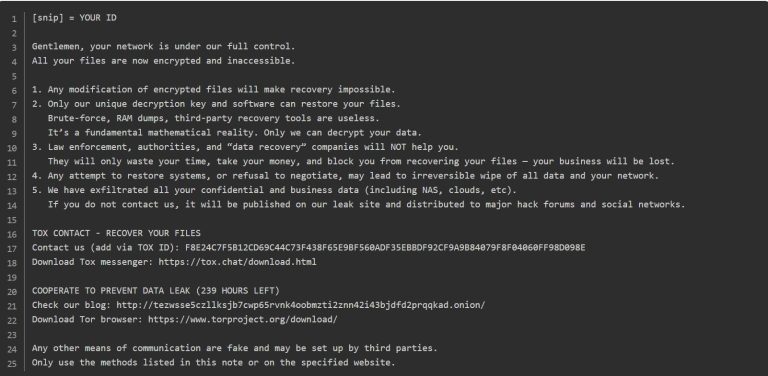
The +README-WARNING+.txt ransom note is explicitly tailored for corporate leadership (“Dear Management”), combining technical warnings with regulatory and reputational coercion. Below is the complete text observed in the wild.
Dear Management, If you are reading this message, it means that: – your network infrastructure has been compromised, – critical data was leaked, – files are encrypted The best and only thing you can do is to contact us to settle the matter before any losses occurs. You can download SimpleX Chat at the following link: hxxps://simplex.chat Our contact in the SimpleX chat: hxxps://smp10.simplex.im/a#BRH6wNST6CNKfy1c8OzsZneUcvfkqt8ZOvLiK0qmhP8 Chat qtox: hxxps://tox.chat/download.html Our chat ID: 00C664CAFAFB960B4633200E854919C76A1BAD7B1B5146B05AC400ACE44D1631852E1E655B91 1. THE FOLLOWING IS STRICTLY FORBIDDEN 1.1 EDITING FILES ON HDD. Renaming, copying or moving any files could DAMAGE the cipher and decryption will be impossible. 1.2 USING THIRD-PARTY SOFTWARE. Trying to recover with any software can also break the cipher and file recovery will become a problem. 1.3 SHUTDOWN OR RESTART THE PC. Boot and recovery errors can also damage the cipher. Sorry about that, but doing so is entirely at your own risk. 2. EXPLANATION OF THE SITUATION 2.1 HOW DID THIS HAPPEN The security of your IT perimeter has been compromised (it’s not perfect at all). We encrypted your workstations and servers to make the fact of the intrusion visible and to prevent you from hiding critical data leaks. We spent a lot of time researching and finding out the most important directories of your business, your weak points. We have already downloaded a huge amount of critical data and analyzed it. Now its fate is up to you, it will either be deleted or sold, or shared with the media. 2.2 VALUABLE DATA WE USUALLY STEAL: – Databases, legal documents, personal information. – Audit reports. – Audit SQL database – Any financial documents (Statements, invoices, accounting, transfers etc.). – Work files and corporate correspondence. – Any backups. – Confidential documents. 2.3 TO DO LIST (best practices) – Contact us as soon as possible. – Contact us only in our live chat, otherwise you can run into scammers. – Purchase our decryption tool and decrypt your files. There is no other way to do this. – Realize that dealing with us is the shortest way to success and secrecy. – Give up the idea of using decryption help programs, otherwise you will destroy the system permanently. – Avoid any third-party negotiators and recovery groups. They can become the source of leaks. 3. POSSIBLE DECISIONS 3.1 NOT MAKING THE DEAL – After 4 days starting tomorrow your leaked data will be Disclosed or sold. – We will also send the data to all interested supervisory organizations and the media. – Decryption key will be deleted permanently and recovery will be impossible. – Losses from the situation can be measured based on your annual budget. 3.2 MAKING THE WIN-WIN DEAL – You will get the only working Decryption Tool and the how-to-use Manual. – You will get our guarantees (with log provided) of non-recoverable deletion of all your leaked data. – You will get our guarantees of secrecy and removal of all traces related to the deal in the Internet. – You will get our security report on how to fix your security breaches. 4. Your Information and Keys 4.1 All leaked Data samples will be Disclosed in 7 Days if you remain silent. 4.2 Your Decryption keys will be permanently destroyed at the moment the leaked Data is Disclosed. 5. RESPONSIBILITY 5.1 Breaking critical points of this offer will cause: – Deletion of your decryption keys. – Immediate sale or complete Disclosure of your leaked data. – Notification of government supervision agencies, your competitors and clients.
5. Phase 1: Detection & Threat Hunting
Upon detecting .yyt204 files on any host, sweep the network immediately to map all affected endpoints, inventory unique victim IDs, and check for RDP brute-force or VSS tampering indicators.
Actionable PowerShell Threat Hunt
Deploy this PowerShell script via your EDR Live Response console or SCCM to audit Windows endpoints for Yyt204 (Makop) artifacts:
# ==============================================================================
# Decryptors.org Incident Response Script: Yyt204 (Makop) Audit
# Target: Windows Endpoints & Servers (Run as Administrator)
# ==============================================================================

Write-Host "Starting Yyt204 (Makop) Network Audit..." -ForegroundColor Cyan
$infectionFound = $false

# 1. Check for encrypted .yyt204 files in key directories
$testPaths = @("$env:USERPROFILE\Documents", "$env:USERPROFILE\Desktop", "C:\Data", "D:\Shares")

foreach ($path in $testPaths) {
    if (Test-Path $path) {
        $encryptedFiles = Get-ChildItem -Path $path -Filter "*.yyt204" -Recurse -ErrorAction SilentlyContinue
        if ($encryptedFiles.Count -gt 0) {
            Write-Warning "[!] CRITICAL: Encrypted .yyt204 files detected in $path ($($encryptedFiles.Count) files)"
            $infectionFound = $true
        }
    }
}

# 2. Hunt for the specific +README-WARNING+.txt ransom note
$ransomNotes = Get-ChildItem -Path C:\ -Filter "+README-WARNING+.txt" -Recurse -Depth 4 -ErrorAction SilentlyContinue
if ($ransomNotes) {
    Write-Warning "[!] CRITICAL: Yyt204 ransom note (+README-WARNING+.txt) discovered:"
    foreach ($note in $ransomNotes) {
        Write-Warning "    -> $($note.FullName)"
    }
    $infectionFound = $true
}

# 3. Check Event Logs for Volume Shadow Copy (VSS) deletion & suspicious RDP logons
try {
    $vssEvents = Get-WinEvent -LogName System -MaxEvents 200 -ErrorAction Stop |
                 Where-Object {$_.Id -eq 7036 -and $_.Message -match "Volume Shadow Copy"}
    if ($vssEvents) {
        Write-Warning "[!] Warning: Volume Shadow Copy service modifications detected in recent logs."
    }
} catch {
    Write-Output "[i] Could not parse System Event Logs."
}

if ($infectionFound) {
    Write-Warning ">>> IMMEDIATE ENDPOINT ISOLATION REQUIRED. DO NOT REBOOT OR SHUTDOWN. <<<"
} else {
    Write-Output "[i] No immediate signs of Yyt204 infection on this endpoint."
}
6. Phase 2: Immediate Containment Protocol
HALT ALL RESTORATION ATTEMPTS IMMEDIATELY. Restoring clean backups onto an actively compromised network—or leaving exposed RDP ports open—will result in immediate re-encryption.
- Physical & Logical Isolation Without Rebooting: Disconnect affected workstations and servers at the switch or hypervisor level (unplug Ethernet / disable vNIC). Do not shut down or restart infected machines—preserving volatile RAM prevents mid-encryption corruption and retains critical memory artifacts for forensic investigators.
- Block RDP Immediately: Close TCP port 3389 on your perimeter firewall and disable Remote Desktop via Group Policy until MFA-enforced VPN access is in place.
- Isolate Backup Repositories: Immediately sever all logical and physical connections to NAS devices, SANs, tape libraries, and cloud backup gateways to protect unencrypted historical snapshots.
- Export Firewall & RDP Logs: Preserve the past 30 days of perimeter egress logs and Windows Security Event Logs (Event IDs 4624/4625) to trace the initial RDP breach and verify whether the attackers' data exfiltration claims are authentic.
7. Phase 3: Cryptographic Triage & Recovery Strategies
Once the network is isolated and the RDP/perimeter intrusion vector is closed, execute recovery using a strict clean-room methodology.
Method 1: The Gold Standard - Restoring from Immutable Backups
- Clean-Room Rebuild: Because Makop operators perform hands-on-keyboard intrusions and frequently deploy secondary password-stealing trojans or hidden admin accounts, never simply delete
.yyt204files and resume operations. Format compromised drives completely and perform bare-metal OS reinstallations. - Active Directory & Credential Rotation: Assume all domain, local administrator, and SQL service credentials are compromised. Force a global password reset and reset the AD
krbtgtaccount password twice to invalidate forged Kerberos tickets. - Sequenced Restoration: Rebuild Domain Controllers first in an isolated VLAN, followed by SQL databases and user shares—confirming every backup archive predates the initial RDP compromise.
Method 2: Forensic Data Carving & Extortion Risk Management
If viable backups were encrypted or deleted, brute-forcing Makop's encryption without the attacker's private key is mathematically unfeasible. Before making any contact over SimpleX Chat or qTox:
- Clone Affected Drives First: Create bit-stream forensic images of all critical encrypted drives using a hardware write-blocker. Never run recovery tools directly on original production drives.
- Evaluate Database & Unallocated Carving: Have DFIR engineers inspect large SQL Server databases (
.mdf) and unallocated disk clusters for intact pre-encryption fragments or partial encryption boundaries. - Sandbox Any Decryption Tool: If negotiation is ever pursued as an absolute last resort, work strictly through professional DFIR negotiators and legal counsel. Execute any acquired decryptor exclusively inside an air-gapped workstation against cloned drives, verify file integrity, and scan all outputs with multiple EDR engines before reintroduction.
8. Phase 4: Post-Incident Hardening & RDP Resilience
Preventing future Makop or Phobos-style intrusions requires closing exposed remote access services and modernizing backup immutability.
- Eradicate Public RDP Exposure: Never expose TCP port 3389 directly to the internet. Require a phishing-resistant MFA VPN combined with a hardened jump host or Privileged Access Management (PAM) gateway for all remote administration.
- Deploy Immutable, Air-Gapped Backups (3-2-1-1-0 Rule): Implement Write-Once-Read-Many (WORM) immutable storage (such as Veeam Linux Hardened Repositories or AWS S3 Object Lock) completely decoupled from Active Directory credentials so compromised admins cannot delete recovery points.
- Deploy Tamper-Protected Behavioral EDR/XDR: Replace legacy antivirus with behavioral EDR configured to auto-isolate endpoints executing mass file renames, credential dumping, or shadow copy deletion.
- Enforce Account Lockouts & Network Segmentation: Enable strict Active Directory account lockout thresholds to neutralize brute-force tools, remove local administrator rights from standard workstations, and isolate database and backup servers on firewalled VLANs.
Yyt204 Ransomware (Makop family) represents a high-impact corporate extortion threat combining RDP-driven manual intrusions, decentralized SimpleX/qTox communications, and compressed 4-to-7-day leak deadlines. Overcoming a Yyt204 breach requires immediate isolation without rebooting, independent verification of egress logs, and a hardened, clean-room rebuild backed by immutable storage.