
Bitco1n Ransomware Decryptor
Our cybersecurity specialists have reverse-engineered the Bitco1n ransomware’s encryption algorithm, developing a professional decryptor that has already helped restore data for multiple victims worldwide. Whether running on Windows desktops, business servers, or virtualized environments like VMware, this decryptor ensures reliability and accuracy during recovery.
Decryption Methodology Explained
Bitco1n ransomware recovery requires precision. Our decryptor applies the following techniques to restore locked data:
- AI-Powered Validation: Files are scanned within a secure environment to confirm integrity before decryption begins.
- Unique ID Mapping: Each victim’s ransom note includes a System ID. Our decryptor uses this to identify the correct encryption batch.
- Fallback Universal Key: For victims without the ransom note, we provide a premium universal decryptor capable of handling newer Bitco1n strains.
- Secure Processing: The decryption runs in read-only mode first, ensuring no further damage occurs to the already compromised files.
System Requirements for Decryption
To operate our recovery tool effectively, victims must provide:
- A copy of the ransom note (How To Restore Your Files.txt)
- Access to at least a sample of encrypted files
- An internet connection (for secure key validation)
- Administrator privileges on the affected system
What to Do Immediately After a Bitco1n Attack
Swift action can make the difference between partial recovery and total data loss.
- Disconnect compromised machines from the network to prevent lateral spread.
- Preserve all ransom notes, encrypted files, and system logs for forensic review.
- Avoid rebooting infected systems, which could trigger additional encryption scripts.
- Contact professional ransomware experts before attempting any form of self-recovery.
How to Decrypt Bitco1n Ransomware and Recover Data
Bitco1n, like other CONTI derivatives, is a high-risk ransomware designed to cripple entire infrastructures. Victims often assume paying the ransom is the only path forward, but professional decryptors and structured recovery steps can restore data without funding cybercriminals. Our decryptor is designed specifically for the “.Bitco1n” extension and has successfully reversed encryption in multiple cases.
Free Recovery Approaches
While free methods have limitations, they should be considered before exploring paid solutions.
Community Decryptors
Security vendors occasionally release tools targeting early ransomware builds. Unfortunately, there is currently no free decryptor that works for modern Bitco1n variants.
Backup Restoration
If offline or cloud-based immutable backups exist, they remain the most effective recovery method. Administrators must verify snapshot integrity before re-deploying them to ensure ransomware has not corrupted stored images.
VM Rollback
Virtual environments such as VMware ESXi allow rapid rollback to pre-attack states if snapshots were secured. However, attackers often attempt to delete these during their intrusion.
Paid Recovery Approaches
Victims without backups or free decryptor options are left with limited choices.
Paying Cybercriminals
This method is discouraged. Even when attackers provide a decryptor, it often results in partial or corrupted recovery, and paying may violate local laws.
Hiring Negotiators
Specialized negotiators interact with attackers via TOR-based portals to reduce ransom demands. While sometimes effective, they charge significant fees and provide no guarantees.
Our Professional Bitco1n Decryptor
Our tool represents the safest paid recovery method. It integrates AI-driven blockchain verification, ID-based mapping, and both offline and online decryption support. Unlike criminals, we guarantee file integrity and deliverability.
Our Specialized Bitco1n Decryptor in Detail
- Reverse-Engineered Security: Built on extensive cryptographic research into CONTI ransomware lineage.
- Cloud and Local Options: Victims may choose secure online recovery or fully offline modes for air-gapped systems.
- Forensic Logs: Each decryption run provides an audit trail, ensuring transparency.
- Broad Compatibility: Supports physical machines, enterprise servers, and virtualized deployments.
Step-by-Step Recovery with Our Decryptor
- Confirm Infection: Verify files show the “.Bitco1n” extension and ransom notes exist.
- Isolate Systems: Ensure no encryption scripts continue running.
- Submit Evidence: Provide ransom note + encrypted samples for variant confirmation.
- Run the Decryptor: Launch as admin with stable internet connection.
- Enter System ID: Input the ID from ransom note for tailored decryption.
- Restore Files: Decryption runs securely, recovering original filenames and data.
Offline vs Online Decryption
- Offline Mode: Best for air-gapped or classified environments. Data is transferred via external drives, ensuring no internet connection is required.
- Online Mode: Faster recovery via secure cloud channels, with expert support and real-time validation.
Understanding Bitco1n Ransomware
Bitco1n is part of the CONTI family, infamous for its large-scale extortion campaigns. Like its predecessors, Bitco1n employs double extortion tactics, threatening to publish stolen data if the ransom isn’t paid. It encrypts files quickly and spreads laterally across networks, targeting enterprises, small businesses, and individuals alike.
Lineage and Links to CONTI
Investigations indicate that Bitco1n ransomware shares multiple code traits with CONTI. After CONTI disbanded, several of its affiliates continued operations through new strains like Royal, BlackBasta, and Akira. Bitco1n is considered one of these offshoots, retaining many of CONTI’s encryption modules and ransom note structures.
How Bitco1n Attacks Work
Initial Access
Bitco1n infiltrates networks through phishing emails, brute-forced RDP sessions, malicious ads, torrent files, and exploitation of unpatched vulnerabilities.
Tactics, Tools, and MITRE ATT&CK Mapping
- Credential Theft: Mimikatz and LaZagne extract login details (T1003).
- Reconnaissance: Advanced IP Scanner identifies active hosts (T1018).
- Defense Evasion: Rootkit utilities bypass antivirus detection (T1562).
- Exfiltration: Data moved using FileZilla, RClone, and Mega services (T1048, T1567).
- Encryption: Hybrid algorithm combining ChaCha20 and RSA ensures robust encryption.
Encryption and Extortion Tactics
Bitco1n disables recovery options by deleting shadow copies and system restore points. The ransom note demands payment in exchange for the decryption tool, often escalating threats to publish sensitive files on underground forums if ignored. This double-extortion method pressures victims into compliance.
Indicators of Compromise (IOCs)
- Extension: .Bitco1n
- Ransom Note: How To Restore Your Files.txt
- Registry Modifications: Persistence keys added for startup execution
- Outbound Connections: Communications with Telegram (@Decryptor_run) and attacker-controlled servers
- File Artifacts: Dropped executables matching CONTI detection families (e.g., Ransom:Win32/Conti.AD!MTB)
Bitco1n Ransomware Victim Data
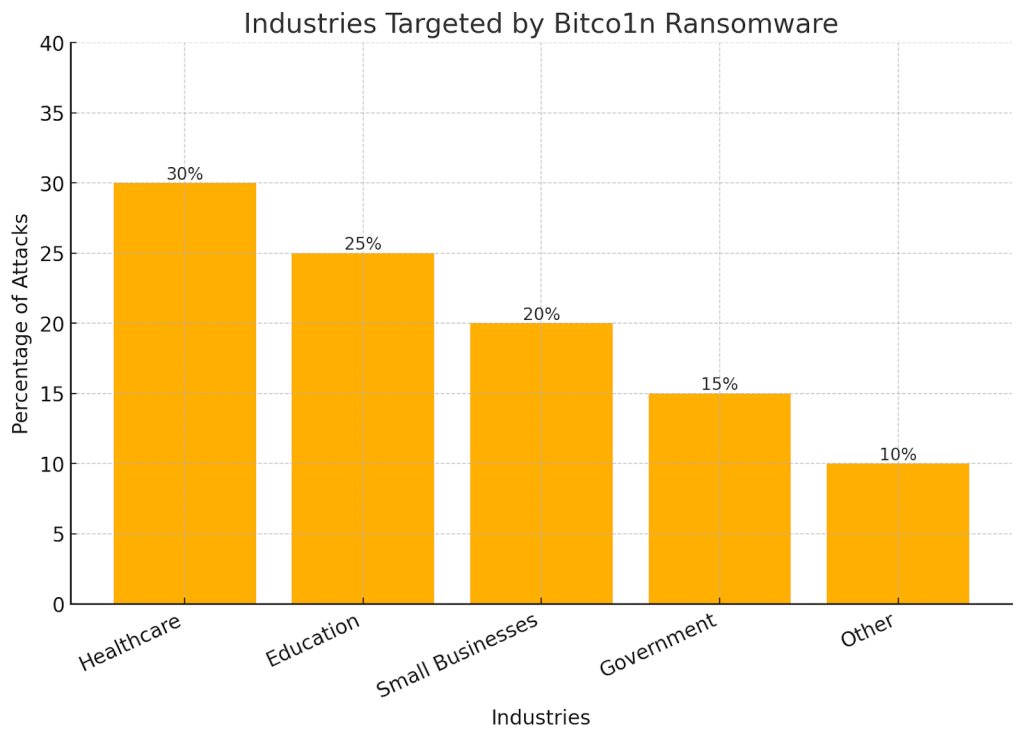
Bitco1n has caused global disruptions across several industries.
Top Countries Impacted

Industries Targeted
Attack Timeline (2024–2025)

Dissecting the Ransom Note
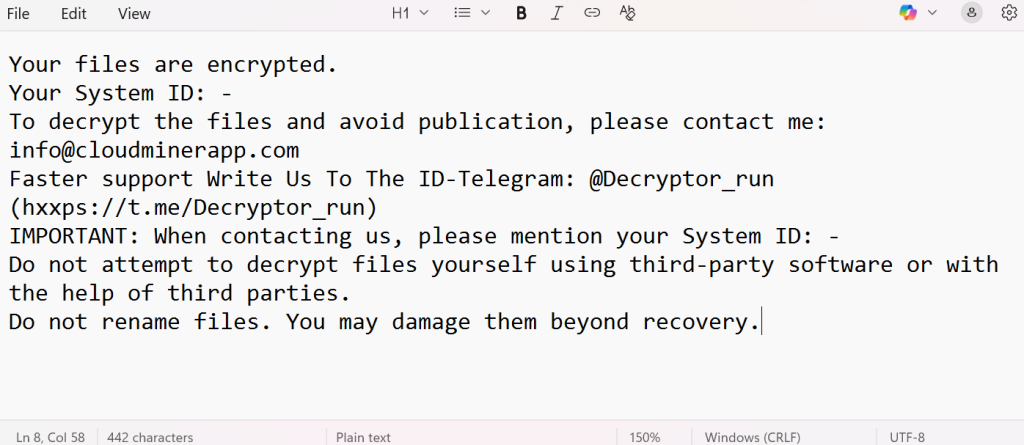
The ransom note How To Restore Your Files.txt includes:
Your files are encrypted.
Your System ID: –
To decrypt the files and avoid publication, please contact me:
Faster support Write Us To The ID-Telegram: @Decryptor_run (hxxps://t.me/Decryptor_run)
IMPORTANT: When contacting us, please mention your System ID: –
Do not attempt to decrypt files yourself using third-party software or with the help of third parties.
Do not rename files. You may damage them beyond recovery.
Conclusion
Bitco1n ransomware (.Bitco1n extension) is a devastating malware that locks files and extorts victims with double-threat tactics. While no free decryptor currently exists, our specialized Bitco1n decryptor provides a secure and reliable path to recovery. The key lies in early action: isolating systems, preserving evidence, and contacting experts before irreversible damage occurs.
MedusaLocker Ransomware Versions We Decrypt