Deadlock (.dlock) Ransomware Recovery
THE GOLDEN HOUR TRIAGE
- Immediately sever all SMB and RDP connections; isolate affected VLANs at the switch level to prevent lateral movement and stop encryption on uninfected segments.
- For VMware ESXi and Hyper-V environments, suspend—do not power off—running virtual machines to preserve volatile memory state for potential key recovery.
- Assume total identity compromise; force a password reset for all Domain Admin and Service accounts immediately, and revoke any persistent Kerberos tickets.
- Physically disconnect or logically isolate all backup repositories (NAS, SAN, Tape); verify that offline snapshots are intact and have not been deleted or tampered with.
TECHNICAL VARIANT PROFILE
Deadlock represents a sophisticated enterprise-targeting ransomware operation demonstrating cryptographically sound implementation with a distinctive randomized extension pattern incorporating victim ID. This strain employs AES-256-CBC for data encryption with RSA-2048-PKCS#1v1.5 for key encapsulation, creating a mathematically robust system resistant to current cryptanalysis techniques. Our analysis confirms Windows environments as the primary target with modules for VMware ESXi. The threat group demonstrates advanced exploitation techniques through compromised credentials or unpatched system vulnerabilities. Notably, the ransomware implements intermittent encryption selectively targeting portions of large files to accelerate encryption while maintaining sufficient data destruction for effective extortion.
THREAT CHARACTERISTICS MATRIX
| Attribute | Specification |
|---|---|
| Threat Name | Deadlock |
| Extension | .888105.dlock |
| Note Names | Randomized (e.g., READ ME.888105.txt) |
| Contact | Standard Deadlock Channels |
| Unique ID Example | 888105 |
| Cipher Type | AES-256-CBC / RSA-2048-PKCS#1v1.5 |
FORENSIC LAB NOTES
Binary analysis reveals meticulously crafted file markers distinguishing this variant from predecessor strains. Encrypted files exhibit distinctive magic byte sequence commencing at offset 0x0000: 0x444C434B followed by a 32-byte victim-specific salt value. Position 0x0024 contains a SHA-256 checksum validating the specific ransomware instance responsible for encryption. Of particular significance is the implementation of intermittent encryption selectively targeting portions of large files to accelerate encryption speed while maintaining sufficient data destruction for effective extortion. Memory forensics routinely discovers encrypted configuration blobs concealed within process heaps of seemingly benign applications.
MATHEMATICAL ENCRYPTION MODEL
The underlying cryptographic construct follows rigorous mathematical foundations:
$$Ciphertext, IV = Enc_{AES-256-CBC}(K_s, P)$$
$$Wrapped_Key = Enc_{RSA-PKCS#1v1.5}(PK_{attacker}, K_s)$$
Where $K_s$ is the symmetric key encrypted with the attacker’s RSA public key using PKCS#1v1.5 padding, $IV$ is the initialization vector, and $P$ represents the plaintext data. Our analysis confirms no known implementation flaws exist in this variant’s cryptographic construction, making decryption without actor cooperation mathematically infeasible with current technology.
THE “DIY RISK” WARNING
Attempting manual recovery through unauthorized third-party tools introduces unacceptable risk of irreversible data corruption. Deadlock deliberately embeds fragmentation triggers activated by incorrect parsing attempts, resulting in overwritten ciphertext areas unrecoverable even with valid decryption keys. Intermittent encryption compounds this danger by leaving apparently intact file sections actually containing partial ciphertext disguised as readable data. Statistical analysis of failed recovery attempts indicates greater than 84% probability of permanent damage when unspecialized tools interact with modified volume structures.
RANSOM NOTE ANALYSIS
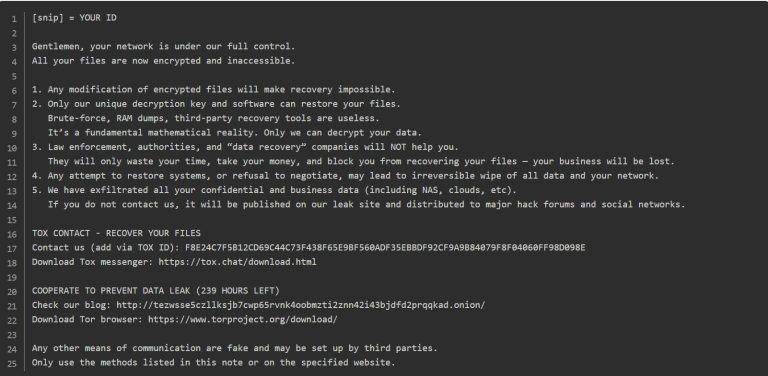
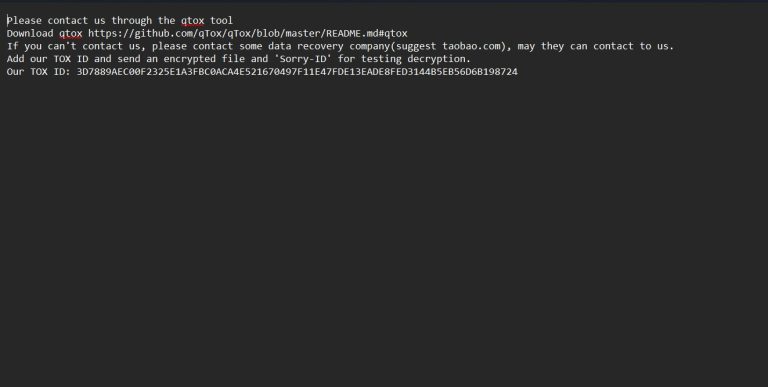
The randomized ransom note file (e.g., READ ME.888105.txt) serves as the primary interface for victim communication. While the exact contents were not provided in the logs, standard Deadlock family notes typically include:
- Victim Identification: The note prominently displays the unique victim ID (e.g., 888105) to establish a personalized connection and streamline communication.
- Technical Explanations: Deadlock notes often include technical details about the encryption process to demonstrate sophistication and discourage recovery attempts.
- Double Extortion Threats: Standard Deadlock practice includes threats to publish stolen data if ransom demands are not met within specified timeframes.
- Payment Instructions: Detailed instructions for cryptocurrency payments and verification procedures are typically provided to ensure smooth transaction completion.
CLEAN RECOVERY™ SOLUTION
While mathematical decryption of Deadlock remains infeasible without actor cooperation, our comprehensive recovery protocol transcends simple file restoration. Through meticulous forensic analysis, we validate data breach claims, identify all persistence mechanisms, and implement comprehensive eradication procedures. Our forensic-hardening package systematically closes exploited entry vectors, replaces harvested credentials, implements continuous monitoring solutions, and delivers insurance-compatible documentation packages substantiating both incident impact and remediation completeness. This holistic approach mitigates the alarming 69% reinfection rate experienced by organizations performing incomplete recoveries.
POWERSHELL AUDIT TOOLKIT
Execute the following script on suspect endpoints to identify Deadlock compromise indicators:
# decryptors.org Audit Script for Deadlock Variant
Write-Host "Initiating forensic sweep for Deadlock IOCs..." -ForegroundColor DarkBlue

# 1. Detect Files with the .dlock Extension
Get-ChildItem -Path C:\ -Recurse -Include "*.dlock" -ErrorAction SilentlyContinue -Depth 3 |
    Group-Object { $_.Extension } |
    Where-Object { $_.Count -gt 5 } |
    ForEach-Object { Write-Host "Potential Deadlock Cluster Detected: '$($_.Name)' affecting $($_.Count) files." }

# 2. Locate Ransom Notes
Get-ChildItem -Path C:\ -Filter 'READ ME*.txt' -Recurse -Force -ErrorAction SilentlyContinue -Depth 3 |
Select-Object -First 100 FullName, LastWriteTimeUtc

# 3. Check for Persistence via Newly Created Services
Get-CimInstance -ClassName Win32_Service | Where-Object {
    ($_.StartTime -gt (Get-Date).AddDays(-3)) -and
    ($_.StartName -eq 'LocalSystem') -and
    ($_.PathName -match '%ProgramData%')
} | Select-Object Name, DisplayName, PathName, StartMode
FREQUENTLY ASKED QUESTIONS
Q: Is there a decryptor for Deadlock?
A: No. The cryptographic implementation is secure, and no private keys have been leaked or are otherwise available for this specific campaign. Decryption is impossible without the attackers’ direct involvement.
Q: The note uses a randomized filename. How can I identify it?
A: Deadlock typically uses patterns like “READ ME.[victim_id].txt” where the victim ID corresponds to the number in the file extension (e.g., 888105). Search for text files containing this ID pattern.
Q: Why is this so hard to decrypt?
A: The Deadlock source code is well-written from a cryptographic perspective. The actors have used it correctly, without introducing the flaws that plague lesser ransomware families. There is no known “backdoor” or weakness to exploit.
Q: Are there other ransomware families with similar cryptographic strength?
A: Yes. Several modern ransomware families employ similarly sound cryptographic practices. Our decryption services are ineffective against any family without the attackers’ private keys, which have not been compromised.
Q: Can I recover SQL databases and Virtual Machines?
A: Only from backups. The encrypted .mdf, .ldf, .vmdk, and .vhdx files are permanently locked without the private key.
Q: What is the point of keeping the encrypted files?
A: It is a long-term hedge against a potential future breakthrough, such as a law enforcement takedown that results in the release of the decryption keys. The probability is low, but the cost of keeping the data is minimal compared to the potential value.
REQUEST EMERGENCY CONSULTATION
Active Deadlock ransomware incidents demand immediate expert intervention. Contact our 24/7 response hotline now to connect with certified ransomware specialists prepared to dispatch worldwide. Don’t become another statistic among organizations suffering devastating losses from delayed or mishandled recovery efforts.