
.stolen9 MedusaLocker Ransomware Decryptor
How Our Decryptor Works
Our cybersecurity experts have developed a sophisticated decryption utility specifically for the MedusaLocker .stolen9 variant. This tool is the result of extensive reverse-engineering of MedusaLocker3’s encryption framework, allowing the recovery of data that has been locked by this ransomware. The decryptor is compatible with Windows, Linux, and VMware ESXi systems, providing a stable and forensic-grade recovery process for enterprise and individual victims alike.
The decryptor was built after deeply analyzing the cryptographic patterns used by the MedusaLocker .stolen9 strain. Through static code inspection and behavioral simulation, our engineers reconstructed the encryption algorithm’s key flow. This enables the decryptor to map relationships between the attacker’s RSA public key and the per-file session keys used to encrypt data.
An artificial intelligence module runs automated scans across encrypted file headers and ransom notes. It identifies the variant’s encryption markers, compares them with known MedusaLocker patterns, and then determines the most accurate key structure for recovery. This ensures precision in recognizing .stolen9 signatures without corrupting the file set.
Each ransom note — in this case titled Read_Note.html — contains a victim-specific identifier. The decryptor extracts and uses this ID to match the specific encryption batch used in the attack. This mapping is essential to accurately link encrypted session keys to the correct public-key pair used by the attackers.
In cloud-enabled mode, encrypted files are securely uploaded to an isolated sandbox for controlled validation. This environment analyzes cryptographic integrity without exposing sensitive data. No actual file content leaves the environment; only metadata and encrypted markers are evaluated, ensuring total confidentiality during processing.
Before any decryption begins, the utility performs a non-destructive, read-only check. This pre-scan verifies that each encrypted file is structurally intact, properly formatted, and not partially corrupted. Only after this verification passes does the controlled decryption sequence commence.
Evidence and Artifacts to Preserve
In the wake of a ransomware incident, preserving evidence is crucial to support both technical recovery and possible legal action. All original artifacts should remain untouched.
Critical items to retain include:
- The original ransom note HTML file in its raw form.
- Multiple encrypted files with their original metadata and timestamps.
- Any suspicious executables or scripts discovered during investigation (such as stolen9.exe).
- System and security logs, including authentication events, Windows event logs, and network flow records.
- Memory dumps if the system is still running, as these can contain encryption keys or transient process information.
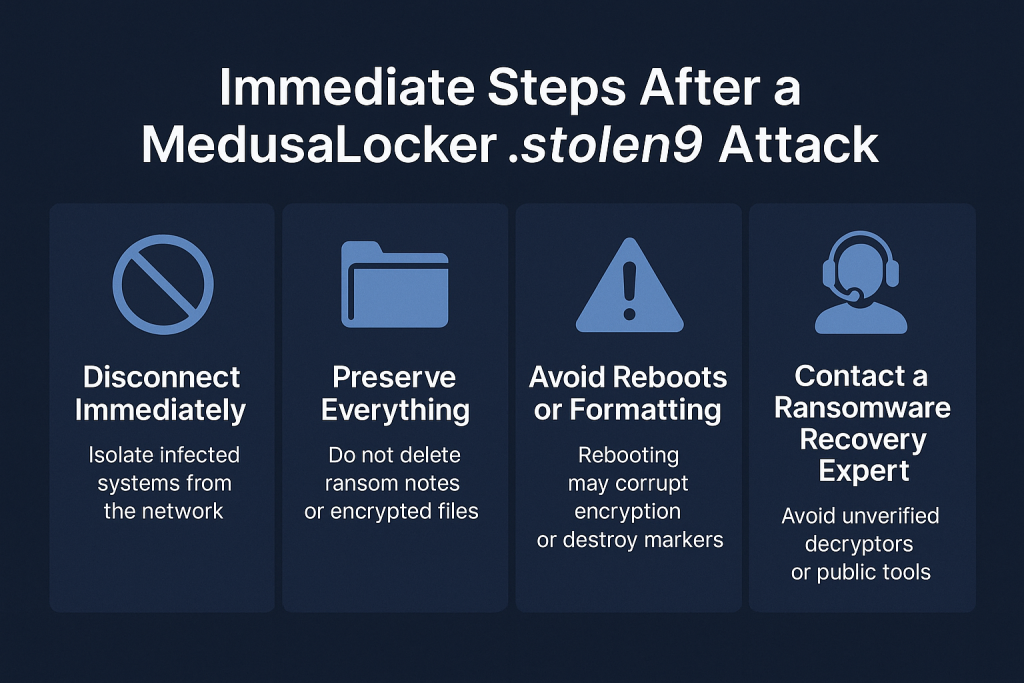
Immediate Steps After a MedusaLocker .stolen9 Infection
Time is critical when responding to an active ransomware attack. The following steps can greatly improve the chances of containment and successful data recovery.
Immediately isolate all compromised machines from the network. Disconnect shared storage, servers, and any mapped network drives. This prevents further file encryption or lateral movement across the environment.
Do not delete, rename, or modify any encrypted files. Keep the ransom notes intact and retain all associated data such as event logs, system hashes, and packet captures. This information is indispensable for analysis and for validating recovery tools later.
Rebooting or reformatting may activate hidden encryption scripts or permanently destroy decryption markers within the file headers. Leave infected systems powered on but isolated, allowing analysts to capture memory and disk images properly.
Avoid using random decryptors or online “miracle tools.” These may further corrupt data. Work with experienced incident response or recovery specialists who have handled MedusaLocker3 and similar families. Quick professional intervention significantly increases recovery success rates.
How to Decrypt .stolen9 Files and Recover Data
The .stolen9 variant belongs to the MedusaLocker3 ransomware lineage, known for its RSA + AES hybrid encryption. Each file is encrypted using a unique symmetric AES key, which is then locked with the attacker’s RSA public key. Our decryptor reconstructs these AES session keys and validates them against the corresponding RSA key relationships found in the infection artifacts.
Decryption and Recovery Options
Older community decryptors developed for legacy MedusaLocker versions exploited flaws in weak key generation. Unfortunately, these tools are ineffective against modern .stolen9 samples, which use updated and hardened cryptography.
Backup Restoration:
If you maintain clean, immutable backups, restoring from these is the most effective method. Validate integrity using checksums or by mounting the backups to ensure they were not affected by the ransomware.
VM Snapshots:
Organizations running virtualized environments may be able to revert systems to pre-attack snapshots. Ensure snapshots are isolated and not encrypted or deleted during the compromise before proceeding with rollback.
Our threat research division discovered that .stolen9 ransomware occasionally generates encryption keys influenced by system timestamps and hardware-seeded randomness. By reconstructing the timestamp window and using GPU-accelerated brute force, we can test large sets of potential keys in parallel. This process is entirely read-only and used only in forensic recovery scenarios.
Paying the ransom may result in receiving a decryption key from the threat actors, but there is no guarantee the key or tool will function correctly. Many victims report corrupted or incomplete decryptors and even hidden backdoors. Payment can also carry legal risks, particularly in regulated industries.
Some victims choose to use professional negotiation intermediaries, who verify proof-of-decryption samples before any payment. While occasionally successful, these services are costly and do not guarantee data safety or full restoration.
Our decryptor was built specifically for the .stolen9 strain using reverse-engineering, key reconstruction, and forensic validation. It does not rely on ransom payment or attacker cooperation.
Core Capabilities Include:
- Automatic identification of .stolen9 or related MedusaLocker3 variants.
- Decryption synchronized using Victim ID values from ransom notes.
- Optional cloud-based sandboxing for secure verification.
- Full offline support for isolated or classified networks.
- Forensic-grade logging of every file processed for transparency and auditing.
Step-by-Step .stolen9 Recovery Guide
- Confirm Infection
Validate that files are renamed with .stolen9 and ransom notes titled Read_Note.html exist. - Secure the Environment
Isolate all compromised systems, disable shared access, and ensure encryption activity has ceased. - Contact Recovery Experts
Submit a small set of encrypted files along with the ransom note. Analysts will confirm the variant and determine if decryption is possible. - Launch the .stolen9 Decryptor
Run the decryptor with administrative rights. The program automatically performs a safety scan and requests your Victim ID. - Select Recovery Mode
- Offline Mode: For secure, isolated networks.
- Online Mode: Uses our secure servers to accelerate decryption validation.
- Offline Mode: For secure, isolated networks.
- Begin Restoration
Once valid keys are confirmed, the tool decrypts files and restores them to their original state. Every recovered file is logged for chain-of-custody verification.
Offline vs Online Recovery Comparison
| Mode | Process Description | Ideal Use Case |
| Offline Mode | Operates locally without an internet connection; processes encrypted data on an air-gapped workstation. | Critical or classified systems requiring total isolation. |
| Online Mode | Uses encrypted, cloud-based key verification for faster recovery and expert support. | Enterprise networks needing speed and oversight. |
Security and Data Integrity Assurance
Our decryptor performs read-only validation to eliminate accidental data corruption. All communication during online processing is encrypted end-to-end. Most importantly, the entire process avoids ransom payments, ensuring both ethical compliance and complete transparency.
Background: MedusaLocker Ransomware Family
MedusaLocker is a long-running ransomware family first discovered in 2019. Over time, the group has created numerous offshoots — each adding new extensions, modified note templates, and improved encryption methods. Its goal has remained consistent: encrypt sensitive data, demand ransom, and threaten to publish exfiltrated files if payment is refused.
Modern MedusaLocker operations follow a RaaS model. Core developers license the malware to affiliates, who handle initial access and distribution. Each affiliate may customize extensions and ransom notes — resulting in personalized variants like .stolen9.
Observed Artifacts and Behavior
- Encrypted files carrying the .stolen9 extension.
- Presence of Read_Note.html ransom note in each folder.
- Lock screen displaying attacker contact emails.
- Binary identified as stolen9.exe.
- A visible “master public key” printed in the command window during execution.
The ransomware warns victims not to modify encrypted files and provides two contact addresses — [email protected] and [email protected] — offering to decrypt two or three small files as proof of legitimacy.
Ransom Note and Communication Style
Ransom Note Name: Read_Note.html
Excerpt from Actual Message:
YOUR COMPANY NETWORK HAS BEEN PENETRATED
ANY ATTEMPT TO RESTORE YOUR FILES WITH THIRD-PARTY SOFTWARE WILL
PERMANENTLY CORRUPT IT. DO NOT MODIFY ENCRYPTED FILES. DO NOT RENAME
ENCRYPTED FILES.
No software available on internet can help you. We are the only ones
able to solve your problem. We gathered highly confidential/personal
data. These data are currently stored on a private server. This server
will be immediately destroyed after your payment. If you decide to not
pay, we will release your data to public or re-seller. So you can
expect your data to be publicly available in the near future.. We only
seek money and our goal is not to damage your reputation or prevent
your business from running. You will can send us 2-3 non-important
files and we will decrypt it for free to prove we are able to give
your files back.
Contact us for price and get decryption software
To contact us, create a new free email account on the site:
IF YOU DON’T CONTACT US WITHIN 72 HOURS, PRICE WILL BE HIGHER
Tor-chat to always be in touch
File Extension and Naming Conventions
The .stolen9 suffix is campaign-specific and used primarily to mark victims of this variant. Extensions serve as identifiers within affiliate campaigns and help the attackers track infections. Variants may use numeric suffixes, random words, or even embedded victim IDs.
Sample Executables and Indicators
A dropper or main binary usually bears the same name as its extension (e.g., stolen9.exe). Additional scripts, task schedulers, and registry persistence keys are often created to ensure execution after reboot. The presence of a displayed public key confirms asymmetric cryptography is used — each file’s AES key is locked with that RSA key, making decryption without the private key impossible.
Encryption and Cryptography Explained
MedusaLocker’s encryption model combines AES (Advanced Encryption Standard) for speed and RSA (Rivest–Shamir–Adleman) for secure key encapsulation. AES encrypts the file contents quickly, and RSA protects those AES keys. Only the attacker’s private RSA key can decrypt these AES keys, which is why recovery without it is computationally infeasible.
Indicators of Compromise (IOCs)
Files:
- Read_Note.html ransom note
- .stolen9 encrypted samples
- stolen9.exe binary
Emails:
Analysts should monitor these indicators and cross-reference them with network and email logs for lateral detection and containment.
Tactics, Techniques, and Procedures (TTPs)
Common intrusion methods include weak or exposed RDP services, credential theft, phishing emails, and compromised remote administration software.
Attackers often deploy tools such as PsExec, WMI, or PowerShell scripts to spread the ransomware through the network and reach critical systems.
Typical commands executed by MedusaLocker variants include deletion of Windows Shadow Copies and disabling of system backup services to block recovery attempts.
Tools and Utilities Misused
MedusaLocker operators commonly exploit legitimate tools already present on systems — a tactic known as living off the land.
These include:
- vssadmin for deleting shadow copies.
- wbadmin for disabling backup configurations.
- PowerShell for scripting file encryption.
- Remote monitoring or RMM tools for mass deployment.
Prevention and Long-Term Hardening
Enforce multi-factor authentication on all administrative accounts. Limit RDP exposure and utilize VPNs or jump servers to restrict direct remote logins.
Maintain immutable, offline backups stored separately from production networks. Implement regular restore testing and network segmentation to contain breaches.
Deploy endpoint detection capable of identifying abnormal administrative tool usage and sudden file renaming activity. Maintain an incident response plan and conduct tabletop exercises to stay ready.
Conclusion
The .stolen9 infection is a clear evolution of MedusaLocker’s tactics, combining sophisticated encryption with double-extortion pressure. Effective response depends on swift isolation, evidence preservation, and structured recovery through professional decryptors or clean backups. Preventive security measures — particularly strong authentication, segmentation, and regular offline backups — remain the most reliable defense.
MedusaLocker Ransomware Versions We Decrypt