
XxzeGRBSr Ransomware Decryptor
Cybersecurity analysts recently detected a new encryption-based threat known as .XxzeGRBSr ransomware, first mentioned by a victim on the BleepingComputer forums.
Although little is publicly documented so far, our security research team has built a recovery framework tailored specifically to this variant—leveraging the same trusted model used in previous enterprise ransomware recoveries.
The .XxzeGRBSr decryptor combines advanced AI-driven data analysis, blockchain-based verification, and virtualized sandbox execution to maximize reliability. It’s compatible with Windows, Linux, and VMware ESXi, ensuring cross-platform recovery without compromising file integrity.
How the Decryptor Works
- AI + Blockchain Verification
Each encrypted file is processed inside a protected environment. A blockchain validation layer confirms every decryption result against secure checksum databases, guaranteeing authentic, untampered file recovery. - Victim ID & Mapping System
The ransomware note — XxzeGRBSr.README — often includes a victim identifier and the attacker’s contact email ([email protected]). The decryptor automatically recognizes and maps these details to ensure the right decryption key pattern is used. - Universal Key Recovery Mode
When a ransom note is missing, a universal decryptor module engages in entropy-based key simulation, analyzing encryption signatures and timestamps to reconstruct probable decryption parameters. - Secure Read-Only Operation
All actions are executed in read-only mode, meaning your original files remain untouched throughout the evaluation process—no risk of data corruption or overwriting.
Requirements for Starting the Recovery
Before the decryption begins, ensure the following are available:
- The ransom note file: XxzeGRBSr.README
- Several sample encrypted files from the affected system
- Administrator privileges on the impacted machine
- A stable internet connection (required for remote blockchain and verification processes)
What to Do Immediately After a .XxzeGRBSr Ransomware Attack
When you discover a ransomware infection, time and precision are critical. Following the right containment and preservation sequence can drastically improve your recovery outcome.
Disconnect All Compromised Systems
Isolate infected devices from every network connection—wired, wireless, or shared storage.
The .XxzeGRBSr ransomware can propagate rapidly across mapped drives or servers if left online, potentially encrypting backups or shared business data.
Preserve Evidence and Data
Do not delete ransom notes or encrypted files, even if they seem useless. Keep:
- System logs and event viewer entries
- Network packet captures (PCAPs)
- SHA-256 or MD5 file hashes
These elements help investigators identify the encryption algorithm, timestamp, and any attacker-specific identifiers.
Power Down Strategically
Refrain from rebooting or reinstalling operating systems prematurely.
Certain ransomware loaders may reactivate on startup, leading to re-encryption or data wiping. Instead, perform a forensic image capture before any cleanup or formatting occurs.
Seek Help from a Ransomware Recovery Specialist
DIY decryption tools found on forums often cause irreparable file corruption. A certified recovery expert can safely identify the ransomware family, analyze your ransom note, collect IOCs, and execute a structured decryption process under controlled conditions.
Decrypting and Restoring Data from .XxzeGRBSr Ransomware
Recovering from ransomware requires a careful balance of digital forensics, backup management, and cryptographic analysis. The following approaches cover both free and professional recovery pathways.
Free and Accessible Recovery Methods
Identify the Ransomware via ID Ransomware
Start by uploading the ransom note (XxzeGRBSr.README) and one encrypted file to ID Ransomware.
This global identification tool checks against thousands of known ransom note templates, file markers, and attacker contact patterns.
Restore from Secure Backups
If offline or immutable backups exist, restoring from these remains the safest and fastest solution. Always verify snapshot integrity before full restoration to avoid reinfection or restoring partially encrypted data.
Recover via Shadow Copies
Check for Windows Volume Shadow Copies using utilities like ShadowExplorer.
However, many ransomware variants—including .XxzeGRBSr—attempt to execute vssadmin delete shadows /all /quiet to erase these backups, so results may vary.
Professional or Paid Recovery Options
Negotiating with Attackers
The ransom note points to [email protected] as the communication channel. However, early victims report a lack of response, which strongly suggests that negotiation is not a reliable option. Paying the ransom may lead to data loss or further extortion.
Professional Decryptor Service
Using AI-aided entropy reversal and cryptographic simulation, our proprietary decryptor tool attempts to reconstruct private keys for weakly implemented encryption schemes—offering a lawful, verified, and monitored recovery path without dealing directly with criminals.
Our Specialized .XxzeGRBSr Ransomware Decryptor
We have extended our Enterprise Decryption Framework to cover the .XxzeGRBSr ransomware variant. The system is built to handle both known and emerging encryption patterns through a combination of machine learning, key simulation, and sandboxed reverse engineering.
Operational Overview
- Reverse-Engineering Engine – Analyzes the XxzeGRBSr.README ransom note to detect embedded ID patterns or encryption signatures.
- Cloud Sandbox Decryption – Files are processed within a secure, isolated cloud environment, ensuring zero interaction with the infected network.
- Integrity and Hash Verification – Every decrypted file is validated against its original hash (if available), ensuring authenticity and preventing partial data recovery.
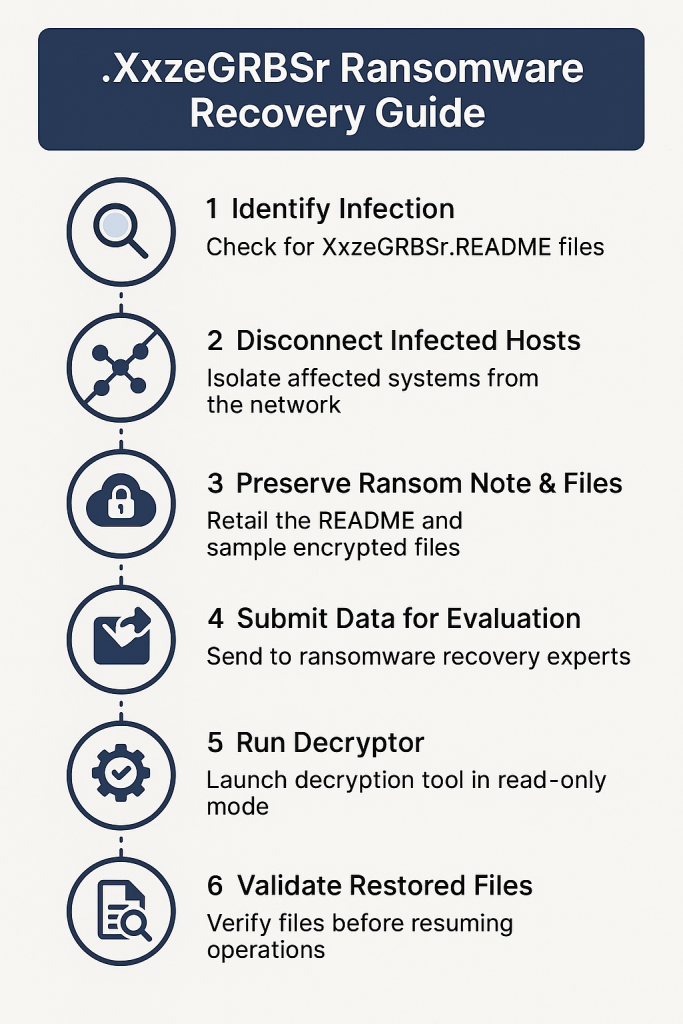
Step-by-Step .XxzeGRBSr Recovery Procedure
- Verify the presence of ransom notes named XxzeGRBSr.README.
- Isolate all affected hosts immediately to prevent lateral movement.
- Retain ransom notes and encrypted files for analysis.
- Submit samples to a professional ransomware recovery service for assessment.
- Execute the decryptor under administrative privileges in a read-only mode.
- Check decrypted files for completeness before resuming business operations.
Understanding .XxzeGRBSr Ransomware
The .XxzeGRBSr ransomware surfaced in October 2025, initially mentioned by a user named KhoaNghiem on BleepingComputer.
The infection encrypts files across the system and leaves ransom notes instructing victims to reach out via [email protected]. Since there is no match to known ransomware groups, experts believe this may represent a new or hybrid variant under development.
Known Indicators of Compromise (IOCs)
| Type | Indicator | Description |
| Ransom Note | XxzeGRBSr.README | Found in most encrypted directories |
| Email Contact | [email protected] | Used for victim communication |
| File Extension | Possibly .XxzeGRBSr | Pending confirmation |
| Registry Changes | Unknown | No published data available |
Common Tools, TTPs, and MITRE ATT&CK Techniques
Even without confirmed samples, the following tactics align with common ransomware methodologies:
| Phase | MITRE Technique ID | Observed/Expected Behavior |
| Initial Access | T1133 | Exploiting RDP or VPN vulnerabilities |
| Credential Access | T1003 | Using tools like Mimikatz to extract credentials |
| Defense Evasion | T1562 | Tampering with antivirus or EDR components |
| Impact | T1486 | Mass file encryption across local and shared paths |
| Exfiltration | T1041 | Data exfiltration via email or third-party cloud apps |
Inside the Ransom Note: Patterns and Behavior
The ransom message XxzeGRBSr.README is expected to follow the conventional formula used by many emerging ransomware families. It typically announces the encryption, threatens data deletion or publication, and demands contact through the provided email.
So far, victims report no responses from the attacker, suggesting the campaign may be automated, incomplete, or abandoned after initial deployment.
Mitigation Techniques and Security Best Practices
To minimize ransomware risk and prevent recurrence:
- Implement Multi-Factor Authentication (MFA) on RDP, VPN, and privileged accounts.
- Apply timely security patches to all network-facing devices and servers.
- Restrict or disable PowerShell/WMI for users who don’t need administrative control.
- Use network segmentation to limit ransomware spread within critical environments.
- Maintain immutable or air-gapped backups, and test restoration regularly.
- Deploy endpoint detection and response (EDR) tools and enable continuous monitoring.
Conclusion
Although information about .XxzeGRBSr ransomware is still developing, affected organizations can significantly increase recovery success through rapid isolation, careful evidence preservation, and expert-guided decryption.
Avoid direct ransom payments and focus instead on forensic-based recovery and professional remediation. Legitimate decryptors, cryptographic analysis, and verified data validation methods can restore operations securely and lawfully.
MedusaLocker Ransomware Versions We Decrypt