Xentari Ransomware Decryptor
Xentari is not just another file locker—it’s a potent Python-based ransomware that leverages AES-256 and RSA-2048 encryption to paralyze organizations and users alike. Once it activates, Xentari appends a .xentari extension to all affected files and delivers a ransom note threatening permanent loss unless 0.5 BTC is paid. But paying isn’t your only option.
Our advanced Xentari Decryptor, developed after extensive reverse-engineering of its encryption routines, has successfully restored systems across sectors including healthcare, logistics, and education—without giving in to ransom demands.
How Our Xentari Decryptor Works
Xentari’s encryption is connected to identifiable system markers and keys embedded in the ransom note file README_XENTARI.txt. Once the ransom note and encrypted samples are uploaded to our secure cloud, our tool uses AI pattern recognition and blockchain-integrated auditing to:
- Reconstruct the original encryption sequence using the ransom note’s unique system ID
- Analyze cryptographic signatures for batch decryption
- Run read-only simulations to prevent file corruption
If the ransom note is unavailable, our Universal Mode kicks in—scanning file structures and timestamp metadata to simulate the encryption key creation process.
Essential Pre-Recovery Checklist
To prepare your environment for safe recovery, make sure you have:
- A copy of README_XENTARI.txt
- Encrypted .xentari files
- Stable internet access (for cloud-based decryption)
- Administrator rights on the affected system
First Actions After Xentari Attack
Isolate Immediately
Disconnect infected systems from your network to prevent the ransomware from jumping to other machines or shared drives.
Preserve All Files
Do not delete encrypted files or the ransom note. Logs, temporary files, and network traffic captures may also prove vital.
Avoid Reboots
Xentari may leave behind hidden scripts. Rebooting could trigger further encryption or system-level corruption.
Engage Recovery Experts Early
Getting expert help in the first few hours increases your chances of recovering files safely and avoiding long-term damage.
Decrypting and Recovering Data After Xentari
Once triggered, Xentari operates silently—encrypting thousands of files and replacing your wallpaper with a stark warning. You’re asked to send 0.5 BTC (~$59,000) to regain access, with the price doubling after 72 hours. But we offer a verified alternative: a powerful decryptor capable of restoring files across Windows, Linux, and even VM environments.
Xentari Decryption and Recovery Paths
There’s no universal fix. Below are the most viable recovery methods depending on your infection type and available resources.
Free Recovery Options
Open-Source Decryption Tools
Early Xentari versions had weak encryption logic that allowed security researchers to build free decryptors.
- Work best on pre-2023 samples
- Ineffective on hardened variants
- Run offline in sandboxed Windows environments
Avast’s Xentari Decryptor
How It Works:
Targeting older Xentari samples with flawed AES key generation, this tool scans for encryption patterns and attempts to reconstruct symmetric keys.
Requirements:
- Works locally on Windows
- Doesn’t need the internet or ransom note
- Best results on early .xentari variants
Limitations:
- Doesn’t support newer payloads
- Using it on hardened variants may result in file damage
Yohanes Nugroho’s Linux GPU Decryptor
How It Works:
This researcher-created tool brute-forces timestamp-based encryption keys using GPU clusters. It leverages CUDA for speed and is built for Linux environments.
Requirements:
- Linux OS
- CUDA-supported GPU (NVIDIA)
- Command-line experience
- Timestamp metadata from encrypted files
Features:
- Fully offline and open-source
- Doesn’t require ransom note
- Suited for air-gapped recovery
Backup Restoration
Offline or Isolated Backups:
If backups weren’t encrypted, simply format the infected systems and restore clean images.
Steps:
- Validate snapshot integrity using checksums
- Use solutions with versioning (e.g., AWS S3 or immutable WORM backups)
- Avoid reintroducing ransomware from infected devices
VM Snapshot Recovery
VM Snapshots:
Admins using ESXi, Hyper-V, or Proxmox can roll back to safe restore points created before the attack.
Caution:
- Xentari may delete or corrupt snapshots
- Inspect retention logs and isolate snapshots before use
- Use only verified, untampered checkpoints
Cybersecurity-Grade Decryptors
Brute-Force Timestamp Recovery:
Researchers continue to explore Xentari’s reliance on seeded time-based values to generate keys.
How It Works:
- Tools simulate billions of possible key seeds
- Recover encrypted content using brute-force matches
- Used by SOCs and advanced recovery labs
Requirements:
- Linux machine
- GPU acceleration (NVIDIA RTX series recommended)
- Deep variant knowledge
Paid Recovery Paths
Process:
- Victim sends 0.5 BTC to a hardcoded wallet
- Contact is made via [email protected]
- Decryptor is supposedly returned
Risks:
- No guarantee you’ll get working software
- Some tools include backdoors or data stealers
- May violate local laws or insurance policies
How They Help:
- Validate the attacker’s authenticity
- Manage encrypted communication over TOR
- May lower ransom demand
Drawbacks:
- Costly (up to 25% of ransom)
- Time-consuming and risky
- No guaranteed outcome
Our Advanced Xentari Decryptor
Features:
- AI + blockchain-powered decryption
- Supports Windows, Linux, and virtual environments
- Online and offline execution modes
- Test one file for free before committing
Process:
- Submit encrypted samples and ransom note
- Tool maps victim ID and encryption batch
- Decryption begins after variant confirmation
- Files restored to their original form with full logs
Xentari Ransomware: Victim Growth, Sector Impact, Ransom Demands, and Recovery Cost Insights (2023–2025)

Step-by-Step Recovery with Our Xentari Tool
1. Detection
Look for .xentari extensions and README_XENTARI.txt.
2. Isolation
Disconnect infected systems immediately.
3. Submit Files
Share encrypted samples and ransom note for analysis.
4. Launch Decryptor
Run with admin rights; tool connects to secure servers.
5. Input Victim ID
This matches your system with decryption keys.
6. Restore Files
Watch as files are decrypted and logs are generated in real time.
Offline vs. Online Recovery
Offline:
Best for air-gapped systems or secure environments. Files are processed locally.
Online:
Faster, more efficient. Requires upload to secure, sandboxed cloud servers.
Both modes are safe, encrypted, and monitored by our expert recovery team.
Understanding the Xentari Ransomware Threat
Xentari is a new Python-based ransomware strain that encrypts user data using strong hybrid cryptography. It modifies file extensions to .xentari and displays a threatening ransom note and wallpaper. Its infection methods vary from email phishing to software cracking tools, with the ransom doubling after 72 hours.
Deep Dive: Xentari Attack Behavior, Tools & Tactics
Initial Access
Xentari primarily spreads through:
- Malicious email attachments (.docx, .zip, .exe)
- Torrent bundles or cracked software
- Fake update prompts and adware installers
The payload is often hidden in double-extension files and triggered by unsuspecting users.
Execution Strategy
Once launched:
- It scans and encrypts targeted file types using AES-256
- The AES key is then locked with RSA-2048
- Files are renamed with .xentari
- System wallpaper is changed
- README_XENTARI.txt is dropped in every folder
Persistence Methods
Some versions:
- Modify Windows Registry keys
- Schedule tasks via Task Scheduler
- Remove Volume Shadow Copies using VSSAdmin
Lateral Movement
Using stolen credentials, Xentari accesses:
- Mapped network drives
- SMB shares
- Weak administrator accounts
Tools like PsExec or scripts are used for lateral deployment.
Credential Theft
Post-encryption tools include:
- Mimikatz – extracts credentials from memory
- LaZagne – dumps passwords from apps like browsers and FTP clients
- AdFind – used to map Active Directory structures
Data Exfiltration Tools
In some variants, stolen data is uploaded via:
- Rclone – for syncing to cloud storage
- WinSCP – used for secure file transfers
- Mega.nz – encrypted cloud storage for stolen data
Recovery Sabotage
To prevent recovery:
- Deletes shadow copies via vssadmin delete shadows /all /quiet
- Disables System Restore
- Targets backup files for deletion
Tools Used in Xentari Attacks – Detailed
Used for dumping plaintext and hashed credentials. Helps attackers log into other systems.
Extracts stored passwords from browsers, FTP tools, and more. Lightweight, effective post-exploitation.
Used to gather details about Active Directory structure. Helps map high-value targets.
Command-line syncing tool used to exfiltrate data to Google Drive, Dropbox, and Mega.nz.
A secure cloud service abused by attackers to store and threaten victims with leaked data.
Used to erase shadow copies and remove rollback options before encryption.
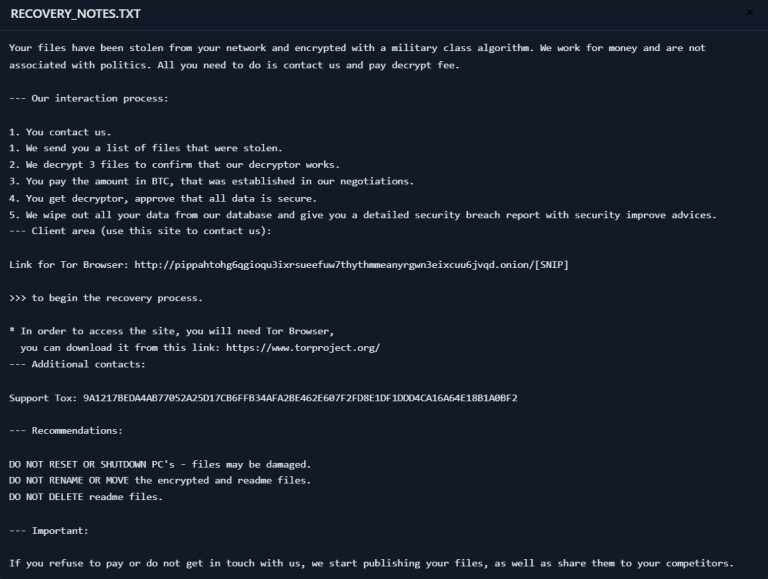
Ransom Message Breakdown: What README_XENTARI.txt Tells You
If you’ve found README_XENTARI.txt, your data has been encrypted. Stop all activity and read carefully.
The ransom note comes with the following message:
All of your important files have been ENCRYPTED!
Your documents, photos, videos, and databases are no longer accessible.
The only way to recover them is by purchasing a unique decryption tool
along with a private decryption key generated specifically for your system.
DO NOT ATTEMPT TO:
– Modify, rename, or move encrypted files.
– Run any recovery software or system restore.
– Turn off your computer during the process.
Doing so will result in PERMANENT LOSS of your data.
Encrypted Extensions: .xentari
Encryption: AES-256 + RSA-2048
TO RECOVER YOUR FILES:
1. Send 0.5 BTC to the following Bitcoin address:
1FfmbHfnpaZjKFvyi1okTjJJusN455paPH
2. Email us at:
[email protected]
with your System ID and payment proof.
3. You will receive the decryption tool and key.
Optional: You may test decryption of 1 file (less than 1MB) for free.
———————————————
DEADLINE: You have 72 hours before the price doubles.
We are the only ones who can decrypt your files.
Tampering or using third-party tools will only damage your data.
———————————————

Conclusion
The Xentari ransomware threat is serious—but not hopeless. From free decryption tools and backup strategies to cutting-edge decryptors like ours, full recovery is possible without rewarding cybercriminals.
Our team has helped countless users and businesses recover securely. Reach out, test your files, and begin restoring your digital life today.
MedusaLocker Ransomware Versions We Decrypt